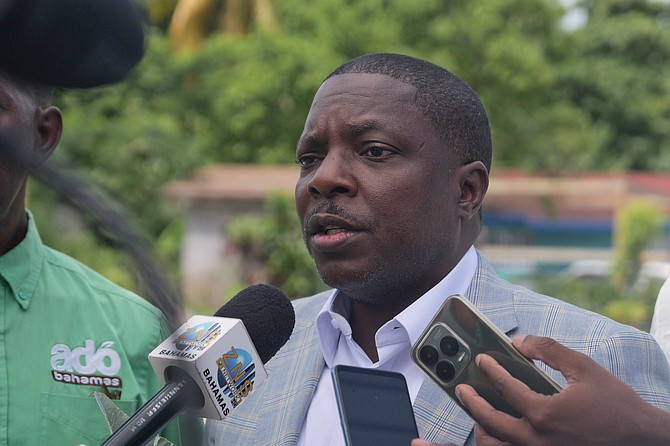
Minister of Agriculture and Marine Resources Jomo Campbell
THE Davis administration is seeking an exemption from a new 12.5 percent United States tariff for Bahamian crawfish and stone crab exports, warning the duty has struck the country’s fisheries industry days before the lucrative crawfish season opens.
Agriculture and Marine Resources Minister Jomo Campbell said the government is also moving to strengthen The Bahamas’ prohibition on forced-labour goods and will dispatch officials to work directly with seafood processors and exporters as they navigate the new charge.
The tariff took effect on Friday, July 24, after the Office of the United States Trade Representative concluded that The Bahamas had failed to impose and effectively enforce a prohibition on imports produced with forced labour.
Mr Campbell stressed that the finding did not mean forced labour existed in the Bahamian fishing industry, saying the measure instead arose from a gap in the country’s laws governing goods imported from elsewhere.
“Let me be plain about what this measure is and what it is not,” he said. “It is not a finding that forced labour exists in the Bahamian fishery. Our commercial fishery is operated by Bahamian owned vessels, crewed under Bahamian law, and it does not employ foreign labour aboard licensed commercial vessels. Our record stands.”
The government’s response comes as fishers prepare for the August 1 opening of the crawfish season and confront the prospect of higher costs in their most important export market.
Crawfish and stone crab are among the Bahamian products most exposed to the measure, with the United States absorbing an estimated 60 percent of the country’s spiny lobster exports. The industry exports more than four million pounds of lobster tails annually and supports about 9,000 fishers, according to the Marine Stewardship Council.
Bahamas Commercial Fishers Alliance president Adrian LaRoda previously estimated that crawfish shipments to the United States generate between $50m and $70m annually, forming a substantial share of an export industry that brings about $120m in foreign currency into The Bahamas each year.
Mr Campbell said the government is pursuing three measures in response to the tariff.
The first involves recent amendments to the Customs Management Act that prohibit the importation of goods produced using forced labour. The government is seeking to determine why the changes did not result in The Bahamas receiving the lower tariff rate and what deficiencies must be corrected.
Six countries moved from the proposed 12.5 percent rate to the lower ten percent levy after updating their laws following the US action, Mr Campbell said.
“We intend to be the seventh,” he said.
The government’s second measure is an attempt to secure an exemption for Bahamian crawfish and stone crab.
Third, the Ministry of Agriculture and Marine Resources intends to work with the Ministry of Finance, Bahamas Customs and the country’s embassy in Washington to help processors and exporters handle shipments in the coming days.
The US tariff was imposed through 60 separate Section 301 investigations into countries and trading blocs that Washington said had failed to prevent forced-labour goods from entering their markets.
The USTR initially named The Bahamas among 54 economies it said had failed both to impose and effectively enforce such a prohibition. Six others were accused of failing to enforce prohibitions already in place.
The list extended far beyond The Bahamas and included major US allies and trading partners such as Canada, the United Kingdom, the European Union, Australia, Japan and New Zealand.
Countries that had imposed a forced-labour import ban, committed to doing so through a trade agreement or established a partial system aimed at blocking such goods were assigned a 10 percent tariff. The remaining economies were subjected to the higher 12.5 percent rate.
The USTR’s final determination imposed the 12.5 percent tariff on Bahamian products, subject to specified exemptions, from 12.01am on July 24. Goods already in transit before that deadline and entered into the United States before July 28 were spared the additional duty.
Mr Campbell said the new tariff should not be confused with a finding about employment practices inside The Bahamas.
The US action focused on whether countries had laws preventing goods made with forced labour elsewhere from entering their domestic markets. It was not an allegation that every country subjected to the tariff produced or exported goods made under such conditions.
Mr Campbell said Bahamian crawfish and stone crab were nonetheless particularly exposed because they are among the country’s largest exports to the United States and because the crawfish season was about to begin.
He also sought to clarify the immediate financial effect of the measure.
Bahamian goods entering the United States had already been subjected to a temporary 10 percent US import surcharge since August 2025, he said. That charge expired on the same day the 12.5 percent tariff took effect, leaving exporters with an additional burden of 2.5 percentage points rather than a new 12.5 percentage points on top of the previous charge.
“Our fishermen should not go into this season believing the figure is five times what it is,” he said.
The US imposed the temporary surcharge to address what the White House described as serious international payments problems and a large balance-of-payments deficit. The measure broadly applied a 10 percent duty to imported goods, subject to a series of exemptions.
Although Mr Campbell sought to ease fears about the scale of the increase, the additional cost lands on an industry that had already warned it operates on tight margins.
A US seafood importer previously urged the Trump administration to exempt Bahamian crawfish and stone crab, arguing that the country’s fishery presented no forced-labour concerns and that the tariff could damage Bahamian suppliers, American distributors and US consumers.
The importer said the additional duty could not be fully absorbed within the seafood distribution industry and risked disrupting long-established relationships between US companies and Bahamian fishing operations.
The wider economic exposure may extend beyond fisheries. A submission made during the US consultation process estimated that as much as $985m in Bahamian exports to the United States could be affected based on 2024 trade figures, including refined petroleum, documents of title, styrene polymers and pearl products. The United States is by far The Bahamas’ dominant trading partner. US government data show that 83.3 percent of Bahamian imports come from the United States, which exported $5.48bn in goods to The Bahamas in 2024 and recorded a $3.7bn trade surplus.
Mr Campbell said the new tariff would not affect seafood sold within The Bahamas or exports to the European Union and Canada. He also said it would not disrupt the opening of the domestic crawfish season.
“Crawfish season opens 1 August as scheduled, across New Providence, Grand Bahama and the Family Islands,” he said.




Comments
Seaman 1 month, 3 weeks ago
Paper sits still for any fool.....some people could see this coming along time ago.
quavaduff 1 month, 3 weeks ago
Add it to the cost per pound... as with most of these trump tariffs, the Americans pay the tariff and they are not liking it.
licks2 1 month, 3 weeks ago
The Americans pay the tariff. . .not us! We ship high-end products. . .which are normally sold to rich Americans. . .not to lower class persons who tend not to buy items that we ship to them right now!!
Our typical exports cater to high-end buyers. . .or maybe the upper-class persons. . .not poor folks!! Those are the classes with adequate disposable income to afford our lux items even if there is a tariff all the time we have been exporting to them!!
All-things-being-equal, this tariff will not agreeably affect us!!
Sign in to comment
OpenID