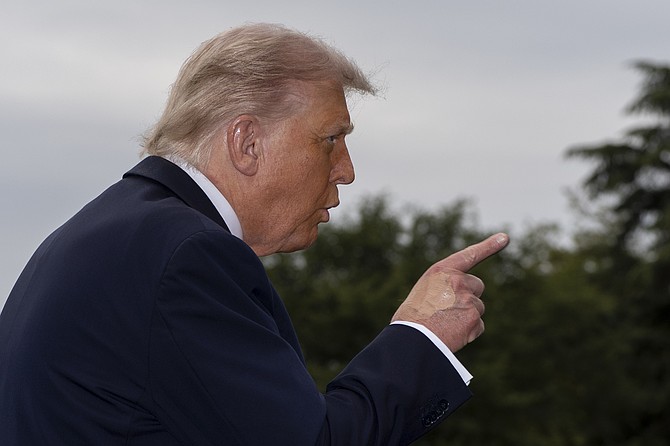
President Donald Trump speaks with reporters before departing on Marine One from the South Lawn of the White House, Tuesday, Sept. 16, 2025, in Washington. (AP Photo/Alex Brandon)
By NEIL HARTNELL
Tribune Business Editor
nhartnell@tribunemedia.net
Donald Trump’s imposition of 12.5 percent tariffs on all Bahamian exports to the US especially “sucks” because it coincides with multiple costs “going through the roof”, Bahamian fishermen are warning.
Paul Maillis, secretary and director at the National Fisheries Association of The Bahamas (NFA), told Tribune Business that the industry fears being squeezed from both sides if the US president’s tariff move results in reduced American consumer and wholesaler demand for Bahamian exports - especially rock lobster, but also stone crab and other products.
And, if Bahamian seafood exporters suffer reduced prices and lower orders, they will likely pass that on to local fishermen to create a negative impact that cascades down the whole supply chain, impacting dependents and whole communities - especially in the Family Islands.
Mr Maillis told this newspaper that the increased US border taxes on Bahamian seafood, and other exports, to the US are striking just as the fisheries industry’s expenses are taking a hit from another of Mr Trump’s actions - the renewed US assault on Iran, which drove global oil prices back over the $100 per barrel threshold towards the end of last week.
While oil prices have since moderated slightly, with per barrel prices as measured by the Brent crude index hovering at just below $97 per barrel last night, the NFA secretary said Bahamian fisheries is bearing the brunt of such hikes because it “100 percent runs on fuel”.
And, with diesel fuel prices above $7 per gallon in Nassau and even higher in the Family Islands, Mr Maillis said fishermen are likely paying $2,000-$3,000 more per trip compared to the $3-$4 per gallon they enjoyed as the COVID pandemic came to an end in 2021. He added that “all the supplies we need” for lobster fishing - ranging from plastics bags to chemical preservatives - are impacted by fuel, oil and energy costs.
However, Mr Maillis also struck a more optimistic tone by arguing that it is uncertain how the Trump tariff impact will play out because multiple factors are involved. Surging tourism numbers, he explained, meant local seafood demand is thriving, especially for the likes of grouper, snapper and conch, while Bahamian fisheries will “have a fighting chance to stay in the game” if Mr Trump creates a level playing field by imposing similar 12.5 percent tariffs on all its foreign rivals.
Still, Mr Maillis warned that the Bahamian domestic market is not large enough to absorb the annual lobster production by itself, making it vital that this nation preserve its US market access and $50m-$60m annual crawfish sales despite Mr Trump’s imposition of tariffs, which act as a tax on exports as they come through the border.
“This is an upgrade to the earlier 10 percent,” the NFA secretary told Tribune Business of the latest levy, which took effect from 12.01am on Friday, July 24. “From the fisheries point of view, we have to get the base amount that we need for the exports. We need to make enough from the exports - per pound of lobster, per pound of fish - we have to make an amount of money that makes sense.”
Mr Maillis said reduced prices and orders, which could result if US wholesale buyers and consumer demand respond negatively to paying increased costs for Bahamian seafood, would “really hurt” Bahamian exporters but they would not be the only segment of the industry to suffer.
“Their demand might go down, and their prices might suffer,” he conceded of Bahamian fisheries exporters. “At the same time, the seafood houses might buy less product from the local fishermen because what they are getting is not as profitable on the export side. There’s a lot of factors that play into this.
“On a positive note, tourism has been doing pretty well recently, so there is a lot of local demand for seafood products. If you know how to market within the country, fishermen don’t have to suffer. If you are focusing on local markets, you can do that for scale fish - things like grouper, like conch, but it’s harder to do for lobster because of the scale of the product.
“The local market cannot absorb so much lobster because the price will crash, and that’s why lobster is important for the export community. It’s because it doesn’t absorb them locally.” Adrian LaRoda, the Bahamas Commercial Fishers Alliance chief, last week voiced hope that the impact from the increased Trump tariffs will not be immediate as US buyers will already have locked in orders with their Bahamian suppliers ahead of crawfish season’s start on Saturday, August 1.
“There’s a lot of anxious folks out there waiting patiently for August 1, hoping to get good prices, because the expense side has gone through the roof,” Mr Maillis told this newspaper. “We are hoping the export market is not as badly affected. If the 12.5 percent tariff is going on all our competitors we then will have a fighting chance to stay in the game. We’ve been through worse.
“Fuel is the number one expense. Just everything depends on the cost of energy. Food prices are so high, all the supplies we need - from plastic bags, everything we need, the chemicals we need for preserving lobster - things are greatly going up and up and up, and for then most part prices are pretty stagnant.
“Right now, the price of diesel is somewhere around $7 per gallon in Nassau,” Mr Maillis added. “It’s much higher in the Family Islands, and the price of lobster and fish has remained pretty much the same. It’s $2,000-$3,000 extra for fuel per trip, and that adds up over the course of the year.
“Our customers are feeling the strain, and everyone is suffering from the inflation period we are in now. They cannot buy as much, cannot buy in bulk some of the same expensive products, so we’re working with customers as much as we can to support them. But there’s only so far we can go.
“We need this Middle East war to be over, we need our economy to come back to normal, and the price of oil to go down. The fishing industry runs 100 percent on fuel. It’s disproportionately impacted because we are ocean transportation.” Mr Maillis voiced hopes that lobster prices will at least remain the same for the upcoming season, and said there was no sign that crawfish stocks will be “drastically different” from 2025, thus ensuring good supply.
As for Mr Trump’s tariff move, he told Tribune Business it “hurts” that The Bahamas - a long-standing US ally - is now being treated as if it was an enemy of Washington D.C. “It sucks for us. It’s never a good thing to have your products taxed to the point where they are less competitive,” Mr Maillis said. “From the US point of view, I can understand why they are doing this because they also produce lobster and stone crab, so it makes sense for them to do that to protect domestic industry.
“But, no matter whether it’s good for them, it hurts us. As their ally, we share a lot of positive relationships and remain a stable democracy on their southern border. It hurts to be treated and roped in with some of the enemies they have. I feel like we don’t deserve that.’
The Bahamas is among 60 countries deemed by the US Trade Representative’s Office (USTR) to have neither enacted, nor enforced, a legal and regulatory regime that bans the entry of imported goods made with forced labour. This, in turn, is considered to give forced labour producers an unfair competitive advantage over US rivals.
The Bahamas is in good company because the likes of Canada, Australia, the UK, the European Union (EU), Israel, New Zealand, Saudi Arabia, the United Arab Emirates and Singapore are among the other jurisdictions also hit with tariffs.
The move also appears to be a thinly-veiled attempt to crack down on the volume of Chinese goods imported by some of Washington D.C’s major trading partners. China has long faced accusations that it subjects ethnic minorities, particularly the Uighurs in Xinjiang province, as well as political prisoners and dissidents to forced or slave labour where they are forced to manufacture goods against their will and for no compensation.
Media commentators have also suggested that the ‘forced labour’ investigation may be a backdoor attempt by the Trump administration to implement last year’s so-called ‘Liberation Day’ tariffs that have been ruled unlawful by both the US Supreme Court and trade court. Those verdicts are now under appeal.




Comments
Jetflt 1 month, 3 weeks ago
The United States will do what is best for the United States, and the Bahamas must do what's best for the Bahamas. It's as simple as that! Diversify your economy, get creative and quit relying on the same ole thing!
Sign in to comment
OpenID