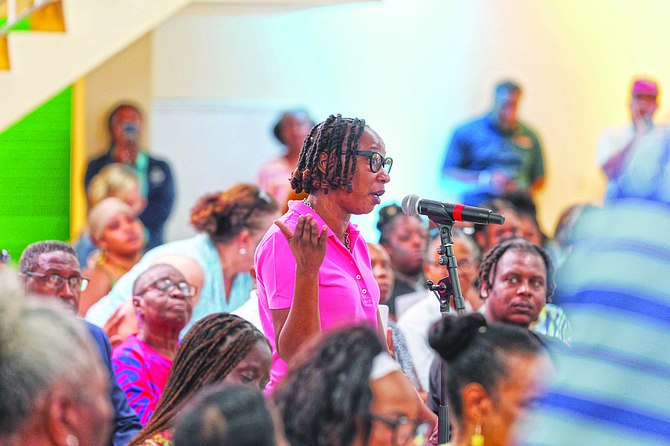
A PARENT speaks during a Ministry of Education, Science and technology Town Hall meeting on Autism on July 27th 2026. Photo: Chappell Whyms Jr
By KEILE CAMPBELL
Tribune Staff Reporter
kcampbell@tribunemedia.net
THE Ministry of Education, Science and Technology will establish a national autism registry as parents and guardians warned that gaps in education, therapy and post-school support are leaving families overwhelmed and fearful for their children’s futures.
At a town hall meeting at Stephen Dillet Primary School, parents described years of struggling to secure assessments, school placements, therapy and support for their children, while facing costs that some said had pushed families to the breaking point.
One mother said the absence of services after students leave school had left some parents terrified about what would happen to their children after they died.
“I have met parents who tell me, ‘I pray to God my child dies before me, because I don't want to leave my child here because there are no resources,’” she said.
“When your child reaches the 12th grade, that's usually the happiest day in their parents' life, but when you have a special needs child, that's your worst day, because you don't know where your child is gonna go, you don't know who's gonna keep your child.”
The meeting was held in collaboration with Resources and Education for Autism and Related Challenges.
The grandmother of a five-year-old child on the autism spectrum said she followed the Ministry of Education’s procedures but encountered repeated obstacles while trying to enrol her grandchild in school.
She said public clinics turned the family away because of the child’s age, and calls were not returned after an online application was submitted, leaving her feeling as though she had been given “the runaround”.
The grandmother said she eventually relied on government contacts to find help but questioned why families should have to use personal connections or seek assistance through a minister’s constituency office.
Although her grandchild was now doing well in a programme, she said many parents could not afford private services or leave their jobs to provide full-time care.
“I made that sacrifice for my daughter, for my grandchild to benefit, and in reality, a lot of parents can't afford the programs,” she said. “If I went and I followed the proper procedures that the ministry asked me to do, why aren't you calling us back? Where do you want the kids to go? I have to wor a nine to five.”
Speech pathologist Alicia Thompson urged the government to make greater use of qualified Bahamian professionals, saying children continued to face lengthy waits for services despite trained specialists being available.
Mrs Thompson said she returned to The Bahamas after earning her undergraduate degree in 2013, expecting opportunities with the Ministry of Education and the Public Hospitals Authority.
However, she said she went months without being hired and could not fully practise because she required professional supervision. The experience drove her from the field for a decade before she returned to complete her master’s degree.
“So, in a country where I wanted to help people who had the same issues as my parents, I was limited, and I had a degree that cost thousands of dollars that I could not use because there was no one to oversee me,” she said.
University of The Bahamas student Reginald Wells, who has special needs, also attended the meeting. Although he graduated from senior high school as a top honours student, he has been unable to pass English and mathematics and cannot complete his degree in culinary and hospitality studies.
A guardian said it took a year and a half to secure an assessment for Mr Wells because the family could not afford the $2,500 cost.
“We are stuck. We can't move forward, so he cannot graduate with a degree,” the guardian said. “All the effort and the time that we have spent - years. It took me a year and a half to get an assessment to get him into UB. I didn't have the $2500 to assess him.”
Another father said his family had spent thousands of dollars on therapy and schooling for his son and questioned whether greater regulation was needed to prevent families of children with special needs from being charged more.
“Everywhere my son is born has cost me 1000s, me and my wife 1000s of dollars, even down to the schools,” he said. “As soon as the schools find your child is special, they find a way to charge you extra.”
He said insurance often covered only a limited number of therapy sessions, leaving parents to absorb the remaining costs.
“It's killing us,” he said. “What about the parents that don't have it at all?”
The father also questioned why Bahamian families should have to leave the country to obtain affordable treatment.
“I don't think I should uproot my whole family to go to Canada where the care is free,” he said. “Why don't we have it here?”
Deputy Prime Minister and Education Minister Chester Cooper said he had instructed ministry officials to prepare a white paper outlining what would be required to establish the national autism registry.
“This is not a talking shop. This is not a commission, and therefore I anticipate that within four weeks, after consultation with the Attorney General's Office, the Ministry of Health and other stakeholders we will begin in earnest the process of implementation,” Mr Cooper said.
Director of Education Dominique McCartney-Russell said work on the registry had already begun. She said it would help the ministry determine how many students on the autism spectrum were enrolled in public schools.
The ministry also plans to introduce its first formal special education diploma programme, with the first graduates expected in 2027, and expand special education services in Grand Bahama, Eleuthera, Long Island and Harbour Island.
Mrs McCartney-Russell said the ministry had spent the past four years expanding special education services, including conducting a needs assessment, partnering with Barry University to train 14 teachers at the master’s degree level and hiring more than 40 special education teachers.
She said there were now more than 120 special education teachers across the public school system.
Mrs McCartney-Russell acknowledged that Beacon School in Grand Bahama was oversubscribed and that onsite support was limited on some Family Islands.
“We hear you, parents. Earlier identification, shorter and better coordinated referral pathways, continued teacher training, increased specialist capacity, which I would say we are struggling with, stronger access for family islands, and improved transition planning,” she said.
Mr Cooper said early intervention remained one of the ministry’s principal priorities and that access to services should not depend on where a child lived.
“A child's future should never depend on the island where that child happens to live,” he said.
He also said the government’s responsibility did not end when students graduated.
“Autism is a lifelong journey,” Mr Cooper said. “Young people need opportunities to continue learning. They need access ti technical and vocational education. They need pathways into employment. They need opportunities for entrepreneurship, independent living, and meaningful participation within their communities.”




Comments
Sickened 1 month, 4 weeks ago
I can't imagine how difficult it is for parents with autistic children. Without substantial personal financial resources the journey of such a family must be overwhelming difficult.
Sign in to comment
OpenID