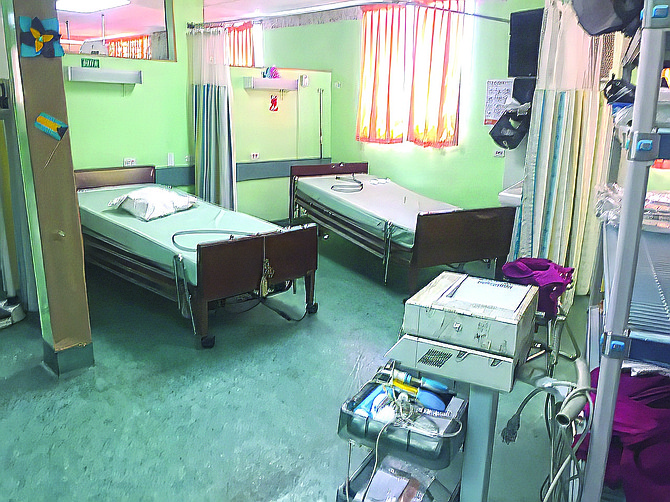
THESE photos show the dilapidated state of the PMH maternity ward and pediatric infants ward at the time of the incident.
By RASHAD ROLLE
Tribune News Editor
rrolle@tribunemedia.net
A SUPREME Court judge has found Princess Margaret Hospital negligent in the death of a newborn girl after staff failed to monitor the baby and her mother for 27 critical minutes before an emergency caesarean section.
Acting Justice Raynard Rigby KC ruled in favour of Widline Guillaume, whose daughter, Elizabeth Lundy, died on August 2, 2022, just over two hours after she was born.
The judge found that the hospital and obstetrician Dr Agatha Foulkes-Mackey fell below the required standard of care by failing to monitor Ms Guillaume and her baby between 4.10am and 4.37am as she waited to enter the operating theatre.
He concluded that the lack of monitoring caused the injury to the baby and was fatal.
“I find therefore on the balance of probabilities that the failure to monitor the mother and baby in the period between 4.10am and 4.37am was negligent and the Defendants fell below the standard of care,” Justice Rigby said.
He ordered that damages be assessed by the Registrar of the Supreme Court and directed the defendants to pay Ms Guillaume’s legal costs if the parties cannot agree on an amount.
The ruling followed a three-day trial in June involving competing expert evidence about whether Elizabeth died from oxygen deprivation or an undetected congenital heart condition.
The judge accepted that the baby probably died from perinatal asphyxia, the cause recorded on her death certificate, rather than a congenital heart defect.
Ms Guillaume arrived at PMH late on August 1, 2022, at 39 weeks and three days pregnant. She was admitted to the public maternity ward after reporting contractions and cramping.
She began pushing at about 2.05am. Dr Azaria Clare assessed her at about 3.30am, and Dr Foulkes-Mackey arrived shortly before 4am.
The doctors decided to perform an emergency caesarean section after labour failed to progress.
Ms Guillaume reached the operating theatre entrance at about 4.10am. However, she did not enter the theatre until 4.37am while hospital staff awaited the result of a COVID-19 test.
The test result was received at 5.10am, the incision was made five minutes later and Elizabeth was delivered alive at 5.20am.
Justice Rigby found no unreasonable delay in the doctors’ decision to perform the caesarean section or in carrying it out once that decision was made.
He said Dr Clare and Dr Foulkes-Mackey acted promptly and did all they could to get Ms Guillaume into the operating theatre.
However, he drew a sharp distinction between the timing of the surgery and the failure to monitor the baby while Ms Guillaume waited outside the theatre.
The judge said a heart-rate deceleration recorded shortly before the decision to perform the emergency procedure showed some sign of foetal distress and made continued monitoring necessary.
“The T1 deceleration occurred immediately prior to the decision for an emergency caesarean and perhaps aided in the decision,” he said. “This fact too led me to conclude on the evidence that the Defendants fell below the standard of care by not monitoring the patient and baby in the period of 4.10am to 4.37am.”
Justice Rigby said no evidence was presented about the baby’s condition during that interval.
He said the hospital was responsible for ensuring some form of monitoring continued, particularly because doctors knew Ms Guillaume had to wait for a COVID-19 test before surgery could begin.
The judge rejected the explanation from defence expert Dr Paul Ward that handheld monitors were not always available because of limited hospital resources.
“There was no compelling evidence led by the Defendants why no monitoring was conducted on the baby between 4.10 am and 4.37 am,” Justice Rigby said. “Dr Ward’s explanation of there being no handheld monitoring devices is not adequate in the circumstances.”
He said the decision to carry out an emergency caesarean section itself required closer supervision of the mother and baby.
“Given the decision to have an emergency caesarean section, I deem it incumbent on the Hospital to ensure that there was some form of monitoring,” he said.
The judge found that Elizabeth had shown signs of distress before the operation.
He said cardiotocography records showed a T1 deceleration at about 3.30am. Although the full set of records was not placed before the court, he concluded that the available evidence showed “some signs” of foetal distress.
Justice Rigby also relied on evidence that Ms Guillaume had undergone an ultrasound about two months before the delivery that showed no foetal abnormality, adequate amniotic fluid and good fetal tone, movement and respiration.
“Given that the signs were that baby Elizabeth was healthy at 30 weeks, I find on a balance of probabilities that lack of monitoring in the 30 minutes window caused the injury to the baby which was foreseeable in the circumstances,” he said.
He said the failure was fatal.
Elizabeth initially received Apgar scores of seven and eight at one and five minutes after delivery.
However, her condition deteriorated rapidly as she was being transported from the operating theatre.
Nursing notes said she became much paler, developed cyanosis in her face, hands and feet and required an immediate transfer to the Neonatal Intensive Care Unit.
Medical staff began chest compressions and a resuscitation effort, but the baby died later that morning.
Justice Rigby criticised the absence of evidence about what happened to Elizabeth after her delivery.
“It is startling that no evidence was led at the trial of the monitoring of baby Elizabeth after her delivery,” he said.
The court received no detailed evidence about the steps taken to monitor her vital signs or the care administered before she was rushed to intensive care.
The judge said the limited information before the court raised more questions than answers, particularly because the baby’s condition changed shortly after she received relatively strong Apgar scores.
He also criticised the failure to perform an autopsy, saying both experts agreed it would have assisted in determining the cause of death.
Dr Ward argued that Elizabeth probably died from a congenital heart condition that had not been detected before birth.
However, claimant expert Dr Carlos Athlestan Chase said the baby died from perinatal asphyxia caused by oxygen deprivation.
Justice Rigby preferred Dr Chase’s evidence.
He said Ms Guillaume’s medical records did not show that she had a congenital heart defect and referred to a normal cardiovascular examination during her pregnancy.
“Although the Court may have been greatly assisted by the evidence of Nurse Cartwright and Dr Inniss, the Paediatrician on duty on the early morning of 2 August 2022, and their lack of appearance before the Court was unfortunate, however on the totality of the evidence before me, it seems probable, and I so find, that baby Elizabeth died from perinatal asphyxia,” he said.
Justice Rigby also expressed disappointment that important material was not produced during the trial.
He said guidelines from the American College of Obstetricians and Gynecologists and the Royal College of Obstetricians and Gynaecologists were extensively discussed but were never placed into evidence.
The hospital’s COVID-19 protocols were also not produced, despite the COVID test contributing to the period Ms Guillaume spent waiting outside the operating theatre.
The judge said the failure to call Nurse Cartwright, the attending paediatrician and the doctor who signed the death certificate was also unhelpful because each could have provided critical evidence.
He further criticised both sides for taking the dispute to trial without attempting settlement or mediation.
The amended claim sought $10,950 in special damages, including medical fees, medication and funeral expenses.
Justice Rigby said the claim was not exorbitant and described the case as well suited for mediation.
“This case is an ideal one for mediation,” he said. “A qualified mediator would more likely have led the parties to a sensible compromise.”
Robert Dupuch Carron, who served as deputy chairman of the Public Hospitals Authority when the incident involving the baby occurred, yesterday described the matter as tragic and said he was distraught that it took so long to resolve.
He said he believes the PHA’s current board leadership is capable of addressing gaps and improving the system to reduce the likelihood of similar incidents.




Commenting has been disabled for this item.