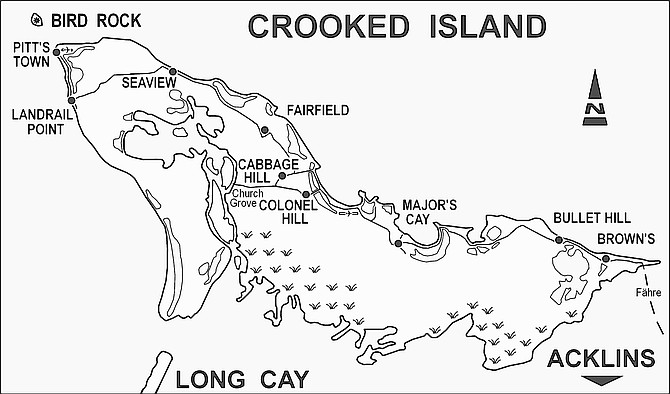
Crooked Island Map Photo: Marinas.com
By ERIC WILBERG
THE Pall Mall Gazette in 1878 focused on recent lighthouse expenditures, which rose “on account of the construction of Bird Rock Lighthouse in the Bahamas.” Why spend so much money on a remote pile or rock built atop a remote rock, taxpayers asked their government in London. The expenses considerably exceeded the estimate granted.
One reason was that without lights to guide them, ships were being delayed. The schooner General Gazneau under Captain Stevens found itself becalmed for nearly a week in the Crooked Island Passage on account of light winds, on its way from Colombia to New York with coffee in the fall of 1869.
In 1872, the schooner B.F. Waite from France under Captain Aylward loaded logwood and coffee in Haiti and then was forced to spend 10 long days with light winds trying to transit the Crooked Island Passage.
Four years later, H. Whatley, inspector of Lighthouses in Nassau, posted a highly detailed description in numerous papers on the “recently erected revolving light on Bird Rock.” It included advice that the light “will be a revolving white light attaining its greatest brilliancy every 90 seconds, elevated 120 feet above water [visible] 17 miles.” The “illuminating apparatus is catoptric or by reflectors of the second order. The tower is 112 feet high, built of stone, faced with blue bricks and slightly conical.”
He warns readers are “cautioned to pay careful attention, as the point of reef extends for about 1.5 miles NNW of the tower, and the current to the North of Crooked Island is variable.”
In 1926, a Notice to Mariners in US papers published observations by the commander of the USS Pittsburg regarding the flash, period, and averages of the Bird Rock Light.
An article entitled Lighthouse Beauty in a 1901 Baltimore paper, speaks of Bird Rock as “an isolated place where the marooned keepers give direction to the navigator in day by the tall tower and at night by the revolving lantern.”
This sets up a story. “A former keeper had a daughter whose face and form won her fame in a beauty show during one of the Paris Expositions. The Bahamian maiden was awarded the prize and in the pride that made her father’s heart swell he is said to have offered 10,000 British Pounds to any respectably connected white man who would be accepted by her as a husband.”
This odd twist was never realized, as in those times her mixed heritage caused all the suitors to balk. (Many a sea captain, including Captain List, retold the tale and wondered as well where the keeper obtained the promised fortune.)
A British steam ship named Ethelwold under Captain Smith, carrying fruit from Cuba for Boston, hit Bird Rock, as a consequence of which the crew jettisoned bananas to lighten ship. A steamer named Flandria tried to help, but could not do so without being endangered herself.
The Alice Maud was on its way from Haiti to New York with logwood when it was wrecked at Bird Rock in May of 1865. A steamer named Dordogne from the UK was en route from Philadelphia to Texas when it struck the rocks at Bird Rock. And in 1922, the New York Herald reported that a Norwegian steamer named Tune said that a wreck visible at Bird Rock was “no longer visible.” Either salvors or the sea must have claimed.
Tragedy strikes remote places as well. In 1933, a seafarer from the United Fruit ship Matapan was lost overboard just 14 miles from Bird Rock Light approaching midnight, and was never found.
In October of 1941, a Tampa newspaper ran a piece on the bright light of Bird Rock Light being “world renown among mariners as Bishop’s Rock, Cape Horn, and Sandy Hook… less than half a storm would send the sea sweeping over all this little ledge. It was covered with coconut trees until the storm of 1932 . . . Two keepers live there, we are told, with their large families. The author noted how a child was recently swept off the ledge there. “You can’t keep the kids imprisoned in the house.”
Soon the sailors under Captain Curry picked up Crooked Island, from which in days of yore locals sold crawfish and other fresh food. They landed a priest named Father Richardson by boat in Albert Town at Fortune Island, taking with them a goat, which found a cozy nook on the Padre’s lap. This caused the jolly fellow to remark that he is a good shepherd after all.
In 1907 the British Consul General in New York placed mariners on notice that the Bird Rock Light would be inoperative for a while, and that mariners would exercise special caution. Hurricane Donna in 1961 hit Landrail Point particularly hard.
In 1900, a steamer arriving in Jamaica reported that the British schooner named Dove went ashore at Bird Rock en route from Nova Scotia to Cuba, though it was believed the ship could be salvaged. In 1856, the French ship Elie of Bordeaux was on a voyage from Haiti to Le Havre, France when the ship ran up on Bird Rock and was totally lost. Fortunately, the crew and some of the cargo was saved.
On top of having to call for help off Bird Rock in 1905, the Danish captain of the bark Embla on its way from Venezuela to Germany was visited by the crew of Admiral Schley who found him in the throes of an attack of dysentery and they furnished medical assistance and medicine.
In April of 1890, passengers of the steamer Italia were found “in the last stages of exhaustion” between Fortune Island and Bird Rock by the crew of SS Ceresi, which took them to New York on their voyage there from Haiti.
SS Italia was wrecked on Watling’s Island, now San Salvador, and this group opted to set sail in a boat rather than suffer ashore. In June of 1897, the Baltimore Sun reported on a Norwegian barquentine named Lidskjalf, which reported to the Bird Rock keeper that all was well on its passage from Jamaica to the UK, proving that not all commercial shipping through the archipelago encountered trouble.
In October of 1914 Hubert Higgs, Mrs. Higgs, and their three children arrived to resume his role as Principal Lightkeeper at Bird Rock, aboard the schooner Mary Ann from Nassau.
In May of 1908 the American-Hawaiian Liner Mexican ran aground on the reef at Bird Rock – it extends a mile or two out to sea – and the port side and double bottom were damaged. Fortunately the ship was refloated and went to Cristobal in Panama. Bird Rock must have had its own radio, as this casualty was reported in the interational papers.
In 1912, a Norwegian steamship named Madeirnse, on its way from New York to Texas when it grounded at Bird Rock. Captain Smith, his wife, and a first mate named Hanson were rescued. However, after his crew were taken off Crooked Island, the captain was unable to defend his ship and cargo. Distraught, he put his family in and open sailboat and fled back to sea. Three days later, having been trailed by sharks, a steamer named Joseph J. Cuneo pulled them aboard and took them to Philadelphia.
Jeffrey Cardenas of StellaMarisSailing recently posted – with justifiable skepticism – a story written by Timothy Harrison in the Lighthouse Digest. In it a writer named Anna Randall Diehl claimed to have met Annie Brock in the UK following a series of three deaths on Bird Rock Light in the 1800s, none of it verified. The story goes, British cousins John and Stephen Brock bring their wives Annie and Mabel on a long stint as light keepers of Bird Rock Light. Mabel falls ill and dies, with nowhere to bury her, her remains are tossed into the ocean, her widower goes mad, attacks his cousin, and they both fall off the tower and die, leaving pregnant Annie to run the light alone until rescue and repatriation to the UK. Lighthouse lore is replete with such stories. Fortunately for Bird Rock Light, there were plenty enough verifiable events to make for rich reading.
In a UK paper in 1956, solo woman sailor Ann Davison had a challenging passage in her 23-foot sailboat Felicity Ann. A “monster battleship” challenged her for the right of way, a massive line squall shut off her retreat along the length of Acklins Island, and she was finally able to take pause under the reassuring beam of Bird Rock Light.
The Palm Beach Post of 1994 commented that the Pittstown Point Landing resort is in a building that in the 1800s was home to men from the Royal Navy’s West Indies Squadron. In the 1930s, the crew of the stranded Royal Navy yacht Tai Mo Shan found a headstone to a surgeon of the Royal Navy in the dunes along the lovely beach.
Angela McKinney Hole also documented Bird Rock Light in more recently in January of 2020, noting unfortunately that the historical landmark “is falling apart and sadly deteriorating rapidly.”




Comments
Use the comment form below to begin a discussion about this content.
Sign in to comment
OpenID