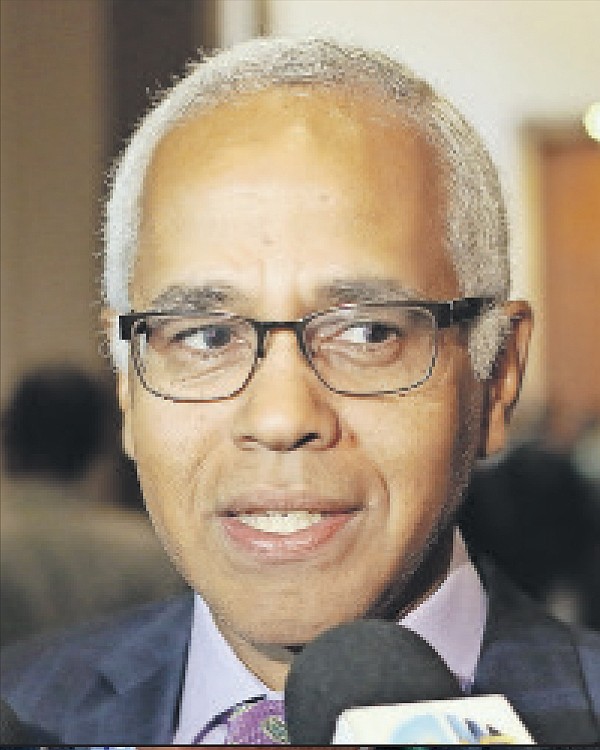
Dionisio D’Aguilar
By Neil Hartnell
Tribune Business Editor
nhartnell@tribunemedia.net
A former Cabinet minister yesterday asserted that the major political parties “aren’t remotely interested” in reversing the ever-increasing size of government and its $1bn civil service because the cost has yet to overwhelm or outrage Bahamians.
Dionisio D’Aguilar, former minister of tourism and aviation in the Minnis administration, told Tribune Business there will be zero political will to arrest the public sector’s continual growth until the level of taxation required to finance and support it hits a tipping point beyond which Bahamians start to push back and resist.
Describing the civil service as “a form of employment agency”, at least in the eyes of successive administrations, he added that The Bahamas appears far away from any such correction despite the negative impact on private sector growth, productivity and ease of doing business caused by the continually expanding bureaucracy.
Speaking after this newspaper revealed that total compensation paid to the Bahamian civil service will breach the $1bn mark for the first time in the upcoming 2026-2027 fiscal period, with its ranks having expanded by 2,342 persons over the past four years, Mr D’Aguilar pointed out that thousands of officials and their families benefit from the current system and will be resistant to any change that threatens their well-being.
And, with many seeking government posts because of the perceived greater job security and better employee benefits, the ex-minister conceded that it will be extremely difficult to change this culture and mindset unless Bahamians “demand better service and there are consequences” for officials who do not deliver.
Mr D’Aguilar, in the aftermath of the 2026-2027 Budget debate in the House of Assembly, said “nobody seems to be interested in reducing spending; it’s how do we raise revenues” as the Davis administration targets a $470m revenue increase for the 2026-2027 fiscal period to around $4.4bn despite this year’s collection pace lagging 2024-2025.
And wages, salaries and NIB contributions on behalf of public officials remain the largest line item in the Government’s recurrent spending, which represents its fixed operating costs for a single Budget period. They are projected to account for 27.2 percent of all recurrent expenditure in 2026-2027, which means more than $1 out of every $4 spent by the Government - or over one-quarter of its $3.724bn fixed costs outlay - will go towards covering personnel related costs.
“The civil service continues to grow and I think the headcount has gone up even more,” the former Cabinet minister told Tribune Business.
“One can chew the cud on how big it is, and how costly it is to the taxpayer, but I don’t think it makes a difference. I don’t think anyone is particularly interested in changing the current construct.
“I don’t think any of the political parties are interested in changing the current construct. It’s a form of employment creation, and whether it’s efficient or delivers good service is irrelevant because it’s a form of employment creation. I don’t think any government, no matter how much chewing of the cud goes on over how big and efficient it is, I don’t think any government is remotely interested in addressing it.
“It’s probably not ideal, and some of those funds could be deployed in creating new streams of business rather than supporting someone who is not needed any more, but I don’t think there’s any interest by the politicians and Bahamian people to address it, so it’s not worth chewing the cud on. One might argue that the Government appears to tax to meet the needs of this big body of people, but I don’t think the electorate is upset about it or making noise about it, so they keep hiring.”
Concerns over the ever-growing size and cost of government in The Bahamas are not new. Robert Myers, the former Bahamas Chamber of Commerce and Employers Confederation (BCCEC) chair, has previously argued that this nation needs to achieve consistent annual economic growth of between 3-4 percent so as to achieve sufficient private sector expansion to absorb workers transferring from the public sector.
However, cutting significant numbers of civil service jobs, especially in a relatively small society such as The Bahamas, comes with potentially major social and economic ramifications unless they find new private sector posts quickly. And the loss of income and spending power represented by their salaries could further retard gross domestic product (GDP) expansion and result in job losses elsewhere in the private sector.
Mr D’Aguilar said many Bahamians are unlikely to draw the “correlation” between higher taxes and the size of government until the cost burden becomes unbearable. He asserted that The Bahamas has not reached this point “by any means” and, until voters rebel over the associated tax and cost burden, there will be no pressure for change and to reform the status quo.
“I guess that when Bahamians finally decide they don’t want to pay any more taxes, and pay any more costs, the Government will be forced to act and address that issue,” he told this newspaper, “but we’re not there by any means.
“I think that the more people you put in the public service, the more bureaucratic doing business in this country becomes. Instead of going through one person, you have to go through five persons to get to the promised land, and that impacts growth, productivity and the ability to conduct business in this country.
“But I don’t think there is any significant interest in addressing it. The Government has constructed an employment agency, and everyone is happy with that. No amount of complaining about it is going to change that,” Mr D’Aguilar said. “The more people you hire, the more cost you take on. If you don’t have the necessary GDP growth to cover it, you have to raise taxes, and that’s when people will push back.
“There’s a correlation between the size of government, size of the public service and the taxes you pay. At some stage, the electorate will say ‘enough is enough’ and they are not prepared to pay any more, but we’re not there by any means, especially if you are beneficiaries of this type of expenditure. You are going to support it. Bahamians by and large want a government job in droves.”
Mr D’Aguilar suggested that such a tipping point may be reached if the Government’s tax revenues as a percentage of gross domestic product (GDP), or economic output, exceeds the Ministry of
Finance’s 25 percent medium-term target.
He asserted, though, that public sector performance, productivity and customer service delivery levels in the public sector are “measured at a lower standard than in the private sector, which is why there are complaints about the public sector being slow, unresponsive and that everything is done in its time”.
“If you are a business, and need a faster turnaround time to grow the economy, you have a number of public servants who say: ‘It is what it is,” Mr D’Aguilar added. “It is frustrating but you cannot do anything about it. You have a group of people protected by General Orders, which makes it very, very difficult to alter that and change that.
“If I know there are no consequences for the way I do my job - do a good job, I keep it, do a bad job, I keep it. The only way we will change that is if the Bahamian people demand better service and there are consequences if you don’t deliver.” Mr D’Aguilar said the concerns regarding the public service, and size and cost of the Government, are not unique to The Bahamas and exist around the world “but that doesn’t make it right or acceptable”.
Budget documents show that the total bill for central government employees is forecast to hit $1.013bn during the 12 months to end-June 2027, all of which will be funded by Bahamian taxpayers. The just-disclosed Fiscal Strategy Report 2026 breaks this figure down into $868.2m in wages and salaries; an additional $96.9m in allowances; and some $47.9m in National Insurance Board (NIB) contributions.
The all-in figure represents a near-$73m, or 7.7 percent, increase on the $940.3m payout forecast for the current fiscal year. And Tribune Business’s review of Budget records shows that the civil service has expanded by more than 11 percent over the past four years, growing from 21,082 total workers in the 2022-2023 period to 23,424 for the upcoming Budget year.
The Davis administration’s projections give the impression of an ever-increasing size of government whose cost burden will have to be funded by Bahamian taxpayers. Total civil service compensation is forecast to grow by almost $300m over the next decade to hit $1.3bn by 2035-2036 - a projection that, if it comes true, will represent a 28.3 percent hike over ten years.




Comments
birdiestrachan 3 months ago
No words from Mr DAguiler lately. Maybe as many retired do not hire new people
Sign in to comment
OpenID