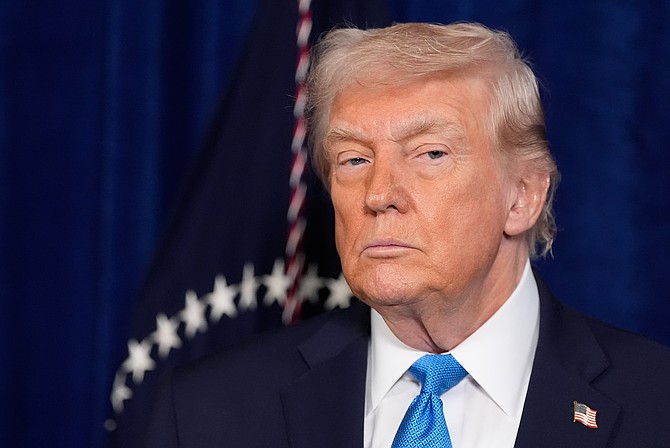
President Donald Trump listens as Defense Secretary Pete Hegseth speaks at Mar-a-Lago club, Saturday, Jan. 3, 2026, in Palm Beach, Fla. (AP Photo/Alex Brandon)
By NEIL HARTNELL
Tribune Business Editor
nhartnell@tribunemedia.net
US seafood importers are urging the Trump administration to exempt Bahamian lobster and stone crab from punitive 12.5 percent tariffs that threaten to place up to $70m of this nation’s exports at “an economic disadvantage” against rivals with “weaker labour protections”.
Joshua Johnson, president and owner of West Palm Beach-based Johnson Seafood Company, yesterday warned the US Trade Representative’s Office that imposing trade taxes on Bahamian fisheries exports to the US will achieve the “exact opposite” of what its intended crackdown on forced labour practices is intended to achieve.
Describing the Bahamian fisheries industry as the very model of “sustainability and ethical labour practices” that the Trump administration is pushing others to adopt, he wrote in a June 23, 2026, letter that “direct financial and economic harm” will be inflicted on both countries if it makes good on its threatened tariff implementation.
Revealing that Johnson Seafood Company imports around 180,000 pounds of Bahamian fisheries products per season, Mr Johnson added that levying tariffs - a form of taxes imposed at the border on imports - will disrupt “mutually beneficial long-term commercial relationships” that it has built with this nation’s suppliers including Boardwalk Seafood Distributors; Hook, Line and Sinker; G & L Seafood; Lightbourne Seafood. and Hurricane Seafood.
And, asserting that the US Trade Representative’s Office’s proposed policy “serves no legitimate forced labour enforcement purpose in the case of Bahamian seafood”, the fisheries importer sought to strengthen his argument by pointing out that US consumers will be harmed by higher-priced lobster and stone crab for which there are no domestic substitutes.
Mr Johnson’s letter confirms The Bahamas has American friends and partners who will advocate on its behalf to eliminate a major threat to this nation’s multi-million dollar goods exports. This arose after it was named among 54 countries deemed by the US Trade Representative’s Office (USTR) to have neither enacted, nor enforced, a legal and regulatory regime that bans the entry of imported goods made with forced labour into this country.
The USTR, which promotes and enforces the US federal government’s trade policies, said in a June 2, 2026, report: “USTR found that The Bahamas has failed to impose, and effectively enforce, a prohibition on the importation of goods produced with forced labour. We found that the failure to impose and effectively enforce a forced labour import prohibition is unreasonable.
“We found that the failure to impose, and effectively enforce a prohibition on the importation of goods produced with forced labour, burdens or restricts US commerce. For the foregoing reasons, the results of this investigation indicate that the acts, policies and practices of The Bahamas related to the failure to impose and effectively enforce a forced labour import prohibition are unreasonable and burden or restrict US commerce.”
The Davis administration, in legislation accompanying the 2026-2027 Budget, introduced reforms to the Customs Management Act that will allow the agency, which is responsible for policing this nation’s borders, to ban or prohibit the importation of goods into The Bahamas that were made with forced labour. However, it is unclear whether passing legislation by itself will be enough to defuse the tariff threat, as the US Trade Representative has made clear it also wants to see enforcement action.
However, Mr Johnson, whose company imports around 150,000 pounds of Bahamian spiny lobster tails, and 25,000-30,000 pounds of stone crab, per season asserted that his suppliers’ transparency, sustainable fishing practices and absence of forced labour is precisely why he does business with this nation.
“We respectfully urge the Office of the US Trade Representative (USTR) to grant an exemption for these specific products from the proposed Section 301 tariffs arising from the forced labour investigation against The Bahamas,” he wrote.
“We do not oppose the administration's stated policy goal of combating forced labour in global supply chains. However, the application of these tariffs to Bahamian spiny lobster and stone crab is misaligned with that objective, causes direct and disproportionate harm to US importers, and creates an unintended competitive advantage for foreign suppliers operating in far less regulated labour environments.”
Mr Johnson told the US trade promotion body that the Bahamian seafood industry presents no forced labour concerns for Washington D.C. “The Bahamas maintains a small-scale, artisanal and heavily regulated domestic fishery governed by the Bahamas Fisheries Act and international sustainability standards,” he argued.
“Bahamian fishermen are independent operators or members of licensed fishing co-operatives, not a captive labour force subject to coercion, debt bondage or exploitative conditions. USTR's stated rationale for the investigation plainly does not apply to this fishery. Subjecting Bahamian seafood to punitive tariffs under a forced labour framework - where no forced labour exists - undermines the credibility and precision of this enforcement mechanism.”
Mr Johnson warned, in effect, that the US will shoot itself in the foot if it suppresses demand for Bahamian crawfish and stone crabs by imposing tariffs that make them too expensive for consumers as there are no domestic substitutes or alternative products. Florida lobsters and stone crabs, he added, are simply not available at the volume, price and supply consistency that he and other wholesalers desire.
“These tariffs create a perverse competitive disadvantage for US importers,” Mr Johnson warned the Trump administration. “US buyers of Bahamian seafood will face a direct and immediate cost increase under the proposed tariffs. This does not reduce demand for imported seafood; it redirects that demand toward suppliers in countries with demonstrably harsher and less regulated labour environments.
“Competing seafood-producing nations with poor labour rights records may not face equivalent tariff burdens, or their tariff rates may be lower, placing Bahamian product at an economic disadvantage relative to suppliers whose practices are more closely aligned with the forced labour concerns motivating this investigation.
“As a US distributor, we have made deliberate sourcing decisions to partner with the Bahamian fishery precisely because of its transparency, sustainability credentials and ethical labour practices. These tariffs punish responsible sourcing decisions and may push US buyers toward lower-cost suppliers in countries where labour protections are weaker - the exact opposite of the policy's intended outcome.”
Mr Johnson’s letter also exposed the potential harm that the Trump administration’s proposed tariffs threaten for Bahamian small and medium-sized fisheries businesses. He cited numerous companies, and their owners, from whom he sources product - including Boardwalk Seafood Distributors and its proprietor, Kirt Neely Jnr; Hook, Line and Sinker and Aaron Long; and Hurricane Seafood and Shawn Turnquest.
“The cumulative stress placed on every link of this supply chain - from the importer to the wholesaler, the retailer to the restaurant, the market to the hotel kitchen to the hospitality operator - is a direct and foreseeable consequence of a tariff policy that serves no legitimate forced labour enforcement purpose in the case of Bahamian seafood,” Mr Johnson said.
“Furthermore, tariff-driven price increases risk disrupting long-term commercial relationships that US distributors have built with Bahamian fishing co-operatives and operators. Our supplier relationships — with Boardwalk Seafood Distributors, Hook, Line & Sinker, G & L Seafood, Lightbourne Seafood, Jacob Cornish and Hurricane Seafood (Shawn Turnquest) - have been cultivated over years and are grounded in mutual trust, transparency and sustainable harvesting practices.
“These relationships support sustainable fisheries management and benefit both US businesses and Bahamian fishing communities. The tariffs impose economic harm on both sides of a mutually beneficial trade relationship that exemplifies exactly the kind of ethical sourcing the administration should be encouraging, not penalising.”
As a result, besides arguing that Bahamian crawfish and stone crab imports should be exempt from the planned 12.5 percent levies, Mr Johnson also urged the Trump administration to “recognise that the Bahamian fishery presents no forced labour concerns, and that applying these tariffs would contradict the stated policy rationale”.
Based on feedback submitted by Ryan Pinder KC, The Bahamas’ former attorney general, in March to the first round of USTR consultation, up to $985m worth of Bahamian exports to the US could be hit by the proposed 12.5 percent tariff based on 2024 data. This nation’s major export was refined petroleum, valued at $610m, while other categories included documents of title ($95.2m), styrene polymers ($55.7m) and pearl products ($39m).
Adrian LaRoda, the Bahamas Commercial Fishers Alliance (BCFA) president, yesterday told Tribune Business that crawfish, or spiny lobster tail, shipments to the US are worth between $50m-$70m annually out of an export industry that typically generates around $120m in annual foreign currency earnings for this nation. “It is significant. It is significant,” he said of this sum, “particularly for such a sector. It’s a lot of money for a sector that employs less than 10,000 people.”
The Bahamas is in good company because the likes of Canada, Australia, the UK, the European Union (EU), Israel, New Zealand, Saudi Arabia, the United Arab Emirates and Singapore are among the other jurisdictions also set to be hit with tariffs.
Those that have enacted prohibitions on forced labour goods, or made commitments to do so, will face a lower 10 percent tariff rate, but those who have neither laws nor enforcement - such as The Bahamas - face being subjected to the higher 12.5 percent rate. The proposed Customs Management Act reforms, which are set to be passed into law come July 1, may result in this nation’s exports being subject to the lower 10 percent rate.
Time is now running out for The Bahamas and other nations to head-off, and prevent, the Trump administration turning its threatened tariff imposition into action. The planned measures must now undergo a further round of consultation in Washington D.C., with the deadline for written submissions to the USTR set as July 6, 2026, and public hearings set to begin one day later.
The Customs Management (Amendment) Bill 2026 introduces a new section 208A which stipulates: “The Minister may, by Order, prohibit the importation of any goods, wholly or partially produced or manufactured, from any supplier, country or territory if there are reasonable grounds to believe that the goods are a result of forced labour.”
The Bill’s ‘objects and reasons’ section reaffirmed that the change is geared towards “prohibiting goods from suppliers, places or countries that produce forced (child) labour from entering The Bahamas”. What is unknown is whether this will be sufficient to satisfy the Trump administration, given that the USTR seems to be demanding enforcement evidence as well as the enactment of the necessary laws and regulations.
Mr Johnson, meanwhile, warned that the impact of tariffs on Bahamian seafood exports to the US will be felt at every level of the supply and value chain. “Margins in the wholesale seafood distribution business are thin, and the additional duty burden cannot be fully absorbed,” he warned.
“The economic damage caused by these tariffs does not stop at the importer’s dock - it travels the entire length of the US seafood supply chain, compounding at every step and ultimately falling hardest on the American businesses and consumers this administration seeks to protect.
“When tariff costs are imposed at the import level, a small business like Johnson Seafood Company faces an impossible choice: Aabsorb the increased cost and threaten the viability of the business, or pass it on to customers.” This, Mr Johnson added, will have a “cascading” effect that translates into increased prices for seafood markets, restaurants and hotels, with small importers such as his business set to be squeezed the most and their very survival threatened.
The USTR investigation also appears to be a thinly-veiled attempt to crack down on the volume of Chinese goods imported by some of Washington D.C’s major trading partners. China has long faced accusations that it subjects ethnic minorities, particularly the Uighurs in Xinjiang province, as well as political prisoners and dissidents to forced or slave labour where they are forced to manufacture goods against their will and for no compensation.
Media commentators have also suggested that the ‘forced labour’ investigation may be a backdoor attempt by the Trump administration to implement last year’s so-called ‘Liberation Day’ tariffs that have been ruled unlawful by both the US Supreme Court and trade court. Those verdicts are now under appeal.




Comments
Use the comment form below to begin a discussion about this content.
Sign in to comment
OpenID