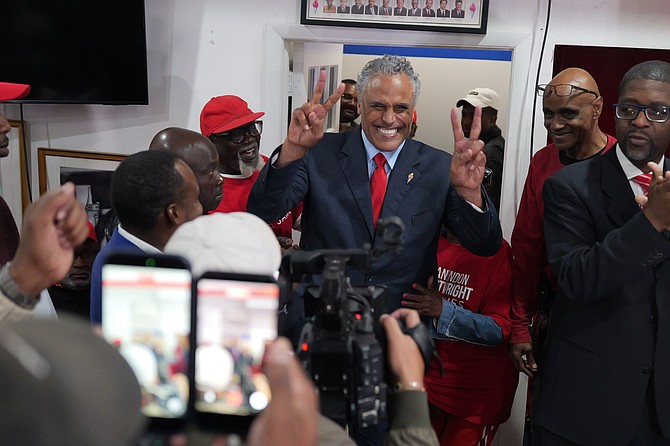
Rick Fox
By ANNELIA NIXON
Tribune Business Reporter
anixon@tribunemedia.net
An Opposition senator, yesterday argued that the Government should formally recognise its largest financial burden by establishing a “Ministry of Debt”, adding that the 2026-2027 Budget prioritises balancing the books over delivering effective results that improve Bahamian lives.
Rick Fox, speaking during the Senate’s 2026-2027 Budget debate, described the Davis administration’s plan as “a disciplined budget” that projects a primary surplus of around $633m and an overall surplus of $223m, while placing the national debt on a declining trajectory.
However, he said: “Balancing the books is not the same as building a nation.” Mr Fox said the Budget succeeds as an accounting exercise but falls short as a blueprint for national transformation, arguing that government spending remains focused on inputs rather than outcomes.
“This Budget gets the accounting right, but the ambition all wrong,” he said. “It is built to decline gracefully. It is not built to win.” Mr Fox repeatedly returned to what he described as an “excellence gap”, criticising the Budget for detailing how much government intends to spend while failing to specify what measurable improvements those expenditures are expected to produce.
“What does this Bbudget actually buy for the Bahamian people?” he asked. “Is it a plan for excellence or a plan for survival? It tells you to the dollar what we are buying. It never once tells you what we expect to get for it.”
Mr Fox added that while some ministries, including agriculture, labour, environment and disaster management, reported measurable achievements and targets during Budget debates, this approach was not consistently applied across government.
“If some ministries can stand and report numbers, then every ministry should be required to report outcomes,” Mr Fox said. “We are spending like a serious country and measuring like an indifferent one. That is the excellence gap in a single sentence.”
Mr Fox’s sharpest criticism centred on The Bahamas’ debt burden, which he said deserves greater public attention given the scale of annual debt-servicing cost that are forecast to hit $711m in 2026-2027.
“The Prime Minister has built a ministry for nearly everything,” he said. “But there is one ministry the numbers are screaming for, and it has no door, no sign and no minister. I call that ministry the Ministry of Debt.
“The Ministry of Debt gets paid first,” Mr Fox said. “It builds no school, it fixes no dock, it opens no clinic, it lowers no light bill, it trains no young Bahamian. But every year, before the future gets its turn, the Ministry of Debt gets paid.”
He argued that every dollar dedicated to servicing debt is a dollar unavailable for investments in infrastructure, education, healthcare and economic development. “Debt must serve the future,” he said. “It must not become the future.”
Among his recommendations, Mr Fox called for a shift to outcome-based budgeting, with ministries required to publish three to five measurable performance targets tied directly to spending allocations. He suggested targets such as grade-level reading proficiency, emergency room waiting times, business-startup timelines and power reliability metrics should accompany Budget allocations so taxpayers can assess whether government spending is delivering results.
“A Budget that tells you what it spends, but never what it intends to change is not a plan,” he said. “It is a receipt.” Mr Fox also advocated for performance-based funding for state-owned enterprises, noting that government subsidies exceed $500m annually.
“Turn subventions into milestone funding, money released against results, not against habit,” he said, estimating that linking even 10 percent of those transfers to performance targets could free approximately $65m for measurable outcomes.
While supporting substantial investments in education and healthcare, Mr Fox said those expenditures should be linked to improvements in student achievement, workforce readiness and health outcomes.
“Big budgets, no scoreboard,” he said, pointing to more than $384m in education spending and over $400m allocated to healthcare and related subsidies.
Beyond fiscal policy, Mr Fox warned that The Bahamas faces not only a financial debt challenge but also what he described as a “reputation debt”.
“Reputation is an economic asset,” he said. “When the national brand is damaged, it does not merely embarrass politicians. It raises the cost of trust for every single Bahamian trying to do business.”
Mr Fox framed The Bahamas’ long-term challenge as achieving economic independence through greater Bahamian ownership of assets and enterprises. “Too often we celebrate employment when we should also be pursuing ownership,” he said. “Too often we celebrate participation when we should be building wealth.”
While emphasising the importance of foreign direct investment, he argued that economic success ultimately requires more Bahamians becoming partners, shareholders and owners rather than solely employees.




Comments
TalRussell 3 months ago
Looking ever so sharp and dapper despite suffering a Parliament constituency defeat, the new redshirts' senator Ulrich Alexander Fox was determined to do his bestest not to screw up asking rivals. "Where’s the ‘Ministry of Debts' beef?"
Sign in to comment
OpenID