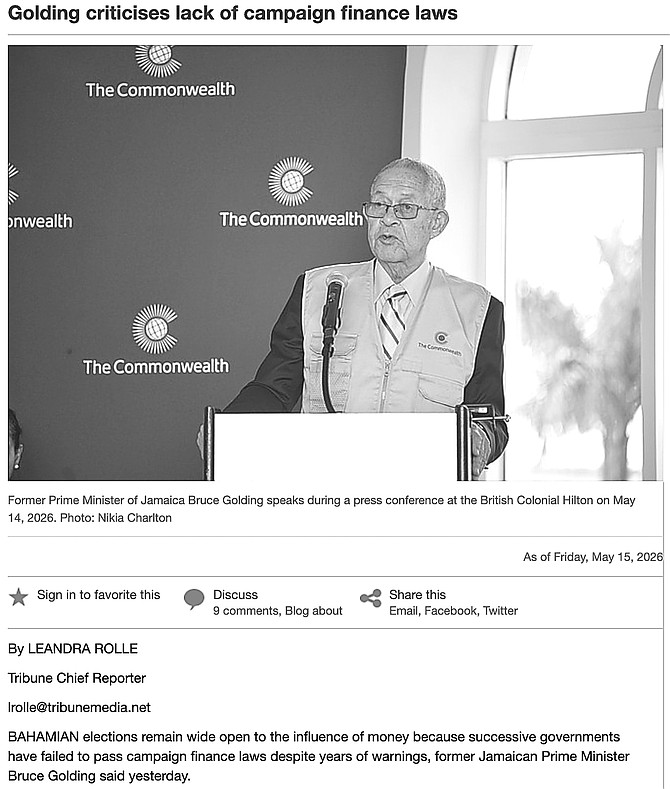
Clip from a May 15 Tribune news article on former Jamaican PM Bruce Golding speaking on the need for campaign finance reform in The Bahamas.
IN revealing that The Bahamas ‘does not maintain a comprehensive campaign-finance regulatory structure comparable to that found in the US,’ Jonathan Gardiner’s lawyer Susie Ribero-Ayala entered as evidence a story from The Tribune in which former Jamaican Prime Minister Bruce Golding states that The Bahamas remains wide open to the influence of money because successive governments have failed to pass campaign finance laws.
In the story, named Exhibit D, Mr Golding, chair of the Commonwealth Observer Group, was critical at the lack of progress in such matters in The Bahamas.
He said the issue had been ‘repeatedly flagged by observer missions, but reform had not followed.’
He recalled jokingly telling the Secretary General that ‘international bodies could spend another century sending observers to The Bahamas to make the same recommendations, only to have them ignored.’
“The people of The Bahamas need to make this their business,” said Mr Golding.
“It is their democracy. It is their future. Politicians, you know, can afford not to listen the Commonwealth Secretariat, but they are not refusing to listen to the people, and therefore much of the hope has to depend on the level of activism that the people in The Bahamas display.”
The story also states that ‘in 2024, Prime Minister Philp ‘Brave’ Davis said campaign finance reform proposals was not in his administration’s priorities, despite earlier promises to advance it.’
Mr Golding said small countries, like The Bahamas, where constituencies have relatively few voters, are ‘especially vulnerable to the influence of money and potential vote buying.’
He warned that wealthy candidates or parties could calculate how many votes they need to win and use financial resources to secure support.
“This is something that worries us,” he said.




Commenting has been disabled for this item.