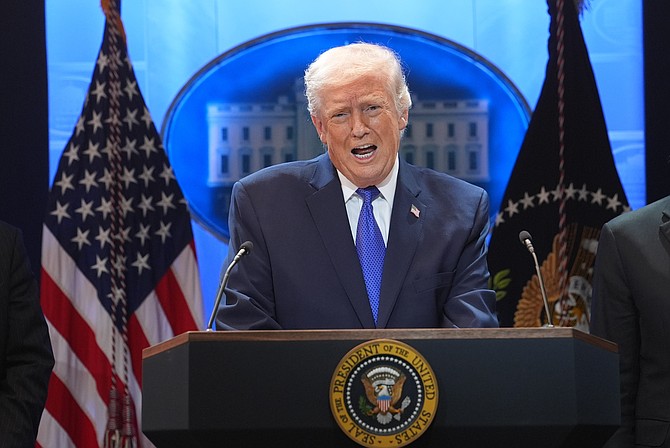
President Donald Trump speaks during a press briefing at the White House, Friday, Feb. 20, 2026, in Washington. (AP Photo/Evan Vucci)
By NEIL HARTNELL
Tribune Business Editor
nhartnell@tribunemedia.net
A Bahamian fisheries chief yesterday revealed that a US customer’s alert over the Trump administration’s plan to impose 12.5 percent tariffs on this nation’s exports had “kind of opened my eyes” to the scale of the damage that could be inflicted on the industry.
Adrian LaRoda, the Bahamas Commercial Fishers Alliance (BCFA) president, told Tribune Business that the call by Joshua Johnson, president and owner of West Palm Beach-based Johnson Seafood Company, to exempt Bahamian spiny tail lobster and stone crab from punitive US trade sanctions had revealed 50 percent of local fisheries harvester and processors are involved in supplying just this one business.
Explaining that this exposes the widespread harm Bahamian fisheries will likely suffer if the Trump administration proceeds, which it says is a response to this nation’s failure to ban goods made with forced labour, Mr LaRoda said that Mr Johnson’s intervention has “opened the door” for the sector to collaborate with its US customers in opposing the tariff move.
“I was hearing on the periphery that there were some concerns from our US buyers,” he told this newspaper. “They know they will have supply, but it was a matter of them being able to make a good profit from our supplies. Now your article has opened the door, I’m going to be interested in working with and talking to our US partners to see what support and lobbying we can get on their end.
“It opens the door to ask our US partners to do lobbying on their side. What affects us affects them way more. They will bear the brunt of higher tariffs and sometimes it will be difficult to pass that on to customers through higher prices. The door has been opened, and we are open to collaborating with our US buyers and the support we get from them to definitely make a difference in how they move forward.”
Mr LaRoda also revealed that Mr Johnson’s June 24, 2026, letter to the US Trade Representative’s Office urging that Bahamian fisheries products be exempted from higher border taxes had brought home to him just how wide the negative impact will be felt by local harvesters and exporters. The US importer had listed multiple Bahamian fisheries houses that he buys product from - all of which could suffer a sales export slowdown if crawfish and stone crab are priced out of consumers’ reach.
“It kind of opened my eyes a bit,” he disclosed. “I didn’t think as many of our guys, the harvesters, the suppliers…. 50 percent of our people are doing exports and supplying that one company. Fifty percent of our suppliers are supporting that one company, and any negative effect on their end will have the same effect on 50 percent of our industry, more or less. This has brought some attention to what could potentially happen to us.”
Mr Johnson, in his letter, revealed that Johnson Seafood Company imports around 180,000 pounds of Bahamian fisheries products per season, and warned that levying tariffs will disrupt “mutually beneficial long-term commercial relationships” that it has built with this nation’s suppliers including Boardwalk Seafood Distributors; Hook, Line and Sinker; G & L Seafood; Lightbourne Seafood; and Hurricane Seafood.
“The cumulative stress placed on every link of this supply chain - from the importer to the wholesaler, the retailer to the restaurant, the market to the hotel kitchen to the hospitality operator - is a direct and foreseeable consequence of a tariff policy that serves no legitimate forced labour enforcement purpose in the case of Bahamian seafood,” Mr Johnson wrote.
“Furthermore, tariff-driven price increases risk disrupting long-term commercial relationships that US distributors have built with Bahamian fishing co-operatives and operators. Our supplier relationships — with Boardwalk Seafood Distributors, Hook, Line & Sinker, G & L Seafood, Lightbourne Seafood, Jacob Cornish and Hurricane Seafood (Shawn Turnquest) - have been cultivated over years and are grounded in mutual trust, transparency and sustainable harvesting practices.
“These relationships support sustainable fisheries management and benefit both US businesses and Bahamian fishing communities. The tariffs impose economic harm on both sides of a mutually beneficial trade relationship that exemplifies exactly the kind of ethical sourcing the administration should be encouraging, not penalising.”
Besides US importers lobbying their representatives in Congress, Mr LaRoda said the Alliance is planning a similar effort in The Bahamas as time is running out before the US Trade Representative’s planned public hearing on the proposed forced labour-related tariffs on July 7 in Washington D. C.
“I’ve already started to try and get meetings with the Trade Commission to get them to understand the importance of discussing it,” he added, noting that the Department of Marine Resources - with whom the Alliance typically engages in government - is a regulator more than an advocacy body.
“We would have been speaking to the Department of Marine Resources on this to see what could be done, and so far nothing has materialised,” the Alliance chief said. “The Bahamas needs a strong lobbying firm to handle these things whenever they arise.”
Mr LaRoda said the Alliance and other members of the Bahamian fisheries industry are also hoping to speak to Herschel Walker, the US ambassador to The Bahamas, in a bid to “soften the approach to our exports”.
He added: “It can’t be done in a vacuum. It has to be done through the Trade Commission. We are happy to be part of the discussions if they are taking place, but we are definitely going to be leading it because we are going to be advocating for it, starting with the Trade Commission and the ambassador. It can’t be done in isolation. It has to be with the Trade Commission.
“We are concerned. Any increase in tariffs will definitely affect our sales to US customers and if they are going to pay that much more for our product they may not buy it. We are competing with Maine lobster, which is not as good, but we are worried. If our US customers cannot sell the volume they are accustomed to, that will affect their bottom line, too.
“A spiny lobster tail landed in Miami could start at $25 a pound but by the time it gets to market it could be $75-$80 a pound. We are exploring new markets, but there is only so much support in terms of market share that’s out there. We cannot just jump into new markets and say: ‘Buy my product’. We may have to start at a low point, which may mean we losing money to gain some traction, which may not be preferable for us.”
Based on feedback submitted by Ryan Pinder KC, The Bahamas’ former attorney general, in March to the first round of USTR consultation, up to $985m worth of Bahamian exports to the US could be hit by the proposed 12.5 percent tariff based on 2024 data. This nation’s major export was refined petroleum, valued at $610m, while other categories included documents of title ($95.2m), styrene polymers ($55.7m) and pearl products ($39m).
The Bahamas is in good company because the likes of Canada, Australia, the UK, the European Union (EU), Israel, New Zealand, Saudi Arabia, the United Arab Emirates and Singapore are among the other jurisdictions also set to be hit with tariffs.
Those that have enacted prohibitions on forced labour goods, or made commitments to do so, will face a lower 10 percent tariff rate, but those who have neither laws nor enforcement - such as The Bahamas - face being subjected to the higher 12.5 percent rate. The proposed Customs Management Act reforms, which are set to be passed into law come July 1, may result in this nation’s exports being subject to the lower 10 percent rate.
Time is now running out for The Bahamas and other nations to head-off, and prevent, the Trump administration turning its threatened tariff imposition into action. The planned measures must now undergo a further round of consultation in Washington D.C., with the deadline for written submissions to the USTR set as July 6, 2026, and public hearings set to begin one day later.
The Customs Management (Amendment) Bill 2026 introduces a new section 208A which stipulates: “The Minister may, by Order, prohibit the importation of any goods, wholly or partially produced or manufactured, from any supplier, country or territory if there are reasonable grounds to believe that the goods are a result of forced labour.”
The Bill’s ‘objects and reasons’ section reaffirmed that the change is geared towards “prohibiting goods from suppliers, places or countries that produce forced (child) labour from entering The Bahamas”. What is unknown is whether this will be sufficient to satisfy the Trump administration, given that the USTR seems to be demanding enforcement evidence as well as the enactment of the necessary laws and regulations.




Comments
Use the comment form below to begin a discussion about this content.
Sign in to comment
OpenID