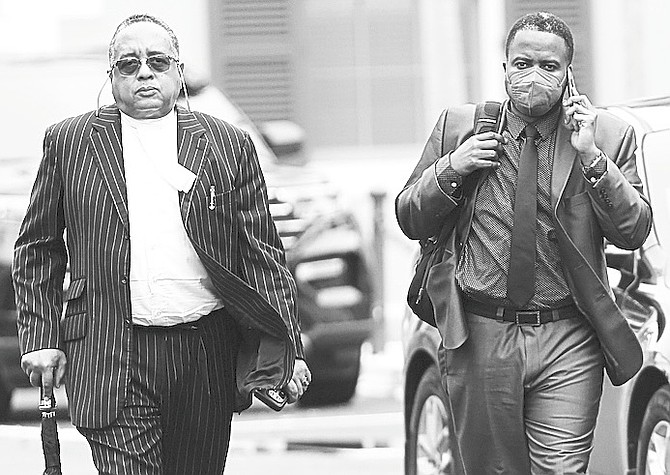
Adrian Gibson leaves court with his attorney Damian Gomez in 2025.
By PAVEL BAILEY
Tribune Staff Reporter
pbailey@tribunemedia.net
THE Court of Appeal has rejected a bid by Adrian Gibson and four co-accused to derail their ongoing criminal trial, ruling that their constitutional motion was an improper attempt to challenge the trial before it has ended.
The court dismissed the appeal by Gibson, Joan Knowles, Jerome Missick, Peaches Farquharson and Elwood Donaldson, who had challenged the trial judge’s refusal to declare a mistrial, discharge the jury and recuse herself.
The appellants claimed their constitutional right to a fair trial had been breached because of alleged irregularities in the jury’s empanelment, alleged non-disclosure of the approved jury list, alleged bias involving a juror and a prosecutor’s office, and alleged apparent bias by the trial judge.
However, Justices Evans, Charles and Kokaram held that the complaints did not justify constitutional intervention while the criminal trial remains underway.
The court said the motion was an “impermissible collateral challenge to ongoing criminal proceedings” and that the issues raised could be dealt with in the trial process or on appeal if necessary.
“The alleged complaints are not about a dispute as to whether a constitutional right exists,” Justice Kokaram wrote. “Rather, they are complaints about the trial process which raises no exceptional features warranting constitutional interrogation or protection.”
The court said any alleged jury irregularity could be reviewed in an appeal if the accused are convicted. It also noted that no allegation had been made that the jurors selected were unqualified or otherwise tainted.
The appellants argued that seven of the nine jurors were not on the approved 2023 jury list. The court accepted that the jurors did not come from the 2023 list, but said the issue did not require the trial to be stopped.
It said the trial judge was entitled to refuse the request to discharge the jury, and any challenge to the composition of the jury could be addressed through the ordinary criminal appeal process.
The court also rejected the complaint that a juror’s alleged connection to someone in the Office of the Director of Public Prosecutions gave rise to apparent bias, saying no formal application had been made before the trial judge.
The judges were equally unmoved by the allegation that the trial judge had a closed mind or should have recused herself.
“We are not satisfied that this allegation was properly made out,” the court said, adding that the issue could be handled on appeal at the end of the trial if necessary.
The court was blunt about the complaint that the DPP failed to disclose the jury list, calling it “a non-starter.” It said the approved list was publicly available and that no request had been made to the DPP to provide it.
The court also said the Attorney General, not the DPP, was the proper party to answer constitutional claims involving alleged acts of the state.
The ruling criticised the long procedural history of the case, saying the trial had been slowed by several rounds of applications and appeals.
“The appeal has been productive of nothing other than to further delay a trial that has been ongoing since 2023,” the court said, quoting an earlier warning in the same litigation.
The judges said constitutional motions should not be used to interrupt criminal trials unless exceptional circumstances exist.
“There has been no alleged constitutional breach that is so significant that will justify a departure from the well-worn investigation by an appellate court of any alleged miscarriage of justice,” the court said.




Commenting has been disabled for this item.