By NEIL HARTNELL
Tribune Business Editor
nhartnell@tribunemedia.net
The Bahamian auto market could suffer “a bloodbath” starting as early as the 2026 second half, a dealer warned yesterday, as he and others voiced concerns about the industry “hitting saturation point”.
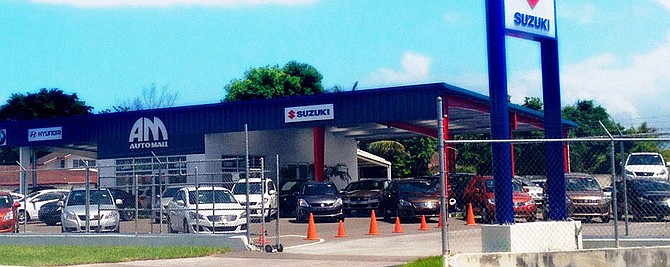
Fred Albury, principal at the Auto Mall, which is the authorised distributor for the Toyota, Hyundai and BMW brands, told Tribune Business that “the market cannot continue to absorb the amount of new vehicles coming in” with an influx of lower-priced Chinese brands further adding to the competitive pressures.
Emphasising that it was his personal opinion, the Auto Mall chief said his 50 years in the auto industry has sensitised him to the market cycles and “ups and downs”, alerting him to when a slowdown seems likely. He forecast that, when the “saturation” tipping point is hit - with too many vehicles seeking too few qualified buyers - many dealers will go into “survival” mode and start discounting prices, with those possessing strong parts and services departments best-placed to survive.
Fred Albury told this newspaper that there has already “been a big slow down” in Japanese used car imports, which he attributed to the arrival of Chinese-made new autos entering the Bahamian market. He disclosed that he and Auto Mall are receiving two to three phone calls per day from Japanese used car dealers, which he interpreted as a sign they are “hurting”.
The same “saturation” concerns were voiced by Ben Albury, the Bahamas Motor Dealers Association’s (BMDA) president and Bahamas Bus and Truck’s principal, albeit to a lesser extent. He agreed that competitively-priced new Chinese made vehicles are displacing the used autos that many Bahamians have traditionally relied upon as a lower-cost transportation option.
Both men agreed that the Middle East conflict, and the surge in global oil prices, have yet to seemingly impact Bahamian consumer confidence or spending with auto buyer interest and sales remaining relatively “robust” for early 2026. Following a soft January, overall market activity was said to have picked up in February, and Ben Albury revealed that Bahamas Bus and Truck has enjoyed more sales during the first three weeks of March than for those two months combined following the arrival of fresh stock.
However, the BMDA president said the auto industry - as well as others - is feeling the initial effects of increased shipping costs as a result of the fuel price spike triggered by the Iran conflict’s impact on global crude oil expenses. The latter jumped to $116 per barrel yesterday following missile and drone strikes on key Middle East energy infrastructure, and Ben Albury said shipping fuel surcharges - a component of total freight costs - had “in some cases” doubled compared to the war’s start.
Fred Albury, meanwhile, sounded the alarm that the Bahamian new vehicle market could soon suffer a downturn following several strong sales years after the economy emerged from the COVID-19 pandemic. He signalled that the industry typically moves in cycles, with a period of strong growth often followed by slower years, as the market adjusts and levels out.
“I said it last year,” the Auto Mall principal told Tribune Business. “With the amount of vehicles coming to the island, all the new vehicles and with all the new competition out there, the new car market is going to hit saturation very soon out there. And, when that happens, you will see a bloodbath with survival and discounts. The dealers which have been around for quite a while, with strong service and parts departments, they will survive.
“A lot of Chinese brands are entering into the car market. There’s been a big slowdown in Japanese used cars. The Chinese vehicles are very competitive and banks are willing to offer financing. I get two or three calls a day from Japanese exporters. I think they’re hurting.”
Asked when he believes the so-called “saturation point” will be reached, Fred Albury replied: “I feel some time this year; the middle of this year, the second half of this year. The market cannot continue to absorb the amount of new vehicles coming in. People are taking out loans that have to be paid off in five years, so they are committed.
“Once that saturation point is hit, we are going to go into a slump for a few years. Once we hit that slump, those who are strong in service and parts will survive. That’s only my opinion but I’be been in the business for 50 years. I’ve been in it a long time to see the ups and downs. We’ve been up for quite a while and it’s been very strong.”
Ben Albury, while voicing similar concerns, acknowledged the new vehicle influx but also viewed it as Chinese brands displacing Bahamians’ prior reliance on used autos. “I always get concerned when I see people bullish on the auto industry because, over the last couple of years, we’ve seen robust growth and very strong sales,” the BMDA president told Tribune Business.
“It always makes me nervous to see that as there comes a point in time where there’s always potential for market saturation, but now we’re increasingly seeing lower costs and more technological options for consumers from China. What we’re seeing is an increase in new car imports and an increase in domestic purchases, because people are realising they are very cost efficient new vehicle options.”
As a result, the BMDA president said Bahamians are realising “they can buy new vehicles at very attractive prices” and no longer have to import used autos from abroad if they want something of “a certain calibre”.
Despite the “saturation” concerns, both Alburys agreed that signs of a market slowdown have yet to emerge despite predictions of inflationary and cost of living pressures due to the Middle East war’s impact on oil prices. Ben Albury, though, confirmed that these are already feeding through into shipping costs.
“Buyer interest is very, very strong, sales are very strong,” the BMDA president said. “We are starting to see some of the effects of the [oil] increase in shipping costs. As of right now, we don’t know how far out and how bad that’s going to go. As far as the industry goes, sales are extremely robust.
“Right now, we don’t see any signs whatsoever of a slowdown. I don’t know how bad shipping costs are going to increase, I don’t know what other expenses people have that may increase. Right now, I am not seeing any indicators of a slowdown whatsoever.”
Ben Albury said increased fuel surcharges are just one component of overall freight costs that have to be paid by Bahamian auto dealers and, indeed, all companies and importers. “It’s not the overall cost of shipping,” he explained. “It’s the fuel surcharge that has started to creep up on you. It’s not the total freight charge. It’s a line item but, in some cases, we’ve seen that line item double. It’s always a concern with anything that can increase price levels. We’re going to have to monitor how long this situation lasts.”
Ben Albury added that Bahamas Bus and Truck was fortunate to receive a shipment of new vehicles just prior to the Middle East conflict’s start. “The industry itself has been extremely robust,” he told Tribune Business. “I know we were waiting on some product we were out of, and other factors that gave me a slower January and February.
“But inventory levels increased and we got product back in. We’ve seen sales skyrocket, and actually surpassed our total sales combined for January and February during the first 20 days of this month. I spoke to other stakeholders in the auto sector and other industries, who saw a slower December and January but it seems that the economy in February and March has simply picked back up. Right now, it’s extremely busy.”
A similar trend occurred at Auto Mall. Fred Albury confirmed that his dealership has seen no impact from global events, but added: “We’ve seen a little tapering off, but it’s still reasonably strong out there…. All in all, we’re still holding our own quite well. January was off a bit, and I say that for overall dealer numbers, but February seems to have bounced back.”
Ben Albury added: “I was speaking to a colleague, and we were saying that we’ve gone through COVID, gone through this thing and that thing, whether it’s a war or VAT. It always seems like something’s around the corner to make another challenge that we’ve not anticipated or want. That’s life. Let’s hope that everything stabilises quickly and we can get back to some sort of normalcy.”




Comments
AnObserver 4 hours, 4 minutes ago
Don't worry, in about three to five years when all those Chinese cars from Temu are rusting away in the dump, people will start buying name brand cars again. People seem to have short memories though, remember about 10-15 years ago someone was bringing in Chinese JAC pickup trucks? There isn't a single one left on the road, they all broke down, self destructed, or rusted away in to nothing, but now I see people going out and buying new ones. The mind boggles.
Proguing 3 hours ago
BYD has been here for eight years, and the quality of its vehicles is better than that of US vehicles.
pileit 22 minutes ago
dripping in ignorance.... Chinese auto builders have been in business for 60 years or more....why did I even bother to engage?
Sign in to comment
OpenID