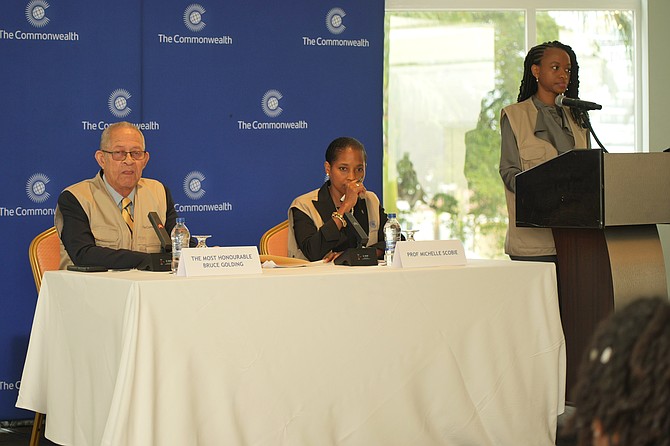
MEMBERS of the Commonwealth Observer Group at a press conference at British Colonial Hilton on May 14, 2026.
By LEANDRA ROLLE
Tribune Chief Reporter
lrolle@tribunemedia.net
DESPITE steps taken by the Davis administration to modernise the electoral process, The Bahamas still needs deeper reform in election management, electoral technology and the media environment, the Commonwealth Observer Group warned yesterday.
The group, which has observed Bahamian elections since 2017, urged the government to act on previous recommendations to modernise voting and establish an independent election management body.
Former Jamaican Prime Minister Bruce Golding, who led the observer mission, said repeated reform recommendations have gone unaddressed for too long. He called on officials to establish a local authority to systematically review and act on past and current findings from international observer missions.
Among the group’s long-standing recommendations is the creation of an independent election authority. Mr Golding noted that almost a quarter of a century has passed since the last referendum on the issue.
“This is sufficient time, we believe, for this issue to be revisited,” he said during a press conference on the group’s preliminary findings.
His comments followed weeks of complaints from opposition parties about the Parliamentary Registration Department’s handling of the electoral process, including concerns about the integrity of the voters’ register, consultation and preparation.
Mr Golding praised election operations, including the conduct of the poll, the role of political party agents and security arrangements. However, he also highlighted several problems.
He acknowledged complaints about voters being incorrectly placed in constituencies or omitted from the register, as well as logistical challenges during last month’s advance poll.
“We urge the Parliamentary Registration Department to draw fully on the lessons of the advanced poll in the conduct of any future electoral exercise, particularly with respect to the number of voters assigned to each polling station, crowd managements, the deployment of polling staff, signage, the timely availability of certified voter lists to political parties and returning officers and clear communication with the public and with political parties on operational decisions,” he said.
Asked whether a fixed election date could address some of the problems, Mr Golding said the group had not considered the matter but noted that fixed election dates have both advantages and disadvantages.
“A situation may arise in a country which demands a return to the electorate and it may not necessarily be a good thing for that necessity to be imprisoned by the fact that the election date is fixed,” he said. “At the same time, a fixed election date does provide some predictability so that people can plan.”
He also recommended that a preliminary voters’ list be published online to allow public verification.
While crediting the rollout of optional biometric cards, Mr Golding said The Bahamas should go further and make the cards mandatory for the next election.
He raised concern about declining voter turnout, noting The Bahamas’ history of high participation before Hurricane Dorian and the COVID-19 pandemic.
“This time around, there's no COVID. We don't have no hurricane and based on the preliminaries of the turnout, it seem to be somewhere in the region of 56 percent. That worries me,” he said.
He said the trend appears to be persistent across the region and urged political parties to examine the causes of what he described as growing “alienation of voters.”
To improve voter awareness and turnout, he proposed a strong public information campaign using traditional and social media long before the next election.
The observer group said press freedom is generally respected, but noted “public disquiet” over government arrangements at the Broadcasting Corporation of The Bahamas in the lead-up to the election.
It restated previous recommendations that the national broadcaster, ZNS, provide equitable access and balanced coverage of all political parties and candidates.
The group said it also received reports of close ties between owners of private media houses and the main political parties, raising concerns about the potential for biased reporting. It recommended that private media consider establishing an independent media association to support and regulate media professionals, along with a media code of conduct.
Mr Golding also noted the creation of two new constituencies by the Constituencies Commission, which he said is “tilted in favour of the ruling party.”
“The delimitation of constituencies under this arrangement has the potential to confer an unfair advantage in election outcomes,” he said.
He concluded by congratulating newly re-elected Prime Minister Philip Davis and commending voters for again exercising their franchise peacefully and orderly.
A final, detailed report by the mission will be released later.




Comments
Use the comment form below to begin a discussion about this content.
Sign in to comment
OpenID