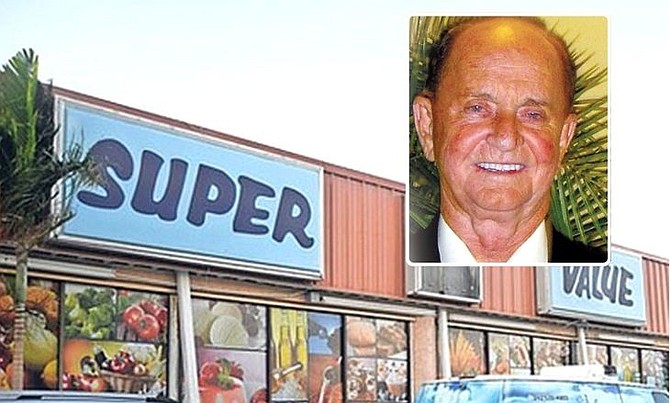
Super Value principal Rupert Roberts
By NEIL HARTNELL
Tribune Business Editor
nhartnell@tribunemedia.net
Super Value’s president is warning of potential food price increases, and a barrier to pay rises for hundreds of staff, due to the supermarket chain having to absorb “over $1m” in extra annual costs from the Government’s VAT exempt treatment of uncooked foods.
Debra Symonette told Tribune Business that the food distribution industry’s new inability to reclaim, or ‘net off’, the tax they pay on input expenses linked to uncooked foods is “a big deal” for all operators as the resulting increase in their costs impacts the business model by eating into bottom-line profits.
While anxious to reassure Bahamian consumers that the 13-store chain has not increased prices yet, she reiterated that it “could happen in the future” depending on the impact that the VAT exempt tax treatment has on earnings. Ms Symonette, conceding that this is “the last thing people need with the already high cost of living”, explained that Super Value cannot afford for its profits to be “eroded too much” as it needs to stay in business and cover its bills.
Large food stores, such as Super Value and BISX-listed AML Foods, while have filed their first VAT returns and payments under the new VAT exempt regime by May 14 last week. Those payments would have represented May’s collections, and Ms Symonette said food retailers and wholesalers continue to hope the Ministry of Finance delivers on a promised compromise that would “balance” the Government’s revenue and fiscal needs with private sector’s desire for tax simplicity and earnings preservation.
“It has not been resolved as yet,” she told this newspaper of discussions between the Government and food distribution industry that began before the May 12 general election. “We spoke to them recently, and they say they are going to present something in the near future.
“We are having to spend quite a bit. It’s going to be like over $1m per year in [extra] expense if we continue to do it the way we have to do it now. We would have to expense VAT rather than take a credit. That could result in us having to increase prices, and certain things we would have to really think hard about, like increases in salaries; that kind of stuff. That’s for sure.
“It’s a big deal because every expense added takes away from your bottom line. We have to control our expenses carefully and ensure that the profits are not eroded too much. Being a big retailer we would feel it more. We’re hoping they [the Ministry of Finance] will come up with a good solution to this, and we won’t have to absorb as much as we are doing now.”
Rupert Roberts, Super Value’s owner, recently told Tribune Business via a series of What’s App messages that the changed VAT treatment of uncooked foods - which accompanied the April 1 elimination of tax paid by consumers - is set to cost the supermarket chain an extra $1.6m per year if no further adjustments are made by the Government.
“The VAT change is costing us $1.6m a year,” he wrote. “New tax. Merchants will have to raise prices to take government out of the revolving door. Government gave consumers 5 percent off [uncooked food] and charged it to merchants. Millions of dollars.” Mr Roberts also confirmed it will likely impact the ability of Super Value and other food store owners to give staff pay and benefits increases.
The food distribution industry’s concerns stem from the Government’s decision to treat the uncooked food VAT elimination as ‘exempt’ rather than ‘zero rated’. While the latter treatment would have eradicated VAT at all stages of the supply chain, using the ‘exempt’ approach means only the consumer, or end purchaser, is not charged this tax.
VAT will still apply at all levels in the supply chain, and ‘exempt’ treatment means businesses such as grocery retailers and wholesalers are unable to recover the tax paid on their input expenses associated with purchasing uncooked foods.
For example, if uncooked foods account for 60 percent of a merchant’s sales, it is unable to reclaim or recover 60 percent of the VAT paid on its light bill, store rents and maintenance expenses. As a result, operating costs will rise, and retailers have warned they may have to increase prices to offset the impact, thereby negating the impact of the uncooked food VAT elimination.
“I wouldn’t want to give the impression we have already increased prices, but that could happen in the future,” Ms Symonette told Tribune Business. “That’s the last thing people need with the already-high cost of living…. I would saw we will watch it and see how much of an effect it has on the bottom line. As the expenses go up, we’d have to find a way to offset them.”
The Super Value president also agreed that the ‘exempt’ treatment is effectively turning the VAT concept on its head - converting it from a tax paid by the consumer, or end-user, to one that is now starting to increasingly be paid by Bahamian businesses. A further example is the reform, introduced with the 2025-2026 Budget, that prevents companies from reclaiming or ‘netting off’ VAT paid on construction materials and other inputs related to building projects worth $1m or more.
“Yes, that’s it exactly,” Ms Symonette said, “because everything now is being passed on to us as businesses. We cannot claim what we used to claim. We have no choice but to expense it. They’ve [the Government] got to find some way to keep the revenues kind of steady. If they cannot get it from the consumers, they have to get it from us.”
Merchants have also warned that introducing VAT ‘exempt’ treatment will make the tax much more complex to administer, increasing costs and time involved with this, and raising concerns they may miss filing deadlines and provide inaccurate return submissions. This was because they now have to correctly categorise products into those that are VAT ‘exempt’, ‘zero rated’, or taxed at 5 percent or 10 percent - in effect, having to account for new VAT-related categories.
Ms Symonette, confirming that Super Value has already submitted and filed its April VAT returns, said the process had been more complex than previous filings. She added, though, that the industry remains optimistic that the Government and Ministry of Finance will come up with a compromise tax treatment acceptable to all parties.
“There was an adjustment and it was something new,” the Super Value president said of the April VAT filings. “We had to make certain changes in the system, and get used to putting them in the correct categories. It’s a bit difficult but, as we go along, it will become easier.” She, though, conceded that the private sector has “no idea” what proposal the Government is likely to come up with.
“We strive to give some suggestions, but we are not sure what they are going to do,” Ms Symonette said. “It has to be a balance between us and them. We’re remaining very hopeful. I don’t know what’s going to happen. I cannot say anything for sure. All we can do is hope: Hope for the best and we hope it’s coming soon. It may take a while, but hopefully not too long.”
She agreed that the VAT ‘exempt’ treatment’s new cost pressures, as well as increases in freight and transportation costs from the global fuel/oil price spikes produced by the Middle East conflict, could wipe out the savings Bahamian consumers were expecting to enjoy from the elimination of tax on uncooked foods.
“Even though they had the decrease in VAT, if the prices go up they won’t even feel the relief any more,” Ms Symonette said. She added that the impact from increased freight and transportation costs has been “happening slowly”, and said: “We haven’t seen too much as yet, but the longer this thing [the Middle East conflict] lasts we can rest assured there will be an impact. The longer it lasts, the more of an impact it will have. It could be significant.
“The more the oil prices go up, the more it’s going to affect shipping and the different expenses that our vendors have to incur. If their prices go up, they will automatically increase the prices they charge us. There’s definitely going to be an affect.”
The Super Value president also revealed that the supermarket chain enjoyed a temporary 10 percent sales boost in the weeks and months leading up to the May 12 general election as the major political parties spent to keep their campaign workers fed and watered.
“When we looked at it, certain departments were up a lot and then other departments were not so high; they didn’t have such high increases,” Ms Symonette said. “When it’s averaged out it’s not more than 10 percent. That was in the weeks leading up to, and then it died back down. I wouldn’t say it was an explosion, but 10 percent is pretty good.”




Comments
Dawes 4 months, 3 weeks ago
Government will just make it seem that its the businesses taking from Bahamians, and enough will believe them and thats all they care about. This is all Government playing politics and using the business to pay for it. Business has to make a profit (something Government will never understand) and will therefore pass it on.
lobsta 4 months, 3 weeks ago
Mr smarty pants could start importing foodstuff from elsewhere. The US food industry is a monopolized rip-off, turning out subpar products. As we see with Waitrose products in places like Fresh Market, it's obviously cheaper to get higher quality goods from Europe than from the US.
pileit 4 months, 3 weeks ago
ahhhh, so you know the grocery business better than those who been in it >50yrs... hurry up call them so you could learn them supm. Such an obvious solution, hurry up call!
tetelestai 4 months, 3 weeks ago
You need to take Roberts boot out of your mouth. If you think he cares about Bahamians, then I have some prime real estate to sell you in Pinewood Gardens - see views too!
Dawes 4 months, 3 weeks ago
Look forward to shopping in your stores when you show us all how it is done!!!!
lobsta 4 months, 3 weeks ago
All I know is that they can't even be bothered to keep their stores in shape and clean. I mean refrigeration dies every other week. With direct competition these guys would have been out of business 50 years ago. It's a monopoly and they, along with a corrupt government that would never allow a world class grocery chain to set up shop are the reason why prices are so high.
bahamianson 4 months, 3 weeks ago
You mean they are not high , now?
Sign in to comment
OpenID