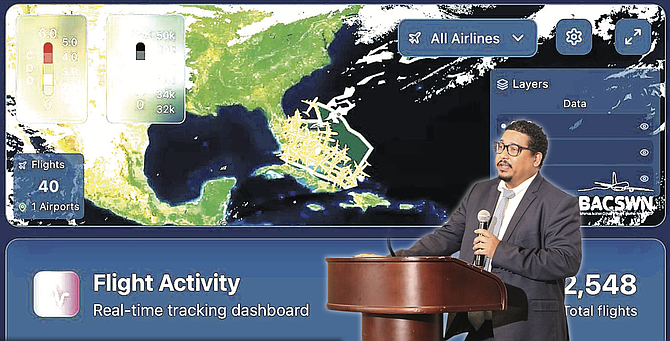
Quincy Rolle, President and CEO of Tribune Digital Labs, presents the BACSWN platform to the panel. As chief project developer, he explained how the system uses real-time weather data delivered to flight decks to help airlines cut fuel consumption and therefore lower carbon emissions.
The Bahamas Aviation, Climate & Severe Weather Network’s ‘First-of-its-Kind’ US Certified real-time aviation carbon credits platform has attracted attention from leading climate researchers and policymakers examining emerging technologies capable of reducing greenhouse gas emissions in the aviation sector.
Delegates at the Intergovernmental Panel on Climate Change (IPCC) meetings hosted in Nassau expressed strong interest in BACSWN’s innovative approach after watching presentations by Michael Strachan, BACSWN’s Chief Operating Officer, and Quincy Rolle, CEO of Tribune Digital Labs and chief project developer, as they demonstrated some of the benefits of BACSWN’s flight path intelligence software.
BACSWN’s carbon credit platform integrates advanced, real-time meteorological data and 3D terrain mapping with live flight tracking analytics to help airline dispatchers and flight crew optimise flights, thereby reducing fuel consumption and generating measurable carbon reduction outcomes.
Among those engaging with the presentation was Kisolel Lina Posanau of Papua New Guinea, a respected climate research officer, meteorologist and expert reviewer for the IPCC, who praised the platform’s potential value for vulnerable island and developing nations seeking climate adaptation and sustainable aviation solutions.
Winston Chow, the prominent Singaporean climate scientist and co-chair of IPCC Working Group II, who has described The Bahamas as “a living case study of the current climate realities,” acknowledged the importance of scalable technologies capable of connecting climate science, operational efficiency and emissions reduction.
The IPCC gathering at the British Colonial Hotel, sponsored in part by BACSWN, represents the largest meeting of its kind staged in the Caribbean, marking a critical milestone in the development of the AR7 report due for publication in 2028.
In delivering the keynote address, Prime Minister Davis noted the government’s partnership with BACSWN and the OPM’s Climate Change Unit in bringing the meeting to Nassau.
The flight path intelligence platform presented at the IPCC on Monday builds on years of development by the company and growing interest from international airlines. The system utilizes BACSWN’s WxSenseNet™ weather network while integrating live flight data and a custom-built algorithm capable of tracking aviation emissions in real-time. Rolle confirmed at the S&P Global Carbon Markets Conference in Barcelona late last year that the full system is now complete, with 16 patents filed and pending.
The platform’s journey from concept to global stage has been swift. BACSWN first unveiled its real-time US Certified Aviation Carbon Credits Platform at the S&P Global Carbon Markets Conference in Barcelona in December 2024, returning the following year to present major advancements.
This initiative, an ancillary benefit of the $427 million Heads of Agreement signed with the Bahamian government in May 2025, encompasses the creation of the Caribbean’s first Next-Generation Aviation Weather Centre. It utilizes multi-function phased-array radars from US defence contractor Raytheon Technologies alongside partnerships with the National Oceanic and Atmospheric Administration (NOAA), the US National Center for Atmospheric Research, Tomorrow.io and The Weather Company. As the exclusive Meteorological Weather Provider on behalf of the contracting state for international civil aviation, BACSWN’s primary goal is to assist the FAA with the safe, efficient and expeditious passage of the flights of any commercial, cargo or private carrier using our airspace.
Representatives from several countries attending the IPCC meetings expressed interest in how BACSWN’s technologies could support national climate initiatives, sustainable transportation frameworks and future carbon market strategies. The international response reinforced growing recognition of The Bahamas as an emerging leader in aviation climate innovation, and of small island developing states as contributors of meaningful technological solutions to the global climate conversation.
“Our aviation-based carbon credits platform offers a powerful tool to reduce the environmental impact of air travel, particularly in the airspace of island nations like The Bahamas, which are highly sensitive to the effects of climate change,” Rolle said of the platform’s mission.
The IPCC meetings continue through May 22.




Comments
Use the comment form below to begin a discussion about this content.
Sign in to comment
OpenID