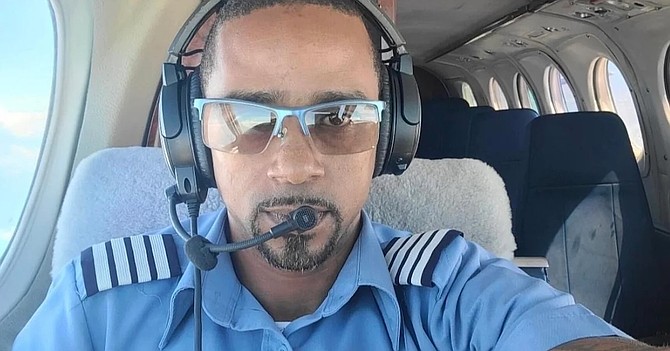
Ian Nixon
By DAVID LEIGH
Tribune Editor-in-Chief.
daleigh@tribunemedia.net
THE pilot at the controls of the Election Day plane which crash-landed at sea carrying drug smuggling kingpin Jonathan Gardiner has categorically denied being an undercover informant for the United States Drugs Enforcement Agency (DEA).
Ian Nixon, who has been the subject of widespread speculation and conspiracy theories because of the extraordinary set of circumstances surrounding the May 12 incident, told The Tribune: “I was never working for the DEA, never in my life – not currently, not ever.”
The 43-year-old father-of-three also dismissed ‘crazy’ accusations that he purposely crash-landed at sea to allow American authorities to arrest Gardiner, alleged to be a key player in an undercover DEA operation running on Bahamian soil for at least the last three years and involving a high-ranking politician known only as ‘Politician-1.’
Mr Nixon, who gained his pilots’ licence aged 18 and has 15,000 flying hours under his belt, added: “I would not do any of that. I was saying to myself, what would I gain from doing it? Like, money? I ain’t got none of that. So what, to get someone locked up? Like, I don't even know the man. I wouldn’t wish that on my enemy.”
His lawyer Bjorn Ferguson, added: “That’s emphatically denied. Absolutely no relationship or communication with any federal authorities.”
Mr Ferguson said he had advised his client to speak in depth to The Tribune to dispel many of the ‘wild conspiracy theories’ circulating online and on social media. Among them are that Mr Nixon was working with the DEA - America’s primary federal agency tasked with combating drug trafficking and narcotics smuggling - and even that he intentionally ditched the plane at sea to allow US authorities to arrest Gardiner.
A high-ranking politician, ‘Politician-1,’ who has not been named, is implicated and is said to have met an undercover DEA source and a drugs mule pilot, to discuss a cocaine shipment allegedly worth $30m, inside the Bahamas Parliament Building. The DEA is said to have used at least three undercover cooperating sources (CSs).
Mr Ferguson described reports that Mr King purposely ditched the plane as ‘totally absurd,’ adding: “Ditching a plane on purpose would have been intentionally putting his own life, and the lives of his ten passengers, at serious risk of injury or even death. No pilot in their right mind who do that.”
That was backed up by Major Elizabeth Piowaty, an Air Force Reserve aircraft commander and pilot with the 920th Rescue Wing, who assisted with the rescue mission, who said the day after the rescue: “I have not known anyone to survive ditching in the ocean. And from what I’ve seen, for all those people to survive is pretty miraculous.”
Mr Ferguson said everyone on board owes their lives to his client’s cool handling of events but he is instead having to deal with conspiracies which are ‘so far wide of the mark it’s unbelievable.’
Theories about the May 12 incident have run wild because of the extraordinary sequence of events which led to the crash, because the plane was up to 80 nautical miles off course when it made its emergency landing, and because convicted international drug smuggler Jonathan ‘Player’ Gardiner was on board.
Also fuelling interest is the revelation that Mr Nixon was himself jailed in the US for cocaine importation, with intent to supply, nearly 20 years ago. Mr Ferguson says the conviction is long in Mr Nixon’s past.
“He may have done stupidness in his previous life, but, you know, he’s paid his debt to society, and he moved on with his life,” he said. “He is a hard-working and happily married father of three who runs also runs his own business. He is not involved with Gardiner in any shape or form. He knows who he is, as do I, but this is a small country, where many people know many people, but the first time he ever met him was on the morning of the flight.”
Adds Mr Nixon: “You got to go back 20 years to find something on me. That should tell you something. If you got to go 20 years to find something on me, I mean, I’ve been clean ever since. I’ve been doing a lot of stuff. I got my business going, and I got my family.”
Mr Ferguson said he also wanted to dispel another theory – that his client was flying illegally without a pilots’ licence.
He admitted his client’s private pilots’ licence was revoked by the US after he was deported, and also revoked in The Bahamas for a number of years. But Mr Nixon had successfully challenged that through the courts, it was reinstated, and he had again been flying legally in The Bahamas for a number of years.
Mr Ferguson said his client was still traumatised by the crash.
Recounting the day in detail for the first time, Mr Nixon said it begun with meeting the man who appeared to be in charge of organising the day’s events – Gardiner – at Jet Nassau sometime after 8am. It was the first time the two men had met.
The chartered plane, a Beechcraft 300 King Air turboprop, was new to Mr Nixon, and a slightly older aircraft than he usually flies. But it was very similar to others he had flown in the past, with the same instruments, but with avionics - the equipment pilots rely on to fly safely, communicate, and navigate - a little older than he was used to.
It was a packed flight, nine passengers, including Gardiner, filling the seats in the back of the plane, and one lady sitting up front alongside Mr Nixon in the co-pilot’s seat. The first leg, to Marsh Harbour, was uneventful. Most of the passengers deplaned, including Gardiner, who then appeared to round up a new set of passengers for the onward flight to Freeport
It left at 9.15am. The 22 or 23 minute journey was uneventful and once the plane landed, Gardiner and all but two or three passengers, deplaned. Whether Gardiner met with anyone in the terminal at Marsh Harbour is not known, but he was seen walking around and rounding up the new passengers for the second leg of the onward journey to Freeport. The flight left about 15 minutes after arriving.
Again, it was a fully-packed flight, nine in the back, one lady in the co-pilot’s seat, and a number in the back decked out in their blue and gold PLP colours - returning to their Grand Bahama constituency to vote. The 96-mile flight, one Mr Nixon had flown many times previously, was scheduled to take between 15-20 minutes.
Mr Nixon takes up the story.
“I’d say about between five and ten minutes out of Marsh Harbour, we are coming out of the clouds at 8,000 feet, when something it like something hit the airplane, and then everything started to go crazy.
“It didn’t feel like normal turbulence. I always call it, like ‘the cloud kick you out,’ but that day it felt very different - it made everyone in the plane jump, scream a little. After that, all the avionics went crazy. The screen of the flight management system (FMS) went black.
As back-up, Mr Nixon was using an iPad with the popular aviation app, ForeFlight, which many pilots use for such things as flight planning, weather briefings, navigation charts and airport diagrams. As extra, extra back-up, he was using Garmin Pilot, Garmin’s equivalent to ForeFlight, on his Samsung phone. It would be hard to accuse Mr Nixon of being ill-prepared.
“But I lost the GPS signal on both of those at the same time,” he explains. “It was like – crazy. I’d never seen anything like that before in an airplane. No one had a signal on their phones. We lost all the signal. A few of us tried to call 911. We tried to call Nassau Tower from the phone. But the radios went out. I tried to call Miami. Tried to call Freeport. We couldn’t get no response on the radio. I wasn’t even hearing static. Maybe, I’d say, after five minutes or so, I started to descend, come through the clouds, and then the engines started to surge.
“First it was the left engine – it started to get overspeeds and the torque on the engine RPM was going like almost two times as fast as it should go. So I was thinking about all of the things I had to do to reduce this, to keep the airplane in the air, so I didn’t want to descend.
“Then maybe, I’d say ten minutes later, the right engine went out. I tried to reset everything... tried to reset things multiple times. I got the left engine restarted once it shut off. Once I got the left engine reset, the FMS came back up briefly and it showed me 40 miles west of Freeport. So I turned towards Freeport...I turned back to the east to go 40 miles, and I was able to get in contact with Freeport, to tell them the fuel gauge was fluctuating. I might have 30 minutes left, it could be 45 minutes, but I left with what should have been enough for about two hours. But it wasn't showing that on the fuel gage. And like a minute after that, this right engine shut off. I knew I had no choice but to put it in the water.
“I started to look for land because of the surging of the engines, and I’ve got the passengers freaking out in the back. So I’m just trying to get the airplane flying at this time. Once I lost both engines, I didn’t circle, I just picked a spot ahead of me. I circled once or twice around because I spotted a boat. I looked for boats hoping they would see us, and I brought the airplane down, controlling it as much as I could.
“I got everyone ready, told them to put on the life vests, and shouted out about the emergency exits, how to open the emergency exits. I was scared, yes, I couldn't believe I was having to put the airplane in the water, but, I tried to make it as much like a regular landing as I could. I was just concentrating on making sure that I put the airplane down correctly, safely, because I know if I could do that, then I could probably save everybody.”
The plane hit the water with a loud thud and ploughed through the waves before coming to a stop. No one was screaming, said Mr Nixon. One of the passengers was injured when he opened the main door and it flew back, off its hinges and smashed into his shoulder. Several others suffered injuries and there were reports of one suffering a heart attack.
Adds Mr Nixon: “As soon as we came to a stop, the first thing I thought was thank God we didn’t die.”
As water gushed though the plane and into the cockpit, passengers scrambled to safety, jumping into the waves and, with the help of others, scrambling up on to the aircraft’s wings.
“We were able to stand on the wings for a few minutes and I went back in one more time, to make sure everyone was safely out of the plane,” said Mr Nixon
Then they jumped into the inflated life rafts and watched in amazement as, within minutes, the aircraft sunk below the surface and disappeared. The crash survivors then drifted in life rafts for five hours in three to five-foot waves before being rescued and flown to a US military base.
With the investigation into the crash ongoing, it is not yet known whether traffic controllers in Freeport or Miami ever received Mr Nixon’s Mayday distress message.
Mr Nixon said he was as shocked as anyone to discover one of his passengers, Gardiner, known as ‘Player,’ had been arrested on narcotics charges after he was forced to ditch into the ocean off the coast of Florida after both engines and his navigation and instrument panels mysteriously failed mid-flight. “I was scared as we came closer and closer to the water but I had no other choice,” he said.
Asked whether he would fly again, Mr Nixon said he was unsure.
“I’m not even thinking about that right now,” he said. “I’m not sure if I’m going back.”
Asked if there was a message for people perpetuating conspiracy theories, he replied: “No, not really. I ain’t got the energy to respond to people right now.”




Comments
TalRussell 4 months, 2 weeks ago
If all is forthright, Bahamian veteran Pilot Ian Nixon is doing an excellent job-clearing the air combating drug trafficking and narcotics smuggling involvement.
Pilot Ian Nixon is clear that air traffic controllers at Freeport Bahamas airport, never responded to his communication as the aircraft was in serious danger.
If Freeport Controllers hadn't received his distress call the result would be the same as when Dr. Myles' private jet crashed, killing all onboard because of long years of equipment neglect.
The US now needs to step forward to **more remove any dark clouds may still be surrounding Pilot Nixon and any of the doomed plane's innocent passengers.
"Ya'll know any you be as ticked off as is Pilot Ian Nixon?
birdiestrachan 4 months, 2 weeks ago
I believe Mr Nixon
pileit 4 months, 1 week ago
your "belief" is not surprising.... its called cognitive dissonance. I gat a couple bridges for you at a discount.
Flyingfish 4 months, 1 week ago
People seem more interested in hunting these DEA agents, than politician 1 & his cronies.
Sign in to comment
OpenID