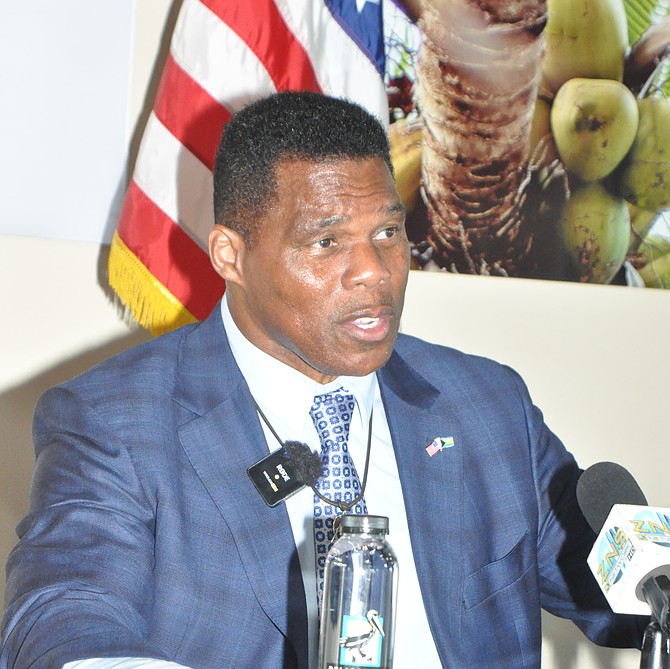
US Ambassador to The Bahamas Herschel Walker speaks at a press conference in Grand Bahama on June 11, 2026. Photo: Vandyke Hepburn
By LYNAIRE MUNNINGS
Tribune Staff Reporter
lmunnings@tribunemedia.net
US AMBASSADOR Herschel Walker has defended his decision to speak out against the government’s proposed changes to Freeport’s governance, insisting that the city’s future is not solely a domestic matter for The Bahamas when American companies have invested more than $1 billion in its development.
“There’s more than one billion reasons that the future of Freeport is not only a ‘domestic’ matter for The Bahamas,” Mr Walker said in an apparent rebuke of Foreign Affairs Minister Fred Mitchell, who recently warned outsiders to stay out of the debate.
Mr Walker said the investments represented thousands of jobs for Bahamians and Americans, adding that protecting those investments was part of his responsibility as ambassador.
“My job as U.S. Ambassador is to look out for those investments, to look out for those families in The Bahamas and in the United States whose livelihoods depend on the success of these investments,” he said.
His comments came after Mr Mitchell, in a voice note last week, criticised outsiders for intervening in the dispute over the Grand Bahama Port Authority (GBPA), describing it as a matter that was “none of their business”.
Mr Mitchell insisted there were no foreign affairs implications and dismissed concerns about expropriation.
Mr Walker rejected suggestions that his intervention was inappropriate.
“When I speak out about the shared importance of transparency, regulatory certainty, and a stable investment climate it is not an ‘error’ (nor a fumble),” he said.
“The United States is your biggest investor, your best customer, your most reliable partner, and your closest neighbor.”
Mr Walker highlighted US investment in Grand Bahama and the American government's financial interest in the island's development.
"American investment is helping drive Grand Bahama's economic revitalization. More than $1 billion in U.S.-linked development projects are under way or completed, and other U.S. companies are actively working to invest in new projects in Grand Bahama," he said.
"The U.S. government also has a direct financial stake in Grand Bahama's development. The U.S. Export-Import Bank approved a loan guarantee exceeding $71 million to support the reopening of the South Riding Point energy terminal. EXIM is eager for more projects in The Bahamas."
The ambassador previously warned that Prime Minister Philip Davis's proposed changes to Freeport's governance risked sending investors the message that the rules could change after they had committed their money.
Mr Davis announced last week that the existing governance arrangement would end, arguing that the 1955 Hawksbill Creek Agreement had outlived its usefulness.
The GBPA has defended its record, with co-chairman Sarah St George highlighting its contributions to education, infrastructure and community development.
Ms St George said the authority had provided more than $10m in scholarships and over $50m in donations, alongside constructing St George’s High School, Jack Hayward High School, Eight Mile Rock High School and several school gymnasiums.
She also cited support for arts, music, sports and community organisations, as well as facilities gifted to the government, including the courthouse, police headquarters, Rand Memorial Hospital, Children's Village and sports centre.
Ms St George defended the GBPA's role in maintaining Freeport's infrastructure, including roads, electricity and water systems, garbage collection, wastewater, drainage and building standards.
She stressed that Freeport remained part of The Bahamas and that Bahamian sovereignty was respected under the existing arrangement.
While acknowledging that Freeport had not reached its full potential, she expressed optimism about increased visitor arrivals and economic activity, urging cooperation rather than confrontation.
“We can all work together. The menu doesn’t have to be either or, surf or turf. Why not both as envisioned in the agreement, knowing that the decision we made today will determine the opportunities of tomorrow,” she said.
Ms St George also called for “inventive interaction, not active intervention”, warning against abandoning the existing framework without considering what could be lost.
The competing positions come as the government opened a six-month public consultation yesterday on its proposed reforms.
The Green Paper, Grand Bahama: A Framework for Stability and Growth, proposes establishing a Grand Bahama Development Council, reviewing the Hawksbill Creek Agreement and introducing legislation to improve islandwide governance and regulatory accountability.
The government has assured investors that legitimate property, contractual and investment rights will be respected, with no retrospective interference.
The consultation runs until April 30, 2027, with a White Paper expected on July 1, 2027.
The Hawksbill Creek Agreement, signed in 1955, is scheduled to remain in force until 2054.




Comments
Entrepreneur 1 hour, 8 minutes ago
Wise words Ambassador, wise words....
quavaduff 10 minutes ago
stop feeding this obviously clueless fella
quavaduff 7 minutes ago
walker's cte brain does not function appropriately ... he has taken far too many blows during his years palying football .... trump just dumped him on the Bahamas
Sign in to comment
OpenID