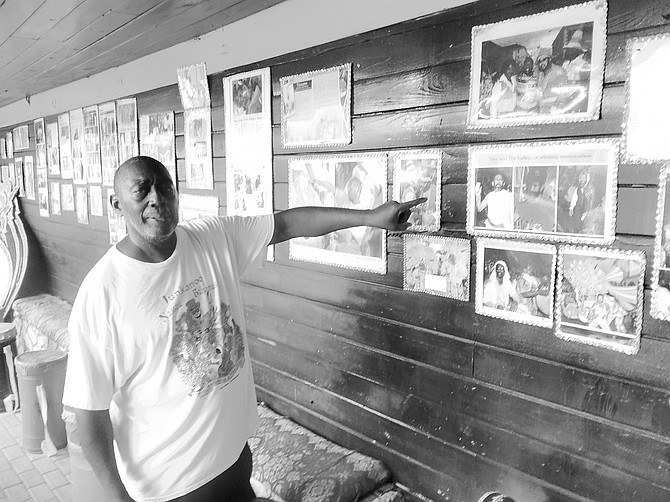
JUNKANOO veteran Quinton 'Barabbas' Woodside, 65, founder of Junkanoo World Museum & Arts Centre.
JUNKANOO veteran Quinton “Barabbas” Woodside says his museum could create up to 50 jobs and expand its cultural programmes for young people if the government and tourism industry provided greater support.
The 65-year-old founder of Junkanoo World Museum & Arts Centre said the facility has struggled to attract sufficient visitors despite Nassau’s booming cruise tourism industry, leaving him and his family to shoulder much of the cost of preserving traditional Junkanoo craftsmanship and providing free instruction to children.
“We could hire at least 40 to 50 persons if it runs properly,” Mr Woodside said, pointing to potential employment for chefs, waitresses, bartenders, bus drivers and other workers.
He called for stronger collaboration with tour operators, taxi drivers and tourism officials, arguing that the museum could become a greater economic and cultural asset while providing opportunities for young Bahamians.
Although the museum welcomes visitors and offers cultural demonstrations, Mr Woodside said too few tourists are being directed to the facility, despite the large numbers of cruise passengers visiting Nassau.
He said existing arrangements with tour operators have not generated sufficient visitor traffic to support an expansion of the museum's operations.
“We have Majestic Tours when they come on Wednesday. That's not enough. Then we have the jeep tour comes when they get a couple people. That's not enough,” he said.
The museum has also attempted to attract more visitors through Friday night cultural performances featuring children involved in its programmes. However, Mr Woodside acknowledged that the initiative struggled to attract paying audiences after an initially successful free event.
Mr Woodside questioned why cultural practitioners who spend their own money supporting young people receive what he considers insufficient government assistance, arguing that greater investment in community programmes would help preserve Junkanoo while providing opportunities for children.
“You should find an avenue to work with that person, because it's not only you giving them money; they're bringing money into the country,” he said.
Mr Woodside said he had raised the issue during discussions with Minister of Culture, Arts and Heritage Leslia Miller-Brice, whom he credited with holding meetings to better understand the needs of cultural practitioners.
“I think she's gonna do well. To me, I think she's gonna do well,” he said. “However, you have other people in office who don't know how to do anything, or like that's too much money to do this, or too much money to do that, or he shouldn't have that money, or she shouldn't have that amount, and they don't know what it requires.”
Keeping the museum operating has come at a considerable personal cost, with much of the financial burden falling on Mr Woodside and his family.
He explained that he relies heavily on income from his upstairs shop, which sells costume materials, along with whatever assistance he can secure.
“I don't have a large staff. My family support me, and a lot of them I can't even pay them what they deserve,” he said.
He credited his family and neighbours with helping to sustain the museum, explaining that some continue to lend a hand even when he cannot afford to compensate them.
The financial pressure is compounded by his efforts to help struggling families in surrounding communities, including some whose children attend the museum.
Mr Woodside said he regularly provides groceries, food and financial assistance to people in need, sometimes helping families obtain medication.
“Some of our children come in here; their parents need help, and we do that,” he said.
Despite those difficulties, he insisted he would continue finding ways to sustain the museum rather than abandon the children and families who have come to depend on it.
Mr Woodside traced the museum's roots to a Junkanoo shack with a history spanning approximately 50 years, explaining that the property eventually developed into an educational camp where children could learn the traditions passed down to him.
He said the facility has continued to develop over the past three decades, providing children with opportunities to learn costume pasting, drum making and cowbell crafting.
Over the years, it has also become a gathering place for young people from surrounding communities, where they receive guidance, learn practical skills and develop relationships that sometimes span generations. “Some of their parents grew up here. Some of their grandmothers went to school with me,” Mr Woodside said. “It's a joy to work with them to show them the right thing.”
The museum's outreach has also included children with disabilities, with Mr Woodside describing activities involving autistic and deaf children, including some who have participated in Junkanoo rush-outs alongside him.
He said the institution has worked with charitable organisations, including the Rotary Club, while its community initiatives have also extended to assisting people with mobility challenges.
During a tour of the property, Mr Woodside showed The Tribune an area where his stepson teaches welding, before demonstrating where children learn the traditional craft of goatskin drum making, from soaking and cleaning the skins to preparing them for use in the instruments.
Mr Woodside said the Ministry of Culture also sends children to the facility during the summer to learn those skills, providing him with a stipend for the programme. However, children who visit the museum independently are not charged for instruction.
Beyond Junkanoo, he said children receive guidance on discipline, schoolwork, personal responsibility and how to conduct themselves when interacting with others.
Mr Woodside recalled watching some of the young people who passed through the facility grow into teachers, preachers, politicians and other professionals.
“When you think about teachers and preachers and welders and politicians grow up right here in this yard, we do need help to continue that,” he said.
For Mr Woodside, the museum's work is also about preserving the knowledge of the cultural icons who helped shape Junkanoo.
Walking through the facility, he pointed to photographs of Gus Cooper, Paul Knowles and Sammy Thompson, recalling the contributions of the veteran practitioners who taught him the traditions he now passes on to younger generations.
“All of the leaders who taught me has passed on,” Mr Woodside said.
He described those practitioners as his teachers and said their passing had strengthened his determination to ensure their knowledge was not lost.
“They are my teachers. I learn from them. Now that's why I want to continue to teach these young ones and show them the other part of it,” he said.
Mr Woodside said the museum's potential remains largely untapped and hopes greater investment and stronger relationships with the tourism industry will eventually allow him to expand its operations.
He has spent years finding ways to keep the institution going, relying on his own resourcefulness, relatives and supporters at home and abroad.
Even as he acknowledged the financial difficulties, he remained determined to continue teaching young people the traditions passed down to him.
“We have to be proud of what we do. We got to keep fighting until the message get to the right set of people,” he said.




Comments
Use the comment form below to begin a discussion about this content.
Sign in to comment
OpenID