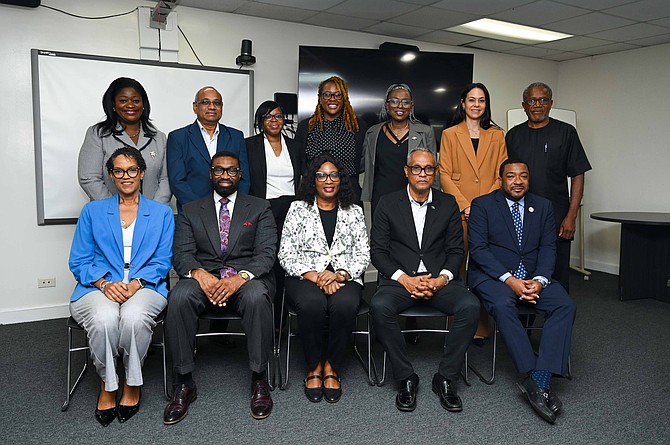
The Sandilands Rehabilitation Centre, in partnership with the Inter-American Drug Abuse Control Commission (CICAD), hosted the opening ceremony of a training programme titled “Treating Adolescents with Substance Use Disorders” on Monday, November 2, 2026, at the Public Hospitals Authority’s Corporate Office. The ceremony featured remarks from Dr. Annalese Richards, Director of Child and Adolescent Services at Sandilands Rehabilitation Centre; Jessica Cartwright, Hospital Administrator at Sandilands Rehabilitation Centre; Charles Sealy II, Managing Director of the Public Hospitals Authority; and Phyllis Baron, OAS Representative in The Bahamas.
By KEILE CAMPBELL
Tribune Staff Reporter
kcampbell@tribunemedia.net
SUBSTANCE use disorders among Bahamian children have reached concerning levels, with patients showing symptoms at increasingly younger ages.
The troubling revelations were disclosed yesterday during the opening of a five-day specialised training programme meant to strengthen treatment and support for young people affected by substance abuse.
Dr Annalese Richards, Director of Child and Adolescent Services at Sandilands Rehabilitation Centre, said more than half of the patients treated by her department met the criteria for a substance use disorder.
Cannabis and alcohol were among the substances identified.
"Relevant to today's initiative, at any given point, more than 50 per cent of the patients that we treat will actually meet a criteria for substance use disorder," Dr Richards said, further explaining that even among children who may not meet the specific medical criteria for substance use disorder, the majority of the children and adolescents her department works with "will have had some exposure or experimentation to substances".
She added that children were being exposed to drugs and alcohol at increasingly younger ages. However, she stressed that understanding what was driving the trend was more important than the figures themselves.
"The devil is in the details, and while we as a team and clinicians appreciate the numbers, for us even more crucial is understanding the why, because it is the why that can get us to the how, that can get us to what we need to do to provide the necessary support," she said.
Dr Richards said the department treated children and adolescents with a range of psychiatric conditions, including depression, anxiety, suicidal thoughts and attempts, psychosis, behavioural disorders and cannabis use disorders.
She said patients generally ranged from 10 to 17 years old, although the department had admitted some younger children, with her department receiving patients referred through the courts, Department of Social Services, schools, medical emergency rooms and clinics.
Dr Richards stressed that understanding the circumstances driving substance use among young people was critical to developing effective interventions.
To strengthen the response, Sandilands has launched a five-day training programme, Treating Adolescents with Substance Use Disorders, in partnership with the Inter-American Drug Abuse Control Commission (CICAD) of the Organisation of American States (OAS).
The programme, held at the Public Hospitals Authority's corporate training centre, is designed to equip healthcare professionals with specialised assessment and treatment approaches for adolescents struggling with substance use disorders and related mental health challenges.
PHA Managing Director Charles Sealy II said the training would strengthen healthcare professionals' capacity to provide evidence-based care to young people.
"By embedding the trainer model into this partnership, we ensure that the knowledge shared here will not remain confined to this week, or just inside this room," Mr Sealy said. "It will cascade throughout our entire healthcare network, establishing a sustainable foundation for continuous professional growth and clinical excellence."
In his remarks, Health and Wellness Minister Dr Michael Darville highlighted findings from the 2025 Global School Health Report that raised concerns about increasing substance use and other risk-taking behaviours among Bahamian students.
The report, based on survey data collected in 2023, found that 21.8 per cent of teenagers surveyed had used illicit drugs at some point, with 54.8 per cent of those reporting their first use at age 13 or younger. It also found that 10.5 per cent of students reported current cannabis use, while 33.6 per cent reported current alcohol consumption.
Dr Darville said the findings had prompted meetings with schools and education officials to develop interventions addressing the concerning behaviors identified among young people.
Comparing the findings with those from 1998, he said the changes were significant, particularly in relation to risky behavior, sexual activity and substance use.
“If I had the report, I would demonstrate clearly that what we saw in 1998 to compare with 2025 is like night and day. More risky behaviors, more risky sexual behaviors, the interaction with substance abuse, particularly alcohol, ” Dr Darville said.
He added that he was particularly concerned over what he said was a growing trend of girls engaging in risky behaviors and substance use at higher rates than boys.
“One of the things in that report that really troubled me is that we are seeing girls who are involved in more risky behaviors and substance abuse than boys.”
Dr Darville said the government is implementing programs at the school level to curb such risk-taking behaviors and that the initiative would allow the government "to change the trajectory that we are currently on and bring our young people back into healthy behavioral and social patterns".
“It is a clear insight of what we are seeing in our children: our behavioural aspects, cyberbullying, alcohol abuse, cocaine abuse, and the list goes on and on that is happening with our kids," the health minister said.
He also disclosed that Ministry of Health representatives were scheduled to present findings concerning substance misuse, including prescription substances, at a meeting in Washington, DC, on November 17.
OAS representative in The Bahamas Phyllis Baron said the training programme was initially developed in 2014 at the request of 13 English-speaking Caribbean member states seeking treatment approaches tailored to adolescents.
She said the curriculum had since been shared with professionals throughout Latin America and the Caribbean and that the training in New Providence provided an opportunity to adapt its approaches to the Bahamian context.
Ms Baron said the initiative was intended to strengthen collaboration among healthcare professionals and improve the support available to young people and families.




Comments
Use the comment form below to begin a discussion about this content.
Sign in to comment
OpenID