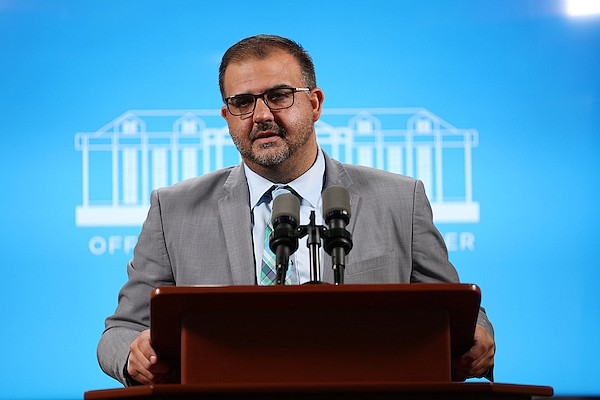
Minister of Works and Family Island Affairs Clay Sweeting speaks during a press briefing at the Office of The Prime Minister on October 22, 2024. Photo: Dante Carrer/Tribune Staff
By FAY SIMMONS
TRIBUNE Business Reporter
jsimmons@tribunemedia.net
A CABINET minister last night proposed that local government councils, which demonstrate they can properly manage public funds and deliver on development priorities, should be given greater autonomy.
Clay Sweeting, minister of works and Family Island affairs, unveiled the initiative as he outlined plans to overhaul the administration of The Bahamas’ 33 local government districts.
Addressing the Local Government Conclave, he said the existing system has too often reduced councils to administering rather than leading, while island administrators have been treated as messengers between residents and Nassau instead of being empowered to drive change in their communities.
He called for a fundamental shift in how government operates across the Family Islands, including expanding the responsibilities of island administrators, introducing individual development plans for all 33 districts and tying budgets more closely to local priorities.
"The Councils that show they can deliver should be given more room to lead," Mr Sweeting said, arguing that greater responsibility must be accompanied by stronger financial management, accurate records and timely reporting.
He added that local councils should become "the true voice and the true board of their districts", holding regular town meetings, setting development priorities and reporting to residents annually on what has been accomplished.
"That kind of leadership demands discipline: Accurate books, timely reports and careful stewardship of public money, because every dollar belongs to the Bahamian people," the minister said.
Mr Sweeting also outlined an expanded role for island administrators, saying they should become the principal c-ordinators of government services in their districts rather than simply processing correspondence and referring problems to Nassau.
"The role of the administrator must change from the keeper of the file to the leader of the district," he said.
Under the proposed approach, administrators would serve as the face of the entire government in their districts, co-ordinating the work of the ministries and agencies responsible for infrastructure, healthcare, education and social services.
"When a road fails, a clinic is short, a school roof leaks or a dock is damaged, the administrator should know before the resident has to call, and should be the one pulling the right people together to fix it," said Mr Sweeting.
He proposed regular meetings involving the heads of government agencies in each district to co-ordinate responses to local problems, adding that administrators must be equipped with the authority, tools, training and support to carry out the expanded responsibilities.
"We will measure your success not by how many letters you send, but by what changes in your district," the minister said.
Mr Sweeting said the reforms will also require a departure from the one-size-fits-all approach to local government, with each of the 33 districts developing its own District Development Plan based on the needs and priorities of its residents. He argued that the development pressures facing each island are different and thus need a specialised plan.
"I want every one of our 33 districts to have its own District Development Plan. Not a plan written in Nassau and mailed out. A plan built in the district, with the people of the district," he said.
The plans would be developed through consultation with residents, churches, businesses, fishermen, farmers and Junior Councils, and should identify the most pressing community needs, the actions to be taken over the following 12 months and how residents would assess whether those commitments had been fulfilled.
Mr Sweeting said district budgets should then be built around those priorities rather than simply carrying forward previous years' allocations.
"And what is spent, and what it delivered, should be published, so that every resident can see it," he added.
The minister said each district participating in the conclave should leave with three immediate priorities identified, one existing practice it intends to discontinue and one new initiative it plans to introduce.
Those commitments are expected to develop into the first drafts of District Development Plans over the following 100 days, with Mr Sweeting noting the next gathering should focus on reporting actual results rather than simply delivering presentations.
He also called for changes within the Department of Local Government, stressing it should move away from acting as a gatekeeper and instead become a service centre supporting the districts.
Mr Sweeting proposed establishing a clear point of contact within the Department for every district, with questions from the Family Islands answered within set and published timeframes.
Routine services, including licences, applications and payments, should also be moved online to reduce the need for residents to travel to New Providence to access government services.
"It means moving routine services, such as licences, applications and payments, online so that a resident in Ragged Island is served as well as a resident in New Providence," the minister said.
Mr Sweeting said the Local Government Act 2024 has established a modern framework with stronger provisions for accountability, public participation and financial management, but acknowledged that legislation alone will not resolve the long-standing challenges facing communities.
He questioned the effectiveness of a system in which residents could approach their local government office with a problem but still find themselves dependent on Nassau for a solution.
"Too often a resident must get on a plane or a mailboat for a service that should be available at home," Mr Sweeting said.
He also acknowledged that reports were sometimes late, funds remained unspent and development plans existed only on paper, arguing that the existing arrangements could no longer adequately serve the country's geographically dispersed communities.
"The Department must move from gatekeeper to service centre. Its job is not to hold the districts back until Nassau is ready. Its job is to clear the way," Mr Sweeting said.
"When an island comes to Nassau with an idea, the first answer should not be 'no' or 'wait.' The first answer should be 'how can we help you do it?'"
Mr Sweeting said the objective was not to impose identical development approaches across the country but to give individual districts the leadership and resources needed to respond to their own circumstances.
"The old way has carried us this far. It will not carry us further. Let us leave this conclave and build the new one together," he said.




Comments
Use the comment form below to begin a discussion about this content.
Sign in to comment
OpenID