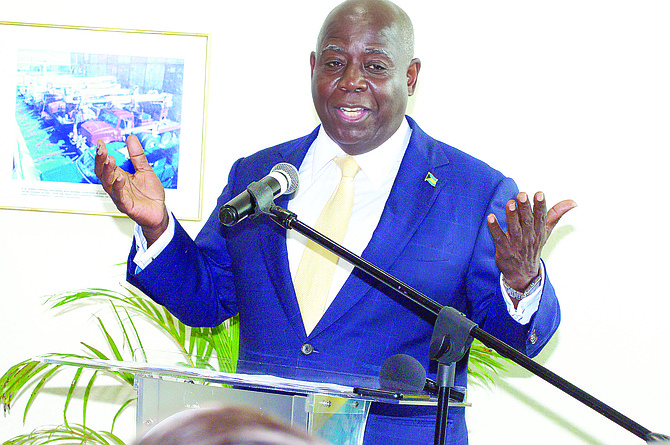
Prime Minister Philip 'Brave' Davis speaks during a ceremony for the signing for the govt to acquire all remaining shares in Grand Bahama Power Company. Photo: Vandyke Hepburn
PRIME Minister Philip “Brave” Davis believes CARICOM is in a stronger position to advance its push for reparatory justice following King Charles III’s recent visit and the acknowledgement of the brutality of the transatlantic slave trade.
Speaking ahead of the Commonwealth Heads of Government Meeting (CHOGM), Mr Davis said the King's remarks represented an acknowledgement of the direction in which discussions on reparations are heading.
“I think CARICOM is in a stronger position in responding to the way forward for reparatory justice,” he said.
“The King's visit, and his acknowledgement of the brutality of the slave trade in that era, is an acknowledgement of where we're headed. The outcome has to be multigenerational. Just can't be for this generation, for generations yet unborn,” he said.
He gave his comments a few days after the King visited The Bahamas and Mr Davis interview with Sky News.
The prime minister said during the interview with the British TV news channel that he is personally “quite agnostic” about whether The Bahamas should remove King Charles III as head of state. He added he was open to the country becoming a republic if that is the will of the Bahamian people.
The Prime Minister also reiterated that reparatory justice should not be viewed solely in financial terms, but should address the lasting social, educational and psychological consequences of slavery and colonialism.
“I think reparatory for me is repair. What are we going to repair? We in our small island developing states, where we had this scourge of slavery and colonialism, [it] has impacted our ability to educate our people,” he said.
“It has put [a] mindset amongst our people that is not progressive to their own being, and the removal of these barriers, which are basically emancipation of our minds, is a means to repair some of the scourges that we have endured over the years.”
Asked what he would consider a positive outcome for The Bahamas from CHOGM, Mr Davis pointed to greater unity within the Commonwealth, practical initiatives to improve citizens' lives and progress towards reparatory justice.




Comments
Use the comment form below to begin a discussion about this content.
Sign in to comment
OpenID