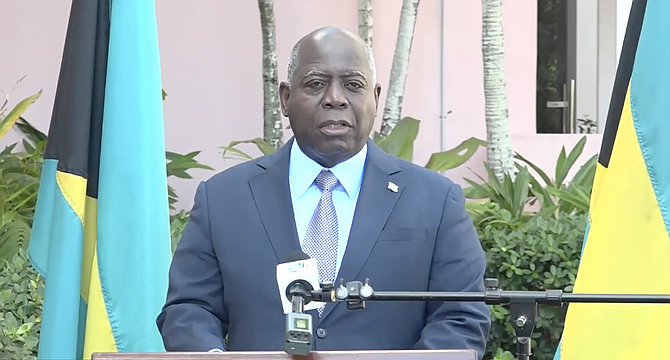
Prime Minister Philip Davis
By DENISE MAYCOCK
Tribune Staff Reporter
dmaycock@tribunemedia.net
PRIME Minister Philip “Brave” Davis has urged Commonwealth leaders to unite in protecting their digital sovereignty, sharing technology resources and ensuring young people benefit from the emerging artificial intelligence economy.
Speaking at the 14th Commonwealth Business Forum 2026 in Antigua and Barbuda yesterday, Mr Davis declared: “We must protect our digital sovereignty.”
“By that I mean a simple right: our people’s right to decide how their data is used, who profits from it, and which laws protect it. We fought for the right to govern ourselves. Digital sovereignty is the unfinished business of independence.”
His remarks on sovereignty follow similar comments he made during his address to the 81st United Nations General Assembly in New York in September.
He warned that smaller countries risk repeating a familiar pattern in which their resources generate wealth for others while their own people receive too little in return. “Yesterday, it was raw materials. Today, it is data,” he said.
Mr Davis urged Commonwealth leaders to protect their people's digital future, calling for the same courage that helped bring an end to apartheid in South Africa.
He argued that courage remains one of the scarcest resources in public life and that every generation of leaders must find the determination to confront the defining challenges of its time.
For the present generation, he said, that challenge is ensuring young people have control over their economic and digital futures.
Mr Davis noted that six in every 10 people across Commonwealth member countries are under 30, representing more than 1.5 billion young people.
However, he said one in four young people across the Commonwealth is not working, studying or participating in training.
He questioned whether governments were doing enough to create opportunities for qualified graduates who complete their education but struggle to secure employment.
At the same time, he said artificial intelligence was transforming the global economy, creating new industries and employment opportunities while threatening to displace existing jobs.
Commonwealth countries, he argued, must ensure their young people are not simply consumers of technology but active participants and beneficiaries of the digital economy.
Mr Davis explained that every time a young person in Nassau, Kingston or Lagos searches online, watches a video or shares a photograph, data is generated.
That data has become a valuable resource used by companies to develop artificial intelligence systems and generate substantial profits, with much of the economic benefit flowing to companies outside the Caribbean and other developing regions.
He said Caribbean countries had supplied raw materials for centuries, while much of the wealth generated through processing and manufacturing accumulated elsewhere.
PM Davis warned that the same pattern could emerge in the digital economy if countries failed to protect their interests. He also raised concerns about cultural ownership, arguing that control of digital platforms increasingly determines how history, music, languages and national identities are preserved and presented.
Caribbean young people, he said, have inherited a proud but painful history shaped by slavery and indentured labour and must have the opportunity to tell their own stories.
“Our young people are the storytellers of an unjust past. They must be the authors of a just future,” he said.
To address these challenges, Mr Davis outlined three priorities for Commonwealth countries: strengthening their collective negotiating power, protecting citizens' data and investing in the skills and infrastructure needed to compete in the digital economy.
He also presented The Bahamas' proposal for a Commonwealth-wide framework called the “Brave Architecture”.
The proposed framework has four pillars: skills that travel, data that answers to national laws, shared infrastructure and stories that communities own.
Under the first pillar, qualifications earned in one Commonwealth country should be recognised across other member states, allowing young people to pursue employment and business opportunities without repeatedly having to establish their credentials.
Mr Davis said a young woman earning a qualification in Freeport should be able to have it recognised in London, Toronto and India.
The second pillar would establish common principles governing how citizens' data is collected, protected, used and taxed.
He said no small country should be forced to negotiate alone with major international technology companies over the use of its citizens' information.
The third pillar focuses on shared digital infrastructure, including data centres and cybersecurity systems.
Mr Davis argued that many small countries cannot independently afford the infrastructure and technical capabilities needed to protect their digital economies but could achieve more by pooling resources. The fourth pillar, “stories we own”, would involve establishing a Commonwealth fund to digitise and protect music, historical archives and languages.
He said communities should have a say in how their cultural material is used to train artificial intelligence systems and should share in the benefits generated from it.
Mr Davis said the Commonwealth's combined population of 2.7 billion, shared language and legal traditions gave its members considerable potential to negotiate more effectively with global technology companies. “Alone, a small state negotiates from weakness. Together, fifty-six nations set the terms,” he said.
Prime Minister Davis called on Commonwealth Heads of Government to commission a detailed plan for the proposed framework ahead of their next meeting, adding that The Bahamas was prepared to assist in developing the initiative.




Comments
Use the comment form below to begin a discussion about this content.
Sign in to comment
OpenID