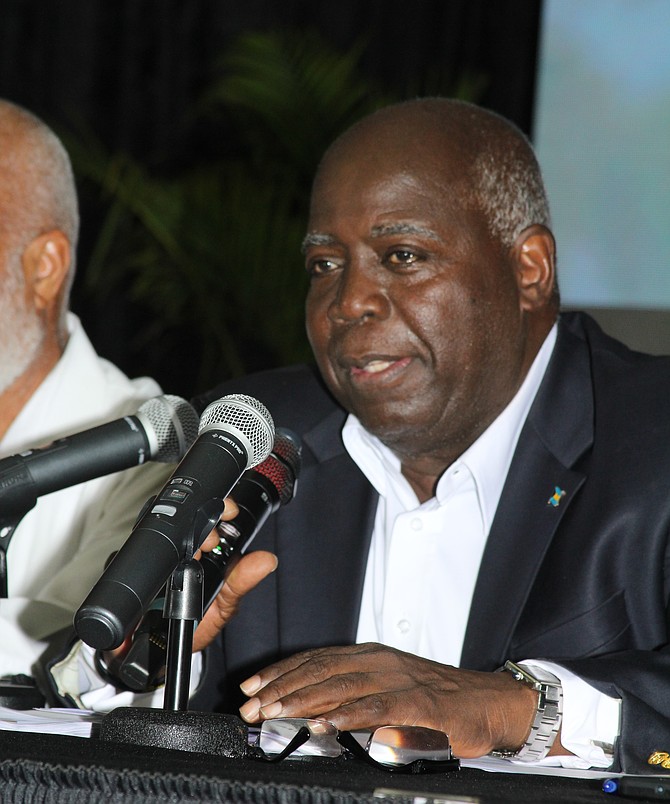
PRIME Minister Philip ‘Brave’ Davis speaks concerning the arbitration over GBPA during a forum in GB on March 9, 2026. Photo: Vandyke Hepburn
By FAY SIMMONS
TRIBUNE Business Reporter
jsimmons@tribunemedia.net
THE PRIME Minister yesterday warned Commonwealth countries against competing with each another to attract technology investment through tax breaks and access to citizens’ data.
Philip Davis KC, addressing the 14th Commonwealth Business Forum in Antigua and Barbuda, argued that small states must negotiate collectively to avoid being placed at a disadvantage against major technology companies.
He said countries are weakening their own bargaining positions by offering investment incentives individually, instead of working together to establish common terms for technology investment.
“Too many small countries try to attract technology investment by offering tax breaks and handing over access to their people’s data. We end up bidding against our own neighbours,” Mr Davis said. “A small state that negotiates alone negotiates from weakness.”
The Prime Minister argued that the concentration of economic power among a handful of technology companies was becoming an increasingly important challenge for Commonwealth economies, particularly as artificial intelligence (AI) drives demand for data and creates new opportunities for commercial exploitation.
He called for Commonwealth countries to establish common rules governing how citizens’ data is collected, protected and taxed, arguing that small states should not have to negotiate independently with the world’s largest technology companies.
The Bahamas is proposing what Mr Davis described as a “Brave Architecture” for the Commonwealth’s digital economy, built around four pillars: Skills that travel, data that answers to national laws, shared infrastructure and stories that communities own.
He said the initiative would allow member states to strengthen their negotiating positions while developing the capacity to participate more fully in the digital economy.
“Data that answers to our laws means common Commonwealth rules on how our citizens’ data is collected, protected and taxed. No small country should have to negotiate with the world’s biggest companies alone,” said Mr Davis.
The proposed framework would also involve pooling resources to develop infrastructure, including data centres and cyber defences, which he said many smaller countries could not afford independently.
“Shared infrastructure means pooling our resources. Few small countries can afford their own data centres or cyber defences. Together, we can,” he said.
Mr Davis argued that the economic value generated from data was increasingly flowing to companies located outside the countries where that data originated, drawing comparisons with the Caribbean’s historical experience of supplying raw materials that were processed and monetised elsewhere.
“Yesterday, it was raw materials. Today, it is data,” he said. Mr Davis said Commonwealth countries need to ensure their citizens were not merely consumers of digital services, but also participants in the economic value created through those services.
The Prime Minister also proposed a system of cross-border qualification recognition to allow young people to obtain skills and credentials that would be accepted throughout the Commonwealth’s 56 member countries.
He warned that AI will create new employment opportunities while eliminating existing jobs, making workforce development and access to training increasingly important.
Around one in four young people across the Commonwealth is not working, studying or training, Mr Davis said, while six in ten of its member countries’ population are under the age of 30.
He called on business leaders attending the forum to commit to apprenticeships, training programmes and investments in young entrepreneurs from small island nations.
Mr Davis asked Commonwealth Heads of Government to commission a plan for the proposed digital framework by their next meeting, adding that The Bahamas was prepared to assist in its development.
“The big technology companies have size and money. We have something, too. We have 2.7 billion people,” he said. “Alone, a small state negotiates from weakness. Together, fifty-six nations set the terms.”




Comments
Use the comment form below to begin a discussion about this content.
Sign in to comment
OpenID