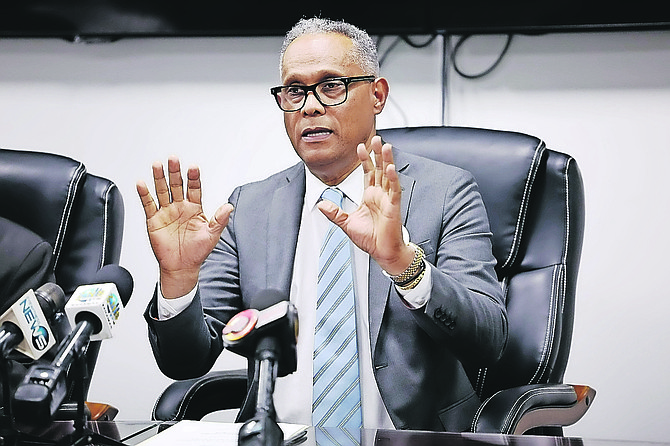
Health Minister Dr Michael Darville
By KEILE CAMBPELL
Tribune Staff Reporter
kcampbell@tribunemedia.net
HEALTHCARE professionals from across the region gathered yesterday to discuss ways to strengthen cancer care and improve the maintenance of diagnostic medical equipment during a three-day regional workshop.
The workshop, titled “Strengthening Operations and Maintenance of Diagnostic Radiation Medicine Equipment in the Caribbean”, began yesterday at Baha Mar.
It bought together medical specialists and international partners to explore ways to improve access to diagnostic technology, strengthen technical expertise, and develop sustainable financing arrangements for medical equipment.
The workshop forms part of the Accelerating Scientific Collaboration and Excellence in Nuclear Technology (ASCENT) initiative, a partnership formed between the United States and the United Kingdom to expand peaceful, safe and secure use of nuclear science and technology.
US Embassy Deputy Chief of Mission Kimberly Furnish, said it was the first workshop under ASCENT, adding that the region deserved a dedicated forum on cancer care and nuclear medicine.
Describing participants as neighbours who "share a region, an ocean, and a future", she acknowledged that cancer affects all families, revealing that her own mother rang the bell last week to mark her recovery from lymphoma.
"Behind every piece of equipment, we'll discuss this week is a patient waiting for an answer,” she said.
She said that while buying equipment is the first step, maintainance was ”the real challenge".
The three-day workshop will include discussions with regional experts and representatives from the International Atomic Energy Agency (IAEA) and Pan American Health organization
(PAHO) on international guidelines and quality standards, along with visits to the Cancer Centre Bahamas and Princess Margaret Hospital.
Participants would also develop financing proposals aimed at attracting support from international finance institutions and private partners to improve diagnostic services across the region.
Mrs Furnish also revealed yesterday that the US provided financial support for the IAEA to procure two mammography machines to be donated to The Bahamas.
She added that US companies hold the highest standards with regards to diagnostic imaging and radiation machine technology, with several to be present during the workshop.
She said the companies were present not to make sales, but to build long term relationships to keep equipment working more consistently.
In his remarks, Acting Prime Minister Chester Cooper called for greater regional cooperation to address disparities in healthcare access, particularly for island nations such as The Bahamas.
He described cancer as a “deeply personal challenge” for many Bahamian families, noting that most people know a relative, neighbour or friend who has suffered from the disease.
“A diagnosis can change the course of a household in a single day," Mr Cooper said.
“The response, therefore, must be organised around the person with clear information, timely investigation, comfort treatment, support throughout the journey.”
He said discussions held during the workshop should contribute to making decisions that are "realistic for small states", planning around equipment after it arrives, how to develop and retain expertise, and making arrangements to keep services available as needs change.
For his part, Health and Wellness Minister Dr Michael Darville said the workshop would examine “how we can cooperate as a region to do a better job in the fight against cancer", with particular emphasis on early detection and the safe use and disposal of materials associated with medical equipment.
“In our midst, we have technical experts from Europe and the United States, along with regional partners, CMOs, and other important medical personnel from the region, where we would discuss how we can cooperate as a region to do a better job in the fight against cancer," Dr Darville said.
Medical oncologist Dr Tracy Roberts-Halkitis highlighted breast, prostate and colorectal cancers as major concerns in The Bahamas, stressing the importance of expanding screening and educating the public about early detection.
She noted that although hereditary genetic mutations contributed to breast cancer rates in the country, most cases were not linked to inherited risk.
“That's the hereditary component, but the majority of breast cancer in the country is attributable to sporadic cases, and most women do not have a family history of breast cancer,” she said.
Dr Roberts-Halkitis also emphasised that screening should extend beyond breast cancer to include prostate, colorectal and cervical cancers.
“So we feel it is important that screening is a major factor in terms of detecting cancer early, and it's not only for breast cancer; it's breast, prostate, colorectal, and cervical cancers,” she said.
Meanwhile, Cancer Centre Bahamas president and chief executive officer Dr Conville Brown appealed for greater emphasis on prevention and early intervention, arguing that more needed to be done to educate Bahamians about preventable illnesses and encourage regular healthcare visits.
“The best approach, and the most cost-effective approach is prevention," Dr Brown said.




Comments
Use the comment form below to begin a discussion about this content.
Sign in to comment
OpenID