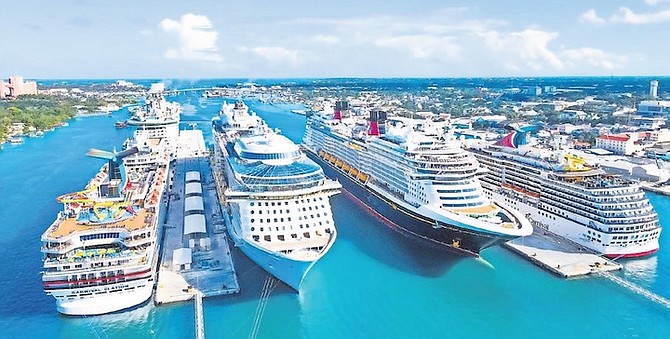
NASSAU CRUISE PORT.
By NEIL HARTNELL
TRIBUNE Business Editor
nhartnell@tribunemedia.net
A FORMER tenants association president yesterday lost her bid for an interim injunction preventing her eviction from the $330m Nassau Cruise Port due to a dispute over a toilet she installed in her stall.
Yvette Prince, the Coalition of Independents (COI) Yamacraw candidate in the May 2026 general election, is battling the Prince George Wharf operator’s move to repossess her Treasures by the Sea International booth on grounds that she committed an alleged fundamental breach of the two parties’ lease agreement by putting the toilet facilities in place for customers to use.
Nassau Cruise Port had given her seven days’ notice to vacate on July 13, 2026, prompting Ms Prince to race to the Supreme Court to both challenge this action and obtain a temporary bar on its enforcement given the challenge of removing $70,000 worth of merchandise in such a short period of time following her 23 years at Prince George Wharf.
However, while she obtained a “status quo” Order on July 23 this year, temporarily ensuring Ms Prince remained in place while banning any use of her stall’s toilet and permitting the Nassau Cruise Port to make compliance inspections, Justice Carla Card-Stubbs yesterday both discharged this and refused to grant an interim injunction.
She ruled that, while Ms Prince had proven there was “a serious issue to be tried” in her fight against eviction, damages were sufficient compensation if she won her case given there was “no identified reason to doubt” Nassau Cruise Port’s relatively deep pockets and ability to pay.
“The substantive proceedings arise out of a dispute between a commercial landlord and its tenant concerning the tenant’s installation and use of a toilet within leased retail premises,” Justice Card-Stubbs wrote in recalling the background to the dispute.
“The claimant, Yvette Prince, carries on business as Treasures by the Sea International. The defendant, Nassau Cruise Port, is her landlord in respect of unit 40 at the Nassau Cruise Port, Prince George Wharf, Nassau, occupied for the operation of a retail boutique.
“Although the tenancy is admitted, the parties disagree about the effect of their dealings before formal execution of the lease and whether the claimant was entitled to connect a toilet to plumbing infrastructure provided within the premises.”
Ms Prince, in challenging Nassau Cruise Port’s “asserted entitlement to recover possession of unit 40 following alleged breaches of the lease” is seeking Supreme Court declarations in her favour based on “proprietary estoppel and implied licence”, plus the injunction preventing eviction and removal of the seven-day notice to vacate.
“The claimant sought an immediate hearing in light of the requirement to vacate within seven days. She stated that she was 62, had operated at the port for approximately 23 years and faced removal of merchandise which she valued at approximately $70,000, with attendant transport and storage difficulties,” Justice Card-Stubbs added.
“She referred to recent bereavement, her physical and emotional difficulties, the business as her only source of income, and responsibility for her adult dependent son. She alleged that eviction would cause business collapse, loss of income, impairment of contractual rights and reputational and financial harm not adequately compensable in damages.”
Ms Prince argued that connecting her stall’s toilet to Nassau Cruise Port’s infrastructure did not breach three separate clauses in the two sides’ lease agreement. However, Nassau Cruise Port cited lease clauses requiring “compliance with the law, prior written approval for improvements and avoidance of nuisance”.
“It also relies on the entire agreement clause and the contractual mechanism for termination following an uncured breach after 30 days’ written notice. It says that no written request for approval of the toilet, or of any plumbing modification to the leased premises, was ever submitted by or on behalf of the claimant, and no such approval was ever granted,” Justice Card-Stubbs wrote.
“The claimant submits that her claim raises serious questions concerning the alleged oral assurance, the intended use of the infrastructure supplied by Nassau Cruise Port, and her asserted proprietary estoppel and implied licence.
“She says that installation of plumbing points within the booths represented that tenants could connect sanitary fixtures at their own expense, that she relied upon that representation, and that Nassau Cruise Port should not now be permitted to resile from it. The claimant contends that these disputed matters require determination at trial rather than final resolution on the interim application.”
Justice Card-Stubbs added: “On the contractual allegations, the claimant submits that the toilet was installed before formal execution of the lease. Alternatively, she distinguishes connection of a fixture to a landlord-provided stub-out from the installation of new plumbing mains and submits that her work does not constitute the breach alleged.
“On damages and the balance of convenience, the claimant submits that eviction would threaten a long-standing business, her sole income and her ability to support her dependent son. She relies also upon her medical needs and the asserted inadequacy or limited availability of communal toilet facilities as explaining the installation. Although damages are claimed, she submits that a later award would not adequately restore the business and continuity of trade lost through eviction.”
Nassau Cruise Port, though, argued that there was “no serious issue to be tried” and that Ms Prince’s claim “lacks prospects possessing substance because the claimant’s asserted entitlement is inconsistent with express terms of the lease”.
“Nassau Cruise Port also denies that its former director ever advised the claimant, whether orally or otherwise, that she was permitted to install a toilet,” Justice Card-Stubbs said.
“Nassau Cruise Port further submits that the tenant has failed to comply with any of the remedial steps required by the notice of breach, a material non-disclosure going directly to the good faith of her application and to the balance of convenience.
“Concerning damages, Nassau Cruise Port submits that the claimant’s alleged losses are principally business interruption and lost profits, capable of measurement and compensation. On comparative prejudice, it submits that injunctive restraint would interfere with its contractual and proprietary rights while exposing it to regulatory, reputational and other tenant risks not readily compensable in money.”
Justice Card-Stubbs, in her decision, said the lease provisions involving written approval, compliance and nuisance “on the face of it” give Ms Prince “significant difficulty in establishing an unrestricted entitlement to install and operate a toilet”. But while this provides “a substantial contract defence”, the judge ruled this does not entirely deal with the former COI candidate’s claim.
“First, there is an issue as to the contractual setting when the installation occurred. The claimant alleges that the toilet was connected before formal signature. Secondly, the pleaded case is not confined to implication of a contractual term,” Justice Card-Stubbs wrote.
“The claimant expressly invokes proprietary estoppel and implied licence, identifies an alleged assurance by a named former director of Nassau Cruise Port that the infrastructure permitted tenants to install toilets or sinks at their own expense, and relies on the provision of plumbing points as conduct consistent with that assurance. She says that she acted upon that understanding in taking or remaining in the tenancy and installing the fixture….
“Whether the assurance was made, its precise scope, the speaker’s authority, what reliance occurred and what expenditure or other detriment followed remain matters requiring proof….. The claimant has identified a particular factual and legal basis for disputing the right to possession which is not shown, in my opinion, to be merely fanciful.”
And, finding that damages would be adequate to compensate Ms Prince for not granting the injunction, should she win her case, Justice Card-Stubbs said: “This court does not minimise the hardship which displacement would cause this claimant. The claimant’s case is that she has spent many years building the business, that it is her only income and supports her dependent son.
“Removal entails disruption, anxiety and the practical burden of moving stock and finding another place to trade. Those consequences are serious, and I have considered them. Their seriousness, however, must be distinguished from the question of whether the resulting loss can adequately be compensated.
“The personal importance of the business and the claimant’s preference for this location do not, without more, make the commercial loss irreparable… I also record my determination that Nassau Cruise Port’s prejudice is not confined to delayed possession or lost revenue. Its evidence raises concerns regarding sanitation, public health, nuisance and potential exposure affecting neighbouring occupiers and visitors to the port facility.”
Tribune Business records show that Ms Prince and the Nassau Cruise Port have had an at-times adversarial relationship. She told this newspaper earlier this year that she had installed the toilet because Prince George Wharf lacked sufficient bathroom capacity to accommodate the up to 30,000-plus visitors it was receiving daily.
And, in 2023, she voiced strident objections to a lease clause that a lease clause that stipulates Nassau Cruise Port tenants cannot open a “competing retail shop” at any other New Providence or Paradise Island resort without the cruise port’s permission.
“The tenant agrees that, during the term of this lease agreement, it shall not own or operate, whether on its own, or in partnership, or other form of association with another, any competing retail shop in any other resort on Paradise Island or New Providence without prior written consent of the landlord, save and except those currently so owned and/or operated as listed” in an annex to the agreement, the lease document said. Those exceptions and the annex were not enclosed.
Ms Prince responded: “One of the things that they want us to sign on the lease says if we signed the lease, if we have an existing business, they want to know where it is. And if we want to have another business, we have to get permission from them. There was no way that I would put my signature on something like that.”




Comments
Use the comment form below to begin a discussion about this content.
Sign in to comment
OpenID