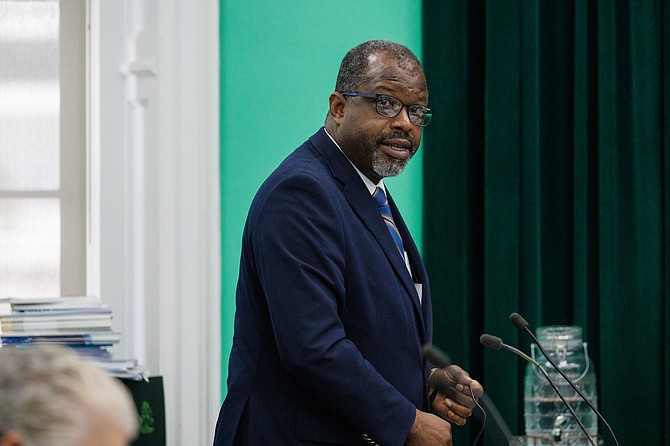
Wayne Munroe Photo: Dante Carrer/Tribune Staff
By NEIL HARTNELL
TRIBUNE Business Editor
nhartnell@tribunemedia.net
THE ATTORNEY General yesterday asserted Parliament’s spending watchdog was unable to identify anything wrong with the handling of accounts in the National Investment Fund’s (NIF) name as he hit back at Opposition charges the investigation is being obstructed.
Wayne Munroe KC, in messaged replies to Tribune Business inquiries while travelling, asserted that he “gave more pages of evidence before the Public Accounts Committee than any other witness I am aware of” while reiterating that the oath Cabinet ministers swear before taking office cannot be “waived” or released by anyone including the Government.
Michael Pintard, the Opposition’s leader and Public Accounts Committee (PAC) chairman, yesterday renewed his call for the Government to “waive any applicable (attorney-client) privilege or convention of confidentiality” to allow both Mr Munroe and his predecessor as attorney general, Ryan Pinder KC, to reveal the legal advice provided to the Government over its management of the so-called National Investment Fund ‘account’ and associated spending.
However, Mr Munroe replied that “there is no convention”, suggesting that Mr Pintard’s description of the ministerial oath is incorrect. He added that this governed by the Official Oaths Act, and “is absolute in its terms” that it cannot be waived or released.
Its language stipulates that all Cabinet ministers and parliamentary secretaries “will not on any account, at any time whatsoever, disclose the counsel, advice, opinion or vote of any particular minister or parliamentary secretary”. Mr Munroe yesterday argued that Mr Pintard and fellow PAC member, Kwasi Thompson, as former Cabinet ministers in the Minnis administration “should know this obligation cannot be set aside for political convenience”.
The controversy over the oath erupted after Kinglsey Smith, the west Grand Bahama MP, told the House of Assembly on Wednesday that Mr Munroe had previously informed the PAC that its terms - as well as Cabinet confidentiality and attorney-client legal privilege - prevent him from “disclosing any advice proffered by him in his capacity as attorney general with regard any matter”.
“This would debar him from disclosing evidence given with regard the NIF account,” Mr Smith said, adding that the same restrictions applied to Mr Pinder. “Senator Wayne Munroe KC also gave sworn evidence that he has directed Ryan Pinder KC that he is not released from the obligations imposed by his Oath of office, Cabinet confidentiality and legal advice and professional privilege,” the west Grand Bahama MP said.
“Senator Wayne Munroe KC, by letter dated November 2, 2026, replied to the PAC’s letter indicating that he would hold Ryan Pinder KC to account if he breach his oath and privilege.” Mr Munroe’s view is that the questions submitted by the PAC to Mr Pinder, for which he had asked and received an advance copy, would violate this - something that Mr Pintard and the Opposition, who hold the majority on the Committee, are disputing.
Michael Halkitis, minister of finance, has previously confirmed nearly $311m of the Bahamian people’s money was spent through these accounts even though the National Investment Fund’s governance and management structures, as required by law, had not been set-up. And, based on information already made public, as much as $965m could have been deposited into the account facilities established in the NIF Fund’s name.
Mr Pinder, who served in the first Davis administration, would have been Attorney General when his Office provided the legal advice relied on by the Government to establish the Fund. Mr Pintard, in a statement yesterday, sought to hold the Government to Mr Halkitis’s mid-September pledge that it would “fully co-operate” with himself and the PAC over the NIF probe.
“Full co-operation cannot mean providing only the information the Government is comfortable releasing. Nor can it mean relying on legal advice to justify decisions while preventing the Committee from examining the basis for that justification,” the Opposition leader argued.
“We have therefore requested that the Government waive any applicable privilege or convention of confidentiality to allow the current and former Attorneys General to provide the evidence the Committee needs to discharge its responsibilities. If the Government refuses, it should explain that refusal to the Bahamian people.”
Mr Munroe, meanwhile, hit back at what he said was a “misleading” attempt by the Opposition “to portray my refusal to disclose confidential ministerial advice as a refusal to give evidence”. He asserted that he had “answered more questions before the Public Accounts Committee than any other witness”.
The Attorney General, in response to Tribune Business inquiries, appeared to base the legal authority for the Government’s management and handling of the account established in the National Investment Fund’s name at the Central Bank, and the monies deposited and spent from it, on the borrowing resolution passed by Parliament during the 2024-2025 mid-year Budget.
“I told them about the resolution,” Mr Munroe said of his evidence before the PAC. “The relevant persons gave evidence about the transfers. I directed them to the presumption of regularity in official acts. They were unable to point me to anything they claim could give rise to any issue.
“If you read the resolution itself it tells you that that funds are to be spent on infrastructural development and the evidence is that it was. The resolution is very clear and is the authority. The NIF Act is also clear in its terms.”
The resolution gave the minister of finance, then Prime Minister Philip Davis KC, approval to borrow up to $300m “from international markets to fund national development objectives including infrastructure development projects”. It also “approves the deposit of the proceeds from the borrowing to the National Investment Fund”.
However, one fiscal specialist, speaking on condition of anonymity, argued that the resolution cited by Mr Munroe did not authorise the funds deposited in the NIF to be spent as another parliamentary approval, or appropriations Bill, would be needed for this.
And they added that the $300m cited “never made it to the NIF because the NIF was not constituted when they transferred and spent the money. The money has been transferred and spent but not made it to the NIF. Not only did it not go into the Government’s consolidated fund, it went into a fund whose legal structure we don’t know”.
The source reiterated that the NIF Fund’s governance, management and administrative structure was not in place because its Board, albeit members had been appointed, had never formally met or been constituted. They added that the NIF Act 2022 explicitly states that all authority flows from the Board, not the relevant minister or government, including the power to open bank accounts and select custodians.
“If you are confident in your advice, you’d say that this was the advice given to the Government,” the source said. “There’s nothing privileged, there’s nothing secret about that unless the Government didn’t follow the advice.”
Total public and taxpayer money placed into the Fund could be as high as $965m. Besides the $700m in borrowing proceeds from the 2025-2026 fiscal year, which Mr Halkitis said were deposited into it, the Davis administration had also previously placed the $265.5m net proceeds from the $1.067bn bond into the Fund during the prior fiscal period.
Tribune Business revelations that most of that $265.5m had been removed from the Fund, leaving just a balance of $200,000 at end-March 2026, sparked the increased scrutiny that ultimately led to Mr Rolle’s disclosures about the Board not being convened, and the governance and operational consequences of this.
The FNM publicly, and other observers privately, have voiced concern that the Government has used the Fund’s Central Bank account as, in effect, a second ‘Consolidated Fund’. By treating its spending as investments, and the borrowing proceeds injected into the Fund as “equity”, they argue that the Government has been able to treat the $311m spent as ‘off-the-books’, thus preventing it from impacting its deficit and blowing the $39m Budget surplus while priming pre-election spending.
Mr Pintard yesterday argued: “The Government says it acted on legal advice. The Committee is asking questions to establish what authority was relied upon and whether public funds were administered in accordance with the law.
“Yet, when the Attorney General appeared before the Committee, he declined to answer certain questions on the ground of legal professional privilege… There are two issues here that the public should understand. First, the office of Attorney General does not carry a blanket immunity from parliamentary scrutiny.
“The Attorney General is the Government’s chief legal adviser, but that position does not automatically exempt the office holder from answering questions about the administration of public affairs or the expenditure of taxpayers’ money,” Mr Pintard continued.
“Legitimate protections exist for confidential legal advice, Cabinet confidentiality, and information whose disclosure may harm the public interest. Those protections must be respected where they properly apply. But they are not the same as a general right to refuse parliamentary questioning. Not every question asked of an Attorney General requires the disclosure of privileged legal advice.
“There is a difference between asking an Attorney General to reveal confidential legal advice and asking factual questions about the work undertaken by the Office of the Attorney General,” he added.
“Who prepared the parliamentary resolution? When was it prepared? What steps were taken to establish whether the National Investment Fund was operational? What public records exist concerning the transfer of funds?
“These are legitimate areas of inquiry. Whether privilege applies must be considered in relation to the particular question and the information sought. The mere fact that a question is directed to an Attorney General does not make the answer privileged.”




Comments
Sickened 3 hours, 13 minutes ago
This is excellent news indeed. Now the people will finally know: -How much was deposited -Where it was deposited -How much went out -Where it was spent -How much is left -How it is being invested -Who is managing the investments
Progress. Not sure why the PLP didn't provide the answers a month ago. Silly!!!
Sign in to comment
OpenID