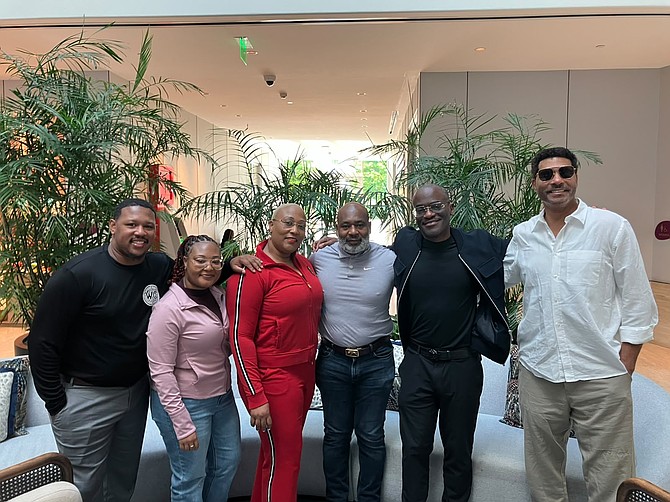
PARTICIPANTS and organisers at the High Level Sports Performance seminars held at Baha Mar last weekend, where speakers discussed athlete wellness, injury prevention, career longevity and the importance of protecting athletes’ physical and financial well-being. Photo: Pavel Bailey/ Tribune Staff Reporter
By PAVEL BAILEY
Tribune Staff Reporter
pbailey@tribunemedia.net
ATHLETES who fail to take ownership of their bodies and their worth will end up as someone else’s puppet, a sports therapist warned at a two-day performance seminar at Baha Mar last weekend.
Edwardo Thompson, an orthopaedic sports and neuromuscular therapist and a featured speaker at the High Level Sports Performance seminars, said too many professional athletes are forced out of their sports early by injury and pressure, losing their value and earning power along the way.
“Your gift is given to you from God. If you don’t own it, then, like I said, someone else is gonna have you like a puppet,” Mr Thompson said.
The seminars, hosted by Anachronist Wellness and The Winner’s Circle, drew an average of about 60 people a day. Guest speakers, including Dr Glenn Toby, Tim Adams and Myron Flowers, covered consistent strength training, maintaining an athlete’s value and networking.
Speaking to The Tribune at Goldwynn Resort on Sunday, Mr Thompson said the programme aimed to change how rehabilitation, performance and recovery are delivered, not only in The Bahamas but globally. He said football players last only about two and a half years in the NFL, and basketball players about five to eight years in the NBA, with most driven out by injuries, wear and tear, and the mental strain of competing under pressure.
The organisers’ approach covers mind, body and spirit, starting with the mindset, he said, because athletes who understand their value take better care of their bodies.
“If you look at your body as a business, you’re the CEO, you show up to work,” he said.
He said the programme was not limited to college or professional athletes, but was meant for athletes of any age, to help them stay active and financially viable for as long as possible.
Mr Thompson also said the organisers have created a programme that can scan the body “from the crown of your head to your toenail” to determine its condition at a cellular level. He said it could then send a signal to help the body recharge and regenerate damaged structures.
“This is the future of medicine,” he said.
Such claims go beyond established medical practice. Regulators have challenged devices marketed abroad as able to scan the body and send healing signals, often under the name bioresonance. Britain’s advertising watchdog has said it has seen no evidence they can diagnose or treat illness.
Fellow lead organiser Lakera Thompson said the same testing system was used in her work on skin care, which she said matters for athletes because of the importance of their image and likeness. She said many athletes, who spend long hours outdoors, develop dark patches from years of sun damage. Her approach combines facials and treatments suited to each person’s skin with work “from the inside”, testing the body at a cellular level for inflammation and toxins and detoxifying it.
Alan J West, an entrepreneur and partner in the humanitarian group Global Estates Society, said the organisers also want to reach athletes in foster care, a cause he said was personal.
“Personally, I was born in Harlem Hospital, left there for 13 months, went into the foster care system,” Mr West said. “So it’s near and dear to my heart.”
“So some of these athletes who are in the foster care system are amazing athletes, but they don’t have mentorship. They don’t have guidance, right?” he said. “So we’re gonna bring it home.”
Mr West said the group planned to bring such athletes to The Bahamas for what he called regenerative longevity therapy. He said it had partnerships with actor Blair Underwood and US media outlets, planned to begin creating content locally with Anachronist Wellness, and was planning a dinner on December 5. He said the organisation also intends to expand its work to the Family Islands.
Rakeem Vick, the organisation’s chief operating officer, said he was moved after visiting Baha Mar’s youth golf programme, where children as young as one were being trained in a toddler class. He said he was struck by a girl of 13 or 14 who was coaching younger players.
“It made me call home because I have three daughters,” Mr Vick said.
His advice to young athletes was to start early and set goals.
“Your game is gonna last for, you know, a few hours. What are you doing after that? You know, what are you doing off the field?” he said.
Local entrepreneur and athlete Aaliyah Thompson said the seminars gave athletes vital knowledge on nutrition, training, physical therapy and the mental side of sport.
“It’s not just wins and losses, but it’s how you recover after mentally and physically,” she said.
She encouraged families to eat and train together to support young athletes. She said that, with the right environment and support, science and technology could help injured athletes recover faster than traditional medicine had led them to expect.
The organisers also discussed early plans to work with Netflix or ESPN on a documentary about local athletes, aimed at raising awareness and directing more resources to Caribbean talent.




Comments
Use the comment form below to begin a discussion about this content.
Sign in to comment
OpenID