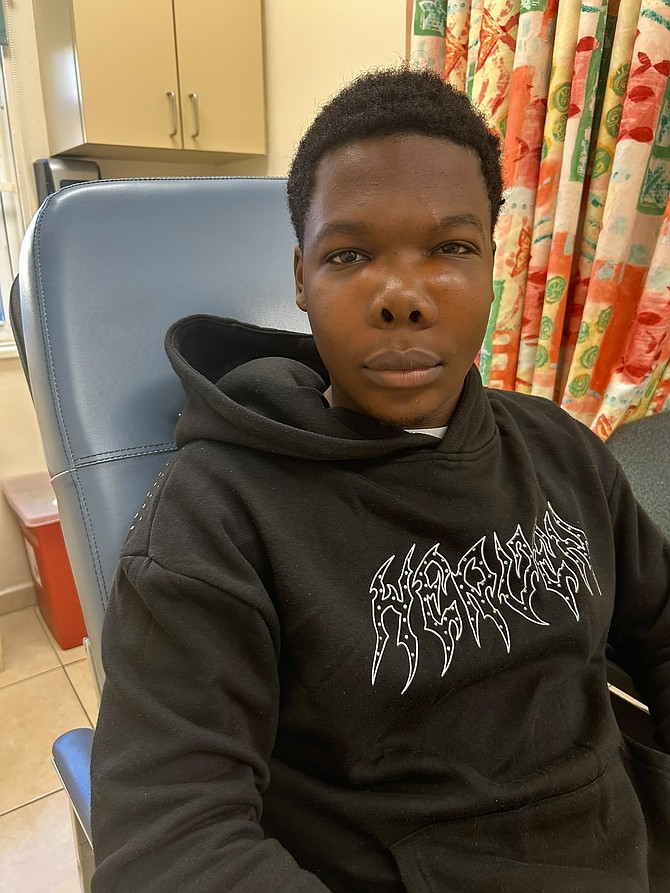
STAGE four non-Hodgkin lymphoma had left the face of Sayid Cargill unrecognisable.
By JADE RUSSELL
Tribune Staff Reporter
jrussell@tribunemedia.net
SAYID Cargill was 19 when a small bump on his face began to grow into a tumour that pressed against his eye, blocked his nose and left him barely recognising the face in the mirror.
The tumour was stage four non-Hodgkin lymphoma, a cancer that develops in the lymphatic system and affects the body’s infection-fighting white blood cells. Two rounds of chemotherapy later, the 20-year-old’s face has almost returned to how it looked before. But his family, who have no medical insurance, have already spent more than $50,000 on his care and are now appealing to the public for help with the cost of the rest of his treatment.
“I was genuinely so happy to see the Sayid who was living in Bimini again, who graduated high school. To say I got my life back was an understatement,” Mr Cargill said.
He had recently graduated from high school and moved from New Providence to Bimini after landing a job. Living on his own, he felt physically well at first, although he noticed his face looked slightly swollen. He had no nausea or other obvious symptoms, but everyday tasks gradually became harder.
As the tumour grew, it spread to his mouth, eye socket, leg and other parts of his body. The pressure on his eye made his vision deteriorate, and his nostrils became almost completely blocked, making it hard to breathe at night.
“My bottom lip would go numb, and then I would get a splitting headache religiously every day, sometimes multiple times a day,” he said. “Right before I had gotten chemotherapy, the nerve involvement had gotten bad to the point where I had started to lose control of my tongue.”
When he returned to New Providence in November 2025, his mother, Santillia Cargill, quickly realised something was wrong with his face. He believed the swelling came from a dental infection linked to his braces, and a dentist prescribed medication. But Ms Cargill, a former nursing student, suspected something more serious. A local doctor then found a mass sitting on top of his upper maxillary bone and recommended a biopsy.
Used to working and supporting himself, Mr Cargill struggled as the growing mass made it harder to work, until he eventually had to stop.
His appearance changed so dramatically that he no longer resembled his mother, as he once had. Instead, he compared himself to “the cat in the hat in live-action”.
“I began to like feel ashamed of going out in public and having people see my face. It had done a very big number on my self esteem and my mental,” he said.
Strangers often stared. Some assumed he had been beaten up or stung by a wasp, while others openly asked what had happened to his face.
His 20th birthday on January 12 was bittersweet. Two days after celebrating, he had surgery for a biopsy as doctors tried to work out what was causing the mass.
Then came months of waiting. In June, while he was being seen by the ear, nose and throat department at Princess Margaret Hospital, doctors received the results. The partial report indicated lymphoma but did not identify the stage or type, and doctors advised the family to pursue further testing because the findings were not conclusive.
His aunt, Candis Marshall, learned her nephew might have cancer before he did. She had been responsible for transferring his medical documents to Princess Margaret Hospital, and she became inconsolable after reading his medical notes the night before she was due to accompany him to his appointment.
“I just cried because for me it was like it was not just about him possibly having cancer it was like how am I going to say this to him? How am I going to say this to my sister? How am I going to say this to our family?” Ms Marshall said. “Now I have to go with him, and I have to sit through the discovery process of the doctors drawing their conclusion before I say anything.”
Ms Cargill said that when she first learned her son might have cancer, all she could do was cry.
In August, Mr Cargill travelled to Nicklaus Children’s Hospital in the United States for a series of tests, including a CT scan, an MRI, an X-ray and another biopsy. On September 2, the diagnosis was finally confirmed.
In the United States, the five-year relative survival rate for non-Hodgkin lymphoma that has spread to distant parts of the body is 67 percent, according to the American Cancer Society.
After months of uncertainty, Mr Cargill said a definite answer came as a relief, despite the gravity of the news.
“For me, I don’t feel like being afraid was an option by that point anymore. Because after we had went through this whole battle of trying to find answers,” he said. “It was just go get it done, so we can be over this and I can be happy again.”
Although doctors were optimistic about his chances, the diagnosis devastated his family, who knew he was only beginning his adult life. His mother feared what treatment would do to him. Searching online, she saw cancer patients suffering weight loss, hair loss and mouth sores. She also worried about the emotional toll of the illness on him at such a vulnerable time.
Mr Cargill is due to have six rounds of chemotherapy and has completed two. Doctors plan to carry out imaging after the third round to see how he is responding.
He admitted he was frightened of chemotherapy at first, having watched two people close to him go through it.
“I am only 20 years old; I don’t know a Christ thing about chemotherapy,” he said. “I’ve seen two people personally go through it, and I did not like what it did to them. So I was scared to think that what would happen to me.”
He and his family praised the oncology staff at Princess Margaret Hospital, describing them as superheroes for the compassion, care and honour they have shown him.
For a young man who once prided himself on his independence, accepting help has become part of a journey he never expected to face so young. He is holding on to the hope that, with continued treatment and the generosity of others, he can regain his health and return to a full life.
Those wishing to support Mr Cargill and his family can donate through their GoFundMe campaign or contact the family at +1 (242) 468-7452.




Comments
Use the comment form below to begin a discussion about this content.
Sign in to comment
OpenID