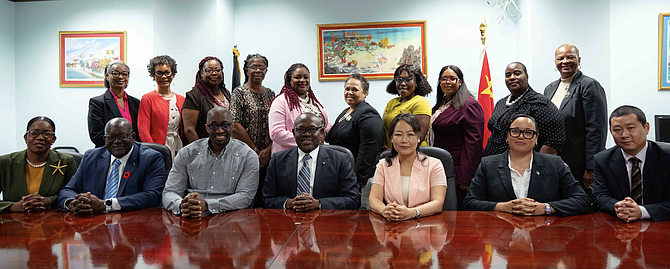
RECEPIENTS (L-R): Bridgette Cooper; Lapeedra Damianos, Columbus Primary School; Indiana Moss; Patricia Knowles, CV Bethel; Samantha Armbrister, CW Sawyer; TERRICE Carey Curry; Ebony Duncombe, Woodcock Primary; Carlene Burrows; Palmdale Primary School; Indira Burrows-Rolle, LW Young and Christine Cunningham, Special Education Officer.
By EARYEL BOWLEG
Tribune Staff Reporter
ebowleg@tribunemedia.net
ELEVEN Bahamian teachers have been awarded Chinese Embassy-funded scholarships to train in special education, as the government works to support what Education Minister Chester Cooper has said could be thousands of students waiting for special needs assessments.
The teachers will take a three-month online certificate programme at the University of the West Indies (UWI) Global Campus, covering autism, positive behaviour, adapting instruction, and social and communication skills. They were chosen from 24 nominated teachers across eight districts, in New Providence and the Family Islands, based on their qualifications, experience, professional performance and commitment to students with diverse learning needs.
Mr Cooper thanked the Chinese ambassador and embassy for the $20,000 contribution through the Ambassador Scholarships Program.
“Its value will be realised when the learning improves what happens in classrooms, and strengthens the support available to families,” he said.
Chinese Ambassador to The Bahamas Yan Jiarong said children with autism deserve understanding, care and opportunity.
“In China, we often call children with autism children of the stars,” she said, “because like stars in the sky, these children shine in their own world. They may see and experience the world differently, but they deserve the same love, understanding, and opportunities as every other child.”
Charlena Burrows, one of the recipients, said the training would give teachers practical strategies to support neurodivergent students in mainstream classrooms.
“In a generalist classroom, you quickly realise that the standard teaching methods do not work for every student,” she said, “especially for our neurodivergent learners who process and experience the world differently.”
“We wanted specialised tools, evidence-based strategies, and a deeper understanding required to ensure that our students, those diagnosed and undiagnosed, are not merely accommodated but truly understood, supported, and celebrated.”
She described the award as “both a privilege and a reminder of our highest calling, to serve every child with excellence, equity, and most importantly, empathy”.
Mr Cooper said the government’s education strategic plan towards 2030 puts student learning, equity and achievement at the centre of reform, and recognises the importance of well-trained teachers, early intervention and access to support services. In August, he said potentially thousands of students across the country had been referred by teachers or principals and were waiting to be assessed.
The ambassador praised the recipients’ dedication. She also said applications for Chinese government scholarships for the 2027 to 2028 academic year had already opened, and that the scholarships are undersubscribed every year.
Mr Cooper also defended the number of acting school leaders, after teachers’ unions said dozens of schools lack substantive principals.
“Let’s be clear: every school in the country today has leadership,” he said. “Some of those persons are acting. There is no ministry in the government of The Bahamas where you will not find acting leaders, executives in some areas.”
“This is not an anomaly. However, we’re making good progress, and we’re getting great support from our colleagues at the Ministry for Public Service.”
He said the government is working with the Ministry of Public Service and the Public Service Commission to fill principal and vice principal vacancies. He said staffing schools presents unique challenges, particularly in small Family Island communities such as Ragged Island, where some schools have as few as three students.
As schools reopened in August, Bahamas Union of Teachers president Belinda Wilson named ten schools she said were without principals. Bahamas Educators Managerial Union president Stephen McPhee has put the number of schools without substantive principals at roughly 30 to 40, disputing a claim he attributed to the Director of Education that only seven schools were affected.




Comments
Use the comment form below to begin a discussion about this content.
Sign in to comment
OpenID