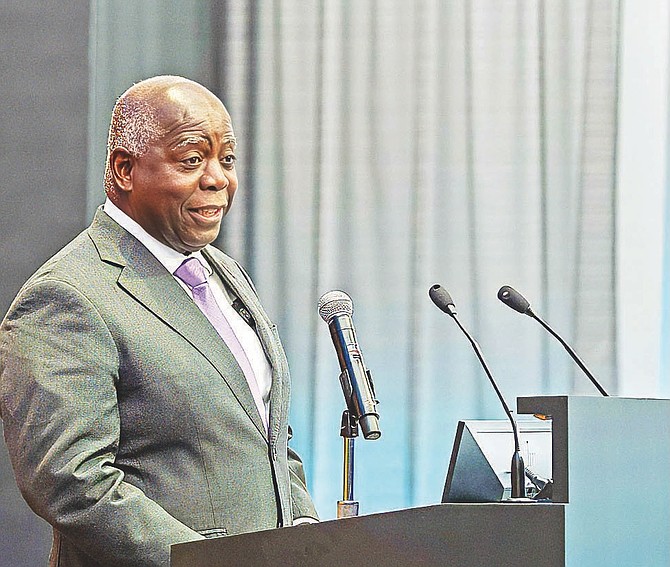
PRIME Minister Philip ‘Brave’ Davis speaks during the United Nations General Assembly in New York on September 25th, 2026
By NEIL HARTNELL
TRIBUNE Business Editor
nhartnell@tribunemedia.net
THE PRIME Minister yesterday revealed The Bahamas is investing a further $75m in its push to monetise its natural marine assets as he urged investors and “purchasers” to join the battle to combat climate change.
Philip Davis KC, formally launching The Bahamas Blue Carbon Programme at the global COP31 climate summit, said this nation is now moving to execution on its strategy to extract value from its seagrass meadows and other carbon dioxide sinks as it takes its spending on the effort to a total $100m.
“In 2022, we passed the Climate Change and Carbon Market Initiatives Act and the Carbon Credit Trading Act. Together, they give The Bahamas the legislative framework to govern its carbon assets and co-operate under Article 6 of the Paris Agreement as a sovereign partner,” he said.
“The legislation establishes a Carbon Emissions Registry, the criteria for validating carbon credits and the options to monetise carbon credits.My government has invested $25m in the first phase of this programme. For a small island developing state, that is a significant sum to risk.
“We made that investment because climate leadership must mean more than telling the world what to do. Leadership means being prepared to act, invest and build the science and institutions that turn ambition into credible action. That is why we have committed an additional $75m to advance phase two.”
Confirming that The Bahamas has been mapping its ocean seagrass meadows using human assessments and satellite data, and verifying the amount of carbon dioxide they extract and recycle from the Earth’s atmosphere, Mr Davis said it is now building a “a national inventory” that will meet the ‘Tier Two’ standard of the Intergovernmental Panel on Climate Change.
“We are also working to include seagrass in our Nationally Determined Contribution, NDC 3.0A, for the first time,” he added. “Phase one lays the groundwork. Phase two is where measurement must translate into credible action and independently verifiable outcomes. We are now moving from science to implementation.
“The additional funding will sustain our measurement, reporting, verification and implementation of our programme of activities. It will support the planning we need to deliver our NDC and the sustainable development goals. Conservation comes first. Our seagrass does not exist to generate carbon credits.
“Climate finance, properly structured, is one tool that can help us protect it at the scale and for the length of time that conservation demands. If we measure that climate service accurately and authorise it properly as a sovereign state, The Bahamas can take part in international carbon markets under Article 6. That includes Internationally Transferred Mitigation Outcomes, known as ITMOs,” Mr Davis continued.
“Every tonne we authorise for transfer will be adjusted in our own national accounts, so that it is never counted twice. And no credit that comes from Bahamian waters should ever become an excuse for anyone to keep polluting. That is why The Bahamas will only take part in internationally-verified carbon markets to ensure transparency, accountability and the environmental integrity the programme demands.
“We intend to do this carefully. We intend to do it credibly. And we intend to keep conservation at the centre of every decision we take. We want the value created by protecting nature to help finance its continued protection.”
Mr Davis said this nation will now launch its Bahamas Blue Economy Institute “to set a gold standard for the transparent and credible stewardship of any proceeds from the transfer of ITMOs. Those proceeds would sustain long-term work on our seagrass, and across the full breadth of our nation’s marine biodiversity.
“The Institute will fund the science and the programmes that strengthen this work and our wider marine environment,” the Prime Minister added. “It will bring leading international scientists and environmental experts together, side by side, with Bahamian professionals, emerging and seasoned alike. The capacity we build will outlast any single project cycle.
“We welcome partners, and we will need them. But the long-term protection of the Bahamian sea cannot depend on donor cycles, or on the priorities of others. These are our waters. These are our ecosystems. Their future is our responsibility. Self-reliance must also reach our people, or it will mean very little.
“A fisherman on any of our islands should be able to see how a healthy seagrass bed protects his livelihood and his children’s future. A young Bahamian studying marine science, data science or finance should be able to see a career in the blue economy in The Bahamas. Our island communities, the relevant departments of government and Bahamian NGOs that meet high standards must all be part of this work, and share in what it achieves,” he said.
“Conservation cannot happen around our communities. They must be built. Additionality must be a call to action. The institutions will not build themselves. We have legislation to strengthen and, where necessary, to develop. We have policies and guardrails to put in place. We have frameworks to build for governance, for fiduciary oversight and for implementation.
“This must become far more than a carbon project. We have rolled up our sleeves, put on our boots, and committed ourselves to the hard work ahead. The science has given us a foundation, but the work has only just begun. We must protect that science and turn this opportunity into lasting environmental, social and economic value for The Bahamas.
Describing The Bahamas’ carbon sinks as “an extraordinary natural asset”, Mr Davis said: “The Bahamas does not want to walk this road alone. We cannot… Today, we do not ask anyone to act against their own interest. We offer a partnership in which your interest and ours point in the same direction.
“Our seagrass protects the world’s climate. Your partnership can help protect our seagrass, the blue heart of the planet. We invite governments to explore co-operation with The Bahamas under Article 6. We invite scientists and international institutions to work alongside Bahamian expertise.
“We invite responsible investors to put their capital behind conservation and restoration at national scale. We invite future purchasers to begin the conversations today that will build high-integrity co-operation tomorrow. In The Bahamas, you will find a sovereign partner, a clear legal framework, science you can verify, and qualified professionals committed to do the work.”




Comments
Use the comment form below to begin a discussion about this content.
Sign in to comment
OpenID