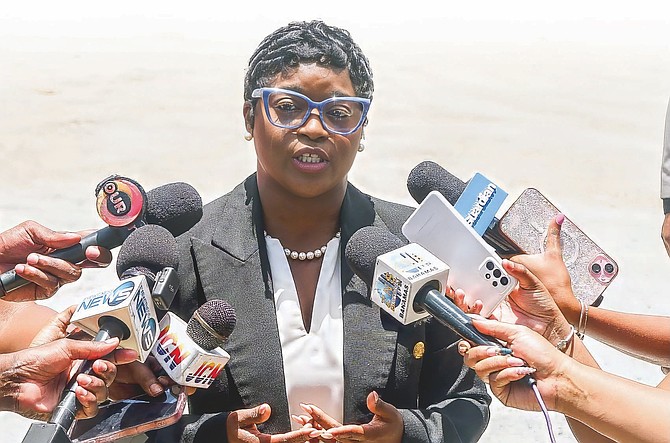
Energy, Utilities and Aviation Minister Jobeth Coleby-Davis speaks to the media June 16th 2026. Photo Nikia Charlton
By FAY SIMMONS
TRIBUNE Business Reporter
jsimmons@tribunemedia.net
A CABINET minister yesterday said the Government’s more than $1bn energy reform programme remains unfinished, and warned that projected fuel savings cannot be treated as realised until liquefied natural gas (LNG) reaches New Providence's generation infrastructure.
Jobeth Coleby-Davis, minister of energy, utilities and aviation, told the Bahamas Institute of Chartered Accountants' (BICA) accountants’ week seminars that LNG is now scheduled to reach the Clifton Pier terminal in early 2027 and the Blue Hills power station in late 2027, while the anticipated savings remained projections.
“That is later than our original target, and I will not describe it as achieved until the gas arrives. The fuel savings we expect remain a projection,” she said,. Mrs Coleby-Davis said the reform programme represents more than $1bn in targeted investment, with $820m allocated to New Providence projects and $324m for the Family Islands.
The programme is intended to overhaul the country's electricity system through changes to the regulatory framework, generation infrastructure, fuel sources and transmission and distribution networks.
Mrs Coleby-Davis stressed the Davis administration inherited a system with almost $500m in debt at Bahamas Power & Light (BPL), a BPL pension liability of a little over $100m, and approximately $40m annually spent on rented generation. More than 80 percent of BPL's existing engines were also expected to reach the end of their working lives within five years, she said.
“Taken together, they described a system that could not go on as it was,” said Mrs Coleby-Davis. She added that the Electricity Act 2024 and Natural Gas Act 2024 came into force on June 1 that year, modernising the rules for generating, transmitting and selling electricity, and establishing a framework for independent power producers.
The Government has also committed around $130m to foundational transmission and distribution upgrades in New Providence, while BPL secured $90m from the Inter-American Development Bank (IDB) for smart meters and outage management.
Mrs Coleby-Davis said the grid improvements were necessary to accommodate new generation sources and improve reliability, noting that renewable energy projects cannot be considered in isolation from the infrastructure needed to carry their output.
“We cannot build tomorrow's electricity generation on yesterday's electricity grid,” she said. The Blue Hills transformation includes approximately 177 mega watts (MW) of combined-cycle natural gas capacity, while plans for New Providence also include about 60 MW of utility-scale solar generation paired with battery storage.
Mrs Coleby-Davis said natural gas will serve as a transitional fuel as renewable capacity expands, reducing reliance on heavier fuels but not eliminating The Bahamas' exposure to imported energy. “The lowest price on paper does not always produce the lowest cost to the system,” she said.
“We must count the costs of integration, storage, reserve capacity and network reinforcement, together with the long-term obligations attached to each contract.”
The Family Islands programme includes a 27 MW hybrid microgrid on Abaco and a 20 MW hybrid microgrid on Eleuthera, both of which broke ground in April and are targeted for commissioning in spring 2027.
Mrs Coleby-Davis said 23 microgrid and solar projects are in design, with plans advancing for hybrid microgrids on Long Island, San Salvador and Cat Island. The Family Islands programme has a pipeline of close to 200 MW of new generation.
She cautioned, however, that a pipeline should not be confused with completed capacity. “A pipeline is not delivered capacity,” she said. The Government has also introduced electricity bill relief through its equity rate adjustment programme.
Mrs Coleby-Davis said the first year of the programme delivered $11.5m in consumer savings, with a household using 200 kilowatt hours a month seeing its bill fall from about $78 to approximately $40.
She said roughly 58 percent of residential customers and 56 percent of regular commercial customers stood to benefit from the adjustments, and added that the reform should ultimately be judged on measurable outcomes, including lower system costs, improved reliability, reduced losses and more renewable energy delivered.
“Projected savings must be distinguished from realised savings,” Mrs Coleby-Davis said. “An enacted law, a signed contract, a project under construction, and a verified result are four different things.”
Mrs Coleby-Davis said the Government expects to be held accountable for whether natural gas arrives on schedule, whether forecast savings materialise, and whether grid upgrades reduce outages and restoration times. “The test now is delivery,” she said.




Comments
Use the comment form below to begin a discussion about this content.
Sign in to comment
OpenID