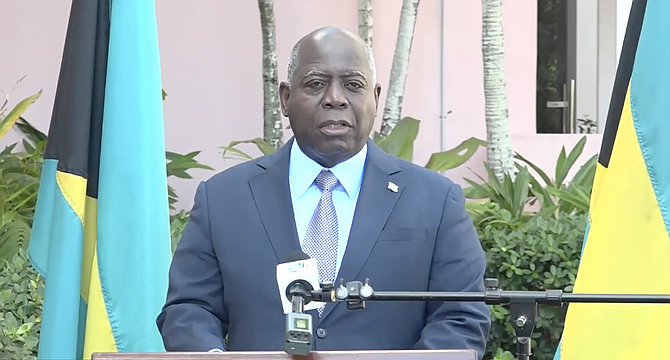
Prime Minister Philip Davis
By RASHAD ROLLE
Tribune News Editor
rrolle@tribunemedia.net
PRIME Minister Philip Davis yesterday pressed international migration agencies to help protect Bahamian families from climate displacement.
On the third day of the COP31 climate conference in Antalya, Türkiye, he also urged investors to back the next phase of the country’s seagrass carbon programme.
“Our message to partners was direct: invest in the ocean we protect, and stand with the families who live in the path of the storms,” Mr Davis said.
The Bahamas delegation also secured the election of Supreme Court Justice Cheryl Bazard as Secretary-General of the Commission of Small Island States on Climate Change and International Law (COSIS). The commission brings small island states together to use international law to win protection from climate harm.
Mr Davis raised climate displacement with Amy Pope, Director General of the International Organisation for Migration, and Professor Kamal Amakrane, Managing Director of the Global Centre for Climate Mobility. The government said The Bahamas is looking for partners who will help people stay safely where they live and move with dignity when they must.
In 2019, Hurricane Dorian drove thousands of residents of Abaco and Grand Bahama from their homes.
McKell Bonaby, Minister of State in the Office of the Prime Minister with responsibility for disaster risk management, took the issue to a regional session titled “The Caribbean: Realising the Global Principles through Regional Cooperation”. Drawing on The Bahamas’ experience of disaster risk management, Mr Bonaby argued that Caribbean states should work together to apply the Global Principles for Addressing Climate Mobility.
At last year’s COP30 in Brazil, Mr Davis called for this year’s UN summit on sea-level rise to produce a declaration protecting the rights and dignity of people displaced by climate impacts.
At the CARICOM Pavilion yesterday, Mr Davis outlined the next phase of the Bahamas Blue Carbon Programme and invited investors and partners to join.
He also met representatives of Australia, which is leading the negotiations at COP31 under a shared presidency with Türkiye, the host country. Both countries have some of the world’s largest seagrass meadows. The Bahamas wants the climate value of those meadows to be recognised and financed.
The programme aims to turn the carbon absorbed by Bahamian seagrass into credits that can be sold. Last November, a $25m financing facility was secured to fund its early stages, including mapping and scientific validation of the meadows. At the time, the programme’s backers said the facility could pave the way for a potential $1bn capital raise within 12 months.
Owen Wells, Minister of State in the Ministry of Health and Wellness, presented The Bahamas School Water Supply and Access Project. He set out how safe, reliable water in schools protects students’ health and learning. The government said a secure supply also helps island communities withstand storms and drought.
Mr Davis nominated Justice Bazard at the annual meeting of COSIS member states, which elected her as the commission’s Secretary-General.
“Five years ago, small island states made a choice. We would no longer wait for the goodwill of others. We would use the law,” Mr Davis said when presenting the nomination.
He said the next chapter would be harder and would need a Secretary-General who had spent a career making institutions answer to the law.
“Today small island states placed their trust in a daughter of The Bahamas, and I congratulate Justice Bazard on behalf of our government and people,” Mr Davis said.
The prime ministers of Antigua and Barbuda and Tuvalu founded COSIS on the eve of COP26 in 2021. In May 2024, at the commission’s request, the International Tribunal for the Law of the Sea found that greenhouse gas emissions are pollution of the marine environment.
The Bahamas, a COSIS member, made written and oral submissions in the climate change proceedings at the International Court of Justice. In July 2025, the court unanimously confirmed that states have binding obligations to protect the climate system.
Justice Bazard was appointed to the Supreme Court in 2025. From 2022 to 2025, she was The Bahamas’ Ambassador to Belgium and Head of Mission to the European Union. As Chair of the Small Island Developing States Forum of the Organisation of African, Caribbean and Pacific States, she addressed the International Court of Justice in its climate proceedings in December 2024. She also represented The Bahamas in Hamburg, Germany, when the tribunal delivered its advisory opinion.
Called to the Bar in 1991, Justice Bazard is a King’s Counsel. She served as a senator from 2012 to 2014 and as counsel in the Office of the Attorney General. From 1998 to 2006, she was regional director of compliance, corporate secretary and counsel at FirstCaribbean International Bank, where she wrote anti-money laundering and governance policies for 16 Caribbean countries. She was the founding president of the Bahamas Association of Compliance Officers.
She began her studies at the College of The Bahamas, now the University of The Bahamas. She earned a law degree from the University of Buckingham, where she won the Tunku Abdul Rahman Prize for a first-class pass in international law. She then earned a Master of Laws in financial compliance and risk management, summa cum laude, from Thomas Jefferson School of Law.
Mr Davis is scheduled to deliver The Bahamas’ national statement to the conference’s High-Level Segment today. He will also address the Global Centre for Climate Mobility’s high-level session on sea-level rise.




Comments
Use the comment form below to begin a discussion about this content.
Sign in to comment
OpenID