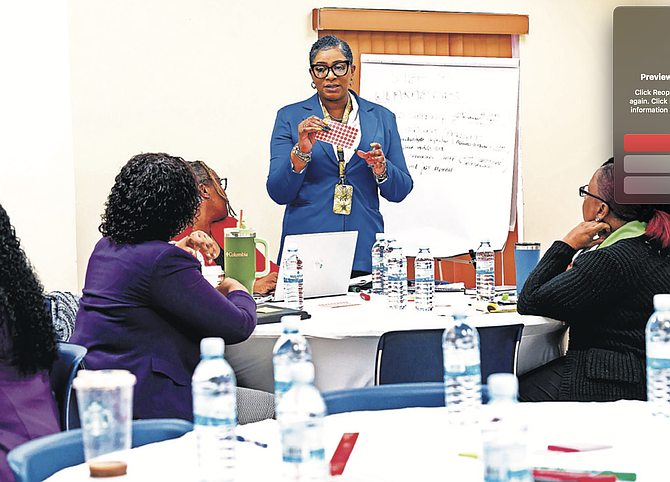
Tia Rolle (centre, standing), supervisor of the GIS Unit at the Bahamas National Statistical Institute (BNSI), moderates a working group assessment.
A workshop attracted 55 attendees for talks on how to strengthen The Bahamas’ national statistics system so that reliable, timely data can be provided to aid evidence-based government policy-making.
Representatives from the Government, civil society and the University of The Bahamas met at the Bahamas National Statistical Institute’s (BNSI) headquarters in Nassau from 11 to 13 November, 2026, in an effort to define the objectives for the country’s 10-year National Strategy for the Development of Statistics (NSDS).
Convened by BNSI and the National Statistical Committee, the workshop assessed what the system does well, where it needs improvement and what could disrupt the production of official statistics. They used that assessment to begin shaping the strategy’s proposed mission, vision and objectives. The Inter-American Development Bank (IDB) is supporting the strategy’s development.
“We have to know where we currently stand, and we also have to be evaluating ourselves realistically and honestly,” said Dr Jamiko Deleveaux, the BNSI’s managing director. “Can we actually get to where we want to go in the next 10 years?”
The BNSI said that, for some agencies, the value of more detailed data is already clear. Howard W. Thompson, director of labour, said unemployment has fallen to 8.1 per cent, which he described as the lowest rate in decades, yet a closer look at the figures shows a different picture for young people.
“When you extrapolate that, we notice that we have a steadily increasing youth unemployment in The Bahamas,” he said. “Knowing that, we then know how to direct resources towards the young persons in the country.” His department wants to understand why Bahamians up to the age of 25 years-old are not finding work, and whether they need more training, mentoring or support to become self-employed.
“For health, data is everything,” said Brenée Wallace, project officer at the Department of Health. She said more complete reporting from the Family Islands would help officials determine which services are needed locally and where to deploy clinic staff, ambulances and emergency care.
Sharmaine Sinclair, deputy director of education, planning, research and development at the Ministry of Education, Science and Technology, said The Bahamas’ geography makes reliable records essential.
“Because we are a nation of many islands, and the islands are different, we have to rely on the statistics,” she said. Records of teachers’ qualifications and postings help the Ministry fill vacancies in specialised subjects such as agricultural science on the Family Islands.
Dr Deleveaux pointed to school feeding programmes as an example of why agencies need to bring their data together. Tracking how many children receive meals, and comparing their grades before and after a programme begins, could help officials assess the impact through programme evaluation to determine expansion or refinement of the initiative.
The workshop also considered how agencies could share the information they already collect and draw on each other’s expertise. Professor Dr Judy L. Simmons, first assistant secretary at the Ministry of Social Services, said sharing records would reduce duplication and give each ministry a clearer picture.
“That’s why it’s important that we collaborate and not duplicate efforts,” she said. Dr Anthony Hamilton, president of Civil Society Bahamas, said non-governmental organisations (NGOs) already provide information gathered in communities that the Government draws on when reporting to bodies such as the United Nations (UN).
Khulyl O’Cof, economist at the National Development Planning Institute, said the gaps identified during the workshop show where the work lies. “We aren’t behind; it’s just that we have more work to do,” he said, pointing to the need for a clear national standard for official statistics and stronger co-ordination between agencies.
For the University of The Bahamas, access to official statistics also matters in the classroom. “In wanting to give our students a Bahamian education, we want it to be informed by Bahamian data,” said Dr William Fielding, data analyst at the University. “We don’t want to be always referring to data that’s come from elsewhere.”
Participants also considered how to keep statistical work going when disasters strike. Dr Deleveaux cited Hurricane Dorian as a factor in the postponement of the census originally scheduled for 2020.
Gabrielle Sullivan, technical officer at the Department of Environmental Planning and Protection (DEPP), described how mapping coastal development alongside projected sea level rise could inform decisions about where to limit building. The workshop, led by facilitator Geoffrey Greenwell, included presentations by Barisse Griffin from disaster risk management and Tia Hinsey-Rolle, BNSI’s geographic information systems supervisor.
BNSI plans to unveil the strategy’s logo and website in early January 2027, and hold a workshop that month to estimate implementation costs. Stakeholders are scheduled to review the draft in March, with publication of the final strategy planned for April 2027.
CAPTION
Tia Rolle (centre, standing), supervisor of the GIS Unit at the Bahamas National Statistical Institute (BNSI), moderates a working group assessment during the National Strategy for the Development of Statistics (NSDS) workshop, held at BNSI headquarters in Nassau from 11-13 November, 2026
Clarence Missick, a statistician at BNSI, discusses health sector priorities with participants at the Health and Wellness table during the NSDS workshop. The three-day workshop brought together 55 representatives from government, civil society and the University of The Bahamas




Comments
Use the comment form below to begin a discussion about this content.
Sign in to comment
OpenID