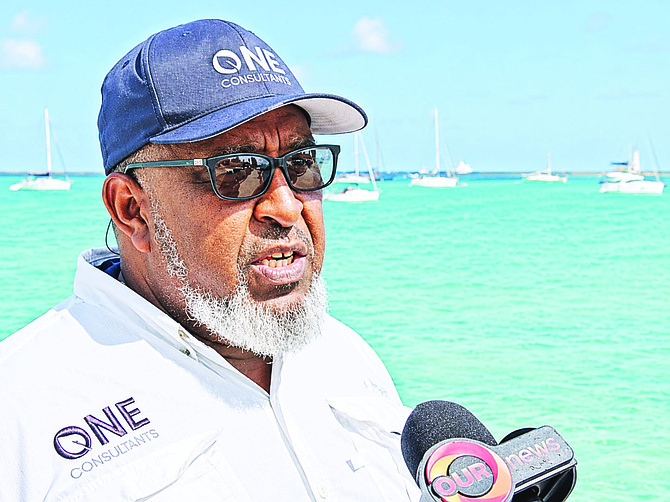
Eric Carey
By NEIL HARTNELL
TRIBUNE Business Editor
nhartnell@tribunemedia.net
A FORMER Bahamas National Trust (BNT) chief yesterday said the developers behind the 976-acre Windermere Point project have pledged to “bring to the table all the lessons learned” from their Abaco development and “minimise” any impact on environmentally sensitive Savannah Sound.
Eric Carey, who confirmed he has been hired as an “independent adviser” to Discovery Land Company’s project team, told Tribune Business the developer plans to apply its Baker’s Bay Golf & Ocean Club experiences in constructing its second Bahamas private members’ club on Eleuthera and “do all they can” to avoid negatively impacting the nearby marine protected area (MPA).
Promising that he himself will “not tell them what they want to hear”, he added that the developer plans to slope the proposed 18-hole golf course inward to prevent any chemical run-off that harms the coast, sea and nearby wildlife, while the use of fertilizer and pesticide treatments is to be sharply reduced and kept to a minimum.
Mr Carey, himself an Eleuthera resident, told this newspaper he has advised Discovery Land Company to speedily “come out of the gate” as a responsible environmental and corporate steward. He added that the developer was already speaking to the Government about how to improve the “already over-stretched” Palmetto Point landfill and address waste management prior to Windermere Point’s completion and the creation of additional trash.
The ex-BNT executive director also said the developer has reinforced the pledges made in its just-released environmental impact assessment (EIA) not to connect to Eleuthera’s existing public utilities systems and further over-burden power and water infrastructure unable to consistently meet present levels of demand.
Besides constructing its own reverse osmosis plant to supply what is envisaged as a 200-home strong residential community, complete with resort-style amenities and back-of-house operations, Discovery Land Company is also negotiating with the Davis administration to “provide as much of their own power as the Government will allow” with 30 percent of the project’s energy needs targeted to come from solar energy.
The developer’s own EIA concedes the project is planned for an area of “notable” environmental and ecological sensitivity given that Savannah Sound was declared one of The Bahamas’ numerous MPAs in 2021. Its environmental consultants described the area as being a “valuable nursery habitat with the high prevalence of juvenile fish species and endangered species such as the green turtle”.
“The MPA, the potential impact on that is the most significant impact the project will bring to bear on the environment,” Mr Carey acknowledged to Tribune Business. “There’s a golf course involved, so that is going to exert significant impact on the terrestrial environment. It’s going to require a loss of vegetation etc.
“It’s not a small project. It’s a major development project that will have significant impact on the environment. I have been engaged by the developer as an adviser. I have been discussing with them the lessons learned from the Baker’s Bay experience. I was part of the broader group of persons who were very concerned about the impact of the golf course run-off on the near-shore reef there.”
The Baker’s Bay Golf & Ocean Club project sparked the first major development-related environmental litigation in The Bahamas after it was unveiled almost two decades ago under the first Christie administration. The Save Guana Cay Reef Association, largely featuring local Guana Cay and Abaco residents, engaged Fred Smith KC to challenge the development’s permits and approvals in the courts via a Judicial Review action.
The legal battle lasted several years, eventually reaching the London-based Privy Council, the highest court in the Bahamian judicial system. However, the Association ultimately proved unsuccessful in overturning the approvals issued and halting the development, with former prime minister Hubert Ingraham, also the area’s MP, subsequently saying there was no good reason why Baker’s Bay could not proceed.
Discovery Land Company, as a result of the legal challenge, made several adjustments to its plans, including sloping the Baker’s Bay golf course inward to prevent run-off into the sea - one of the major concerns raised by environmentalists. The project has since become one of the more successful Family Island resort-style high-end communities and, having finished its build-out and real estate sales, Discovery Land Company is aiming to replicate the model.
Mr Carey said the developer’s executives and project managers have assured him that the Baker’s Bay experience will serve them well at Savannah Sound. “In discussions with the team, they represent that they have learned a lot from that experience,” he told Tribune Business.
“They will bring this experience, I have been advised, those lessons learned, to the table - in their words - to ensure that is not repeated, especially with regard to the MPA of Savannah Sound. They will bring those experiences to the table, and they have made a strong commitment to me to do all they can to minimise the impact on the MPA.
“I know they are looking at sloping the golf course inward. They had to do the same correction at Baker’s Bay,” the ex-BNT executive director added. “The way they are going to use pesticides and fertilizers, from my interaction with the team, golf course management has evolved considerably.
“What happens now, instead of the wholesale spraying of pesticides and fertilizer, the golf course management strategy employed by Discovery Land Company and Baker’s Bay has evolved to where they use localised.. almost spot treatments. The amount of chemicals used is small, and that keeps treating different parts of the golf course a manageable exercise. That’s what they advise they are bringing to the table.”
Disclosing that Discovery Land Company approached himself, rather than the other way around, Mr Carey added: “They know my views, and I told them I view my role as part of the team as an independent adviser, giving them frank advice. I will not tell them what they want to hear; I will tell them what they ought to do to avoid the pitfalls that happened at Baker’s Bay and do things better in Eleuthera.”
Mr Carey said Discovery Land Company “evolved” through the Baker’s Bay challenges “to be good stewards of the environment, good stewards of the community”, and he has impressed on them to do the same in Eleuthera and Savannah Sound.
“I said to them that they need to come out of the gate as community stewards,” he added, citing waste management as one area where it can make ann impact. “The Palmetto Point dump’s a mess and already over-stretched,” Mr Carey told this newspaper.
“I said to them: ‘You need to assist with a way to find a solution for what already exists and improvements for when the community [Windermere Point] comes on stream. They are having discussions with the Government on how to manage waste management streams. They have indicated they have intent to find a solution for the dump or waste management way before it becomes a problem and are forced to find a solution after the fact.”
Affirming that Windermere Point will source all its water needs from its own reverse osmosis plant, Mr Carey said the developer has promised him “there’s going to be zero impact on the fresh water grid of Eleuthera”.
He acknowledged the concerns about the extra demand that Windermere Point would add to Bahamas Power & Light’s (BPL) generation capacity and existing grid, which cannot cope with the current load based on the frequency and duration of outages, but said Discovery Land Company plans to produce and meet its own energy needs.
“They indicated that they are working with the Government, and will produce as much power as the Government will allow,” Mr Carey said. “They will provide additional generation capacity so that there is no impact on the grid unless and until BPL reaches capacity to be able to supply them and sell them electricity.
“Their plan is not to be dependent on, or stress, the grid. It’s in BPL’s economic interests to get the capacity to supply power to this community, but their intent is not to stress the grid because they know the grid cannot begin to carry the load their large development is going to require.”
Acknowledging the environmental risks that will have to be mitigated, the EIA on Windermere Point said: “Two notable sensitive environmental resources exist within the area of influence: The coastal mangrove and tidal flats of Savannah Sound, and the blue hole known as the Windermere Abyss.
“The Savannah Sound Marine Protected Area (MPA) was published in the Gazette Notice of Bahamas Protected Areas in 2021. The Sound was surveyed in 2017 by the Perry Institute of Marine Science (PIMS) in support of its MPA nomination.
“Findings from the qualitative survey performed by JSS Consulting in 2024 for this project also indicate valuable nursery habitat with the high prevalence of juvenile fish species and endangered species such as the green turtle. Its interconnected marine ecosystems contribute to biodiversity, local fisheries, shoreline protection and the ecological resilience of Central Eleuthera.”
The EIA outlined a number of methods and techniques to mitigate the environmental impact, including avoiding “coastal mangrove and seagrass habitat to the extent possible” and limiting marine works on the planned 30-space boat basin to channels and dock piles. Mangrove clearance will be limited to “hand clearing for dock placement” and Windermere Point will have its own wastewater treatment plant to prevent contamination of Savannah Sound.




Comments
Use the comment form below to begin a discussion about this content.
Sign in to comment
OpenID