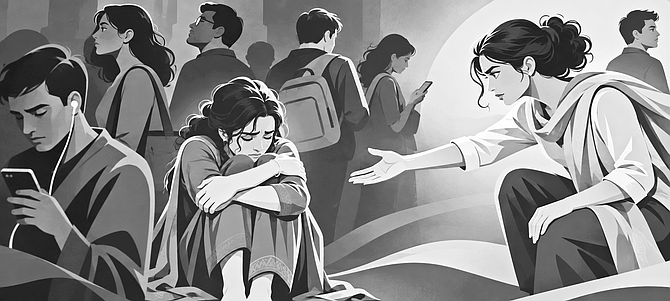
Today, International Day for the Elimination of Violence Against Women (IDEVAW), is the start of the Global 16 Days Campaign which runs until Human Rights Day on December 10. It is a period for multilateral institutions, governments, nongovernmental organizations, and activists to take action to end violence against women, from enacting and amending laws and implementing policies to conducting research and offering programs and services.
Following the development of the Global 16 Days Campaign by women’s rights activists who participated in a training institute, UN Women started using it for its own campaign, calling it “16 Days of Activism Against Gender-Based Violence.” The root, however, will always be in the passion and collaboration of women committed to activism to change the world. It was never meant to be a time for symbolic acts. It was always aimed at activating the world to pay attention to the pervasive issue that violence against women and calling on all people, everywhere, to take action to end this scourge.
Beyond the words of a theme
Every year, UN Women sets a theme, and this year it is “Speak out. Believe survivors. Demand justice.” This theme is rather basic in its message and aim. It is not only for survivors to speak out, but for those who witness violence against women to move from bystander to upstander status by intervening. In December 2024, a man attacked Latasha Rolle at a busy intersection while people watched from their vehicles until, finally, one man ran to help. The attack went on uninterrupted long enough for Ms. Rolle to sustain multiple serious injuries including two broken legs.
It is not only for people to believe the survivor, but to support them. In November 2026, student newspaper The Cornell Daily Sun published an editorial about the sexual assault case filed by Jane Doe after being gang raped by seven students. The university did not take sufficient action, and student journalists decided that they would not be complicit. The went beyond believing as a mental state, putting it into action. When you believe a survivor, you offer a level of care that goes beyond words. This group of students used the power of the press to call for accountability and press the university to deliver justice to Jane Doe.
It is not only for people to demand justice, but to shape it. Justice begins with the structure of society and all that is and is not permissible. It is in the way we raise children. It is in the way businesses operate. It is in the way doctors relate to their patients. It is in the way we respond when a person says they have been hurt by something we have said or done. It is in the way we seek to repair relationships. It is in the way we view and treat one another on a daily basis, beyond times of conflict. Justice is not only what occurs in the court room, but the mechanisms and practices that could prevent us from needing the judicial system. Justice is not (just) a prison sentence, particularly when a survivor depends on the income of the perpetrator to meet the needs of their children. The way we think about justice has to expand, and the version one need now is the one that is dictated by survivors themselves.
The reality of violence against women
Less than one in every four women who experienced physical or sexual violence sought help of any kind. Only 7 percent of women who experience physical or sexual violence went to the police for help. This is the result of multiple failures by governments and communities. It is the result of victim-blaming. It is the result of the shame imposed upon people who have been violated and convinced that it was their fault that they did not avoid it on their own. It is the result of careless reporting on physical and sexual violence in the media. It is the result of the refusal of police to take and act on reports and the message it sends to the community. It is the result of the court cases that have devalued women’s lives and found excuses for the men who enact violence against women and girls. It is the result of the religious (mis)leaders who insist that women must “submit” and interpret it as a woman being disempowered and reduced to objects that are to be possessed and used rather than loved, cared for, and respected. It is the result of cycles of violence in families that do not acknowledge it, intervene in it, or seek to break it.
Systems change
The Global 16 Days Campaign is one of the flagship events of Equality Bahamas, a feminist organization centering women’s and LGBTQI+ people’s rights as human rights and working to end gender-based violence. This year, Equality Bahamas has “DISRUPT” as its theme, noting the need to dismantle existing systems that were never built for with peace or equity in mind. The series of events is designed to encourage different ways of thinking, build skills, foster connections, and chart a path to peaceful, equitable futures. Below are details on the first four events.
Wednesday, November 25, 6pm: DISRUPT the Archive: An Erasure Poetry Workshop with Sonia Farmer
Erasure poetry is the act of removing text from recorded material to create a new narrative. In this workshop, we will use found texts around us—books, official reports, newspaper articles, speeches, manifestos, declarations, manuals, transcriptions, etc.—to experiment with this technique. Join Equality Bahamas at Poinciana Paper Press, 12 Parkgate Road for this free workshop. Register: tiny.cc/16dayspoetry
Thursday, November 26, 6pm: Safeguarding Against Technology-Facilitated Gender-Based Violence with Nicole Hendrickson (Trinidad and Tobago)
With the increase in digital tools, social media apps, messaging apps, and artificial intelligence, Technology-Facilitated Gender-Based Violence (TFGBV) is increasing in frequency and escalating in form and effect. From online harassment and stalking to deep fakes and sexual extortion, it is evolving and disproportionately impacting women, girls, LGBTQI+ people, and people with disabilities. In this session, we will look at statistics, domestic and international laws, digital platform responsibilities, the rights of users, and our own power to end TFGBV. Join Equality Bahamas for this virtual session. Register: tiny.cc/16daysgbv
Saturday, November 28, noon: DISRUPT: A Zine-Making Workshop with Sonia Farmer
Making your own books is an empowering and educational social practice that is available to anyone. In this workshop led by Sonia Farmer from Poinciana Paper Press, you'll learn all about making quick, simple, and effective books called "zines" in order to distribute your ideas and creative work on your own terms. This workshop encourages making and distributing publications by hand, bypassing AI algorithms, digital tracking and other forms of surveillance. You'll be encouraged to get creative with what you have, whether that be with professional or open-source designing software, found magazines and other collage materials, or just pen and paper. Join Equality Bahamas for at Poinciana Paper Press, 12 Parkgate Road for this session. Register: tiny.cc/16dayszines
Sunday, November 29 at 10am: Solidarity is Practice: Palestine and Collective Resistance with Dr. Shahd Qannam, Jackson Petit-Homme, and Rachel Freed
The genocide against the Palestinian people continues, enacted by “Israel” and funded by the U.S. Harmful technology is being tested on the Palestinian people, and the response by the rest of the world is taken as an indication of the evils we are willing to endure in silence. This conversation is a space to learn and strategize toward naming, rejecting, and equipping ourselves to push back against the violence, including ecocide and culturicide, by “Israel” against Palestine. Join Equality Bahamas for this virtual session. Register: tiny.cc/16dayspalestine
Tuesday, December 1 at 6pm: Contemporary Cuba and South-South Solidarity with Dr. Lisa Lawlor-Feller, Dr. Niambi Hall Campbell-Dean, and Ambassador Juan Carlos Marcof Sánchez
The U.S.-driven economic and fuel blockade on Cuba is having a devastating impact on the Cuban people. The decades-long imperialist aggression against Cuba has led to focused national development and self-sufficiency, and has not prevented Cuba from collaborating with and supporting States in the “Global South.” Dr. Lisa Lawlor Feller will share a contemporary history of Cuba, Niambi Hall Campbell-Dean will draw connections between Cuba and (States populated by) Afrodescendent people, and Ambassador Juan Carlos Marcof Sánchez will tell us about the current state of Cuba and ways we can stand in solidarity. Join Equality Bahamas for this virtual session. Register: tiny.cc/16dayscuba
See the full Global 16 Days Campaign event lineup and register




Comments
Use the comment form below to begin a discussion about this content.
Sign in to comment
OpenID