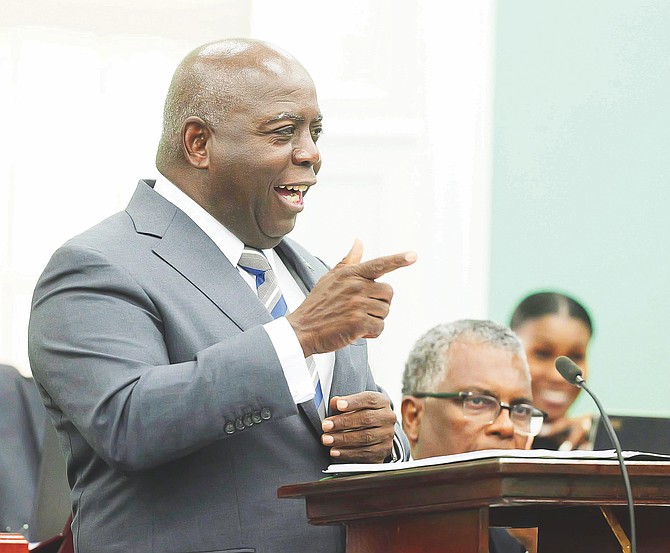
Prime Minister Philip "Brave" Davis
By KEILE CAMPBELL
Tribune Staff Reporter
kcampbell@tribunemedia.net
PRIME Minister Philip Davis told Parliament yesterday that the latest UN climate summit ended without naming fossil fuels as the cause of the climate crisis and dropped a key target for adaptation funding, an outcome he called "deeply disappointing" and said had convinced him The Bahamas must become more self-reliant.
COP31, the annual United Nations climate conference, was held this month in Antalya, Turkey. Mr Davis said it ended without an overarching political agreement after two weeks of negotiations and almost two days of overtime.
"Three years ago, in Dubai, nations agreed to transition away from fossil fuels in energy systems. In Antalya, the final draft made no reference to fossil fuels at all," he said. "The world gathered to confront a crisis driven largely by burning coal, oil and gas, yet some of those responsible for addressing it would not even name its principal cause."
Mr Davis said a target of $120 billion a year in adaptation finance by 2035 had been removed from the draft agreement, an omission he called dangerous for countries like The Bahamas. Adaptation finance helps vulnerable countries pay for stronger sea defences, more resilient infrastructure and early warning systems.
"Every dollar we spend repairing storm damage is a dollar we cannot invest in a new school, a hospital, affordable housing, or opportunities for our young people," he said. "There is a fundamental injustice in requiring nations like ours to borrow and rebuild, again and again, because of a crisis largely created elsewhere."
He said The Bahamas joined the Caribbean Community (CARICOM) and the Alliance of Small Island States in refusing to endorse an outcome that would have weakened existing commitments.
"We could not, in good conscience, come home and tell the Bahamian people that we had given up protections we have spent years fighting for," Mr Davis said.
The Bahamas went to Antalya seeking stronger commitments to cut global emissions, better access to climate finance, progress for small island developing states and international support for its blue carbon programme.
Mr Davis said the country must keep pushing for international action while investing in its own ability to withstand climate threats, protect its natural resources and create economic opportunities.
"We must stay engaged with the world, but we must never surrender responsibility for our future to decisions made elsewhere," he said. "The international community has to act on climate change and provide the finance vulnerable countries need. We will continue to insist that it does."
He pointed to the Bahamas Blue Carbon Programme as one area where the government can press ahead on its own. Earlier this month he announced a further $75m for the programme's second phase, following what he described as a $25m first phase.
He said the money would pay for measurement, reporting, independent verification, conservation and building the institutions needed to run the programme. But he stressed that the country's seagrass beds do not automatically become carbon credits that can be sold.
"Scientific requirements, international accounting standards and legal obligations must all be met first," he said. "For the avoidance of doubt, Madam Speaker, no carbon credits under this programme have yet been authorised, issued or sold."
In 2022, Mr Davis said The Bahamas expected to begin selling blue carbon credits by the end of that year.
He also outlined the previously announced Bahamas Blue Economy Institute. He said it would advance ocean research, conservation and scientific training, and oversee how any money from verified carbon credits is managed.
Mr Davis said Family Island communities, fishermen and local businesses must have a stake in the programme. He said it should also create opportunities for Bahamians studying marine biology, environmental science, technology, finance and international law.
"Our objective is to finance genuine conservation while securing a fair economic return for Bahamians," he said.
He said the government would keep working with neighbouring countries and other vulnerable nations ahead of next year's COP32 summit.




Comments
Use the comment form below to begin a discussion about this content.
Sign in to comment
OpenID