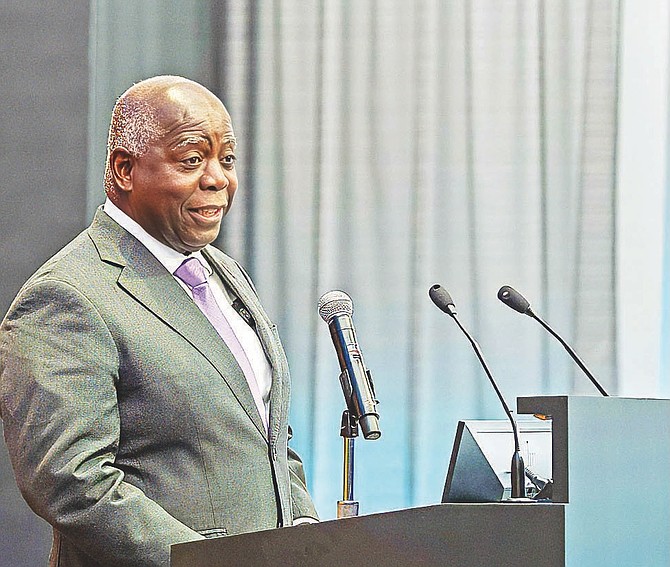
PRIME Minister Philip ‘Brave’ Davis speaks during the United Nations General Assembly in New York on September 25th, 2026
THE government yesterday said there was no evidence its pre-election voucher spending affected the general election, but did not refute the Public Accounts Committee's damning allegations about how the programme was ran.
In a statement responding to the committee's report, the government said the evidence "does not establish that the 1.5 million dollars spent had any impact, determined or materially influenced the outcome of the 2026 General Election".
The committee's report did not claim the spending changed the election result. It found "systemic mismanagement, maladministration and political misuse of public resources" in the Ministry of Finance's voucher and small home repair programmes, which spent $1.56m in March and April, in the run-up to the May 12 election. It recommended referring the evidence to the Royal Bahamas Police Force to examine possible public-finance, procurement and electoral offences.
The government's statement made no mention of the police referral. Nor did it address the committee's findings that Jerome Fitzgerald, then the Prime Minister's senior policy adviser and the PLP's national election coordinator, distributed large quantities of the vouchers without recording who got them. It was also silent on the finding that Financial Secretary Simon Wilson failed to keep the money under control.
It said instead that "some transactions identified by the Committee warrant further examination", and promised that "the appropriate corrective administrative adjustment and action will follow" where spending was found to fall outside the programme's purpose.
The government also said the evidence did not show that people who received home repairs favoured any political party. The committee had said it could not identify who received much of the assistance, because no complete record of recipients was kept.
The statement said the committee's own report acknowledged that "legitimate home repairs occurred and that genuine assistance was provided". The report accepted that "some genuine repairs occurred". It concluded that the government still could not trace the programme to the people who benefited or show it delivered value for money.
The government defended home repair aid as a long-standing programme that has served successive administrations. It said many seniors, low-income households and vulnerable families could not afford to repair a roof, replace damaged windows or fix structural problems.
"There are still senior citizens living in homes that require urgent repairs. There are still families struggling with leaking roofs and deteriorating living conditions," the statement said.
The government acknowledged there was "always room to improve administrative procedures, strengthen internal controls, enhance record keeping and ensure greater accountability". It said it intended to expand the Small Home Repair Programme and increase investment in home repair assistance, while tightening the administrative and financial controls governing it.
The committee's inquiry began after The Tribune reported in April that gift certificates worth more than $200,000, paid for by the Ministry of Finance, were being handed to Abaco residents in the names of PLP candidates and officials.
Among other findings, the committee said a $150,000 government-funded account at Pinder Enterprises was divided into allocations for PLP MPs and a PLP candidate who held no government office. It also found no public application process or published rules on who qualified.
Committee chairman and Opposition Leader Michael Pintard said the report "paints a picture of political misuse and abuse of the Treasury to support an election campaign".




Comments
Use the comment form below to begin a discussion about this content.
Sign in to comment
OpenID