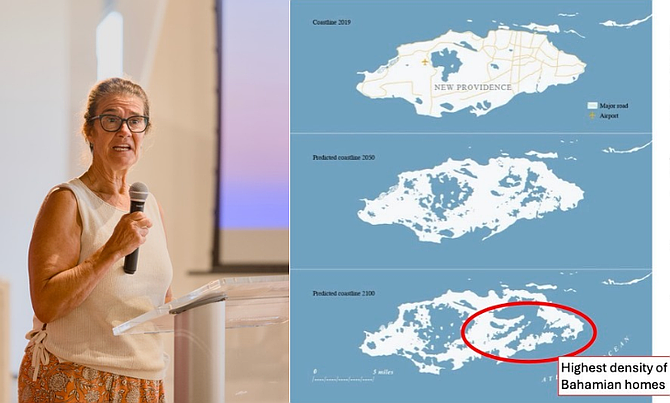
A slide from Dr Kathleen Sullivan Sealey’s Bahamas Climate Week presentation illustrates the projected loss of liveable land in New Providence over time.
By AVA TURNQUEST
Tribune Digital Editor
aturnquest@tribunemedia.net
NEW PROVIDENCE could face the loss of liveable land in some of its most densely populated communities in the coming decades, according to marine ecologist Dr Kathleen Sullivan Sealey, who says The Bahamas must begin planning now for the eventual relocation of people from high-risk areas.
Speaking during Bahamas Climate Week, hosted by the Baha Mar Resort Foundation, Dr Sullivan Sealey pointed to projections for New Providence through 2050 and 2100, warning that areas where large numbers of Bahamians are moving and building homes are among those facing the greatest threat.
“For New Providence, everybody’s moving south,” she said. “They’re the highest density Bahamian homes in areas that we’re going to have the greatest loss of liveable areas. So we’re going to need managed retreat from some areas.”
She said the country must begin confronting what that could mean for families long before relocation becomes unavoidable.
“We have to introduce that idea in managing those coastlines,” she said. “You may live in this home, but your children and grandchildren may not be able to live there. We need better resources and governance of those resources so they’re more equally distributed.”
Dr Sullivan Sealey is Professor Emerita at the University of Miami, and a board member of the Bahamas Academy of Sciences.
She underscored the country's exposure to climate change has been compounded by decades of development that have weakened the natural systems that once protected its coastlines.
She pointed to the removal of mangroves, coastal areas filled to create valuable land and development allowed close to the sea, while coral reefs, seagrass beds and dunes have also been degraded.
“We collectively have not taken very good care of our islands,” she said. “We’ve been sold this lie that environmental destruction is necessary for economic development, that jobs require loss of our natural environment, and that is a lie. There have been historic losses from coral reefs, seagrasses, mangroves and dunes.”
She said those losses have reduced the country's ability to withstand worsening climate impacts and made communities more exposed to storms and flooding.
“Coastal development has already reduced our natural defences,” she said. “It’s far, far, far more expensive to restore or put in new coastal defences like seawalls than it is to protect the original coastline. We have an already weakened coastal ecosystem that is not prepared to take on these changes from the climate.”
Dr Sullivan Sealey identified storms, extreme heat and infrastructure deficiencies among the major climate risks facing the country.
She also singled out Grand Bahama, warning that rising seas could dramatically alter the island's geography.
“Freeport is probably our highest risk island as sea level rises,” she said. “Grand Bahama is going to be cut into eight different islands. We’re going to have to have a bridge.”
Dr Sullivan Sealey said The Bahamas should begin developing relocation and retreat strategies now, alongside greater protection of coastal wetlands, improved wastewater and stormwater management and stronger oversight of coastal development.
She said nature-based solutions should also be considered to protect valuable infrastructure already located along vulnerable coastlines.
“We need to be starting and looking very seriously at nature-based solutions and mitigating high-value, high-risk assets that exist along the coast today,” she said. “We need a national climate action plan. Everybody knows this — to protect and restore coastal wetlands.”




Comments
Use the comment form below to begin a discussion about this content.
Sign in to comment
OpenID