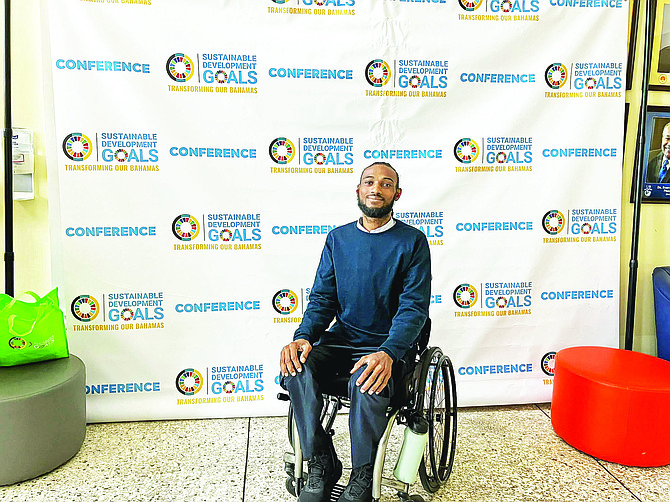
Thorne Clarke
By KEILE CAMPBELL
Tribune Staff Reporter
kcampbell@tribunemedia.net
THE MAN awarded nearly $1m after being left paralysed by a police bullet says he has never received an apology or the names of the officers involved.
Thorne Clarke, who was left wheelchair-bound, was awared $941,893.91 – seven years after judgment was entered against the Commissioner of Police and the Attorney General for failing to file a defence to his lawsuit.
Mr Clarke, 32, told The Tribune yesterday he was grateful for it, but believed it could have been more and would not cover a lifetime of medical care, equipment and accessible transport.
Had his case been settled sooner, he said, the money could have gone further towards improving his quality of life while he adapted to his injuries.
"All of these things have to be done," he said, "and this is something that I have to live with for the rest of my life."
Police and Mr Clarke gave differing accounts of the 2016 encounter. Police said he had attempted to drive into an officer; Mr Clarke denied doing so. The competing accounts were never resolved at a civil trial because the court entered judgment in default of defence, and later proceedings concerned damages.
Mr Clarke said he has received no findings from police about the shooting.
"I wasn't issued any statement from police at all from then to now," he said.
He said a public apology would be meaningful to him and could help build trust between police and the public.
Assistant Registrar Jonathan Deal assessed the damages in a judgment dated September 21. Mr Clarke, who sued in 2018, had sought $2.064m. He has already received an $80,000 interim payment, leaving $861,893.91 outstanding before applicable interest and costs.
He received the interim payment after developing a severe pressure ulcer for which a doctor recommended surgery. He said the operation had not yet been scheduled, although he was making arrangements for it, and described his present health as "pretty good".
Mr Clarke said he has medical bills to meet and needs wheelchairs and other equipment that must be replaced. Accessible transport and further changes to his home will also cost money.
He said he regularly needs diapers, catheters and cushions to relieve pressure while sitting. The type of cushion he uses costs upwards of $400 and must be replaced periodically, he said, and he estimated that his wheelchair needs replacing every three to five years because of wear and mechanical problems.
Without an accessible vehicle, he relies on family and friends for rides. He said he intends to set aside most of the award for disability-related needs.
His condition sometimes requires him to leave work early, he said. Mr Clarke credited his employer, the National Commission for Persons with Disabilities, with making accommodations for him, including buying a changing station.
The shooting also placed financial and physical demands on his family that continue to shape their lives, he said. His mother left work to care for him in the early years after the shooting and eventually closed her business. His father had to keep working after retiring to help cover regular bills and additional expenses.
The family paid out of pocket to install ramps and adapt the bathroom, he said, but has yet to make every change the home needs.
Mr Clarke said the first years after the shooting were the most difficult emotionally. He recalled becoming isolated, falling into depression and struggling with anger as he adjusted to paralysis.
"In those early years," he said, "I never imagined I'd be in a position like this, where my story could help people, where my voice could help people, where people look at me for inspiration."
He said his faith remains a source of support. Through his work at the commission, he has met people with disabilities who lack the resources he has been able to draw on, and he said he wants to find ways to support them and to make society more accessible.
He said he hopes his case will prompt greater urgency in resolving claims involving life-changing injuries, and will draw attention to people with disabilities who have neither a damages award nor family resources to help meet their needs. He urged businesses to consider access to employment and to ordinary public places, saying accessibility involves more than installing a wheelchair ramp.
"A lot of people ask me early on, you know, what do you do for fun or where do you go," he said, "and I normally respond with: 'Where do you think I can go?'"
"We need to start treating accessibility as an essential rather than a luxury," he said.




Comments
Use the comment form below to begin a discussion about this content.
Sign in to comment
OpenID