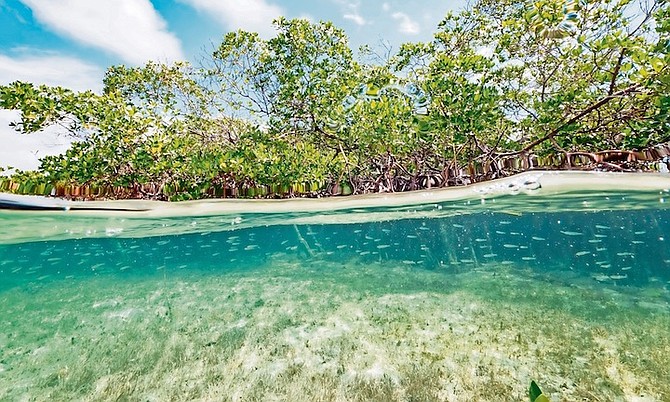
PHOTO COURTESY OF BAHAMAS NATIONAL TRUST.
By RASHAD ROLLE
Tribune News Editor
rrolle@tribunemedia.net
CADMIUM, a toxic metal linked to cancer, has been found in mangrove sediment in East Grand Bahama at more than 700 times the reference level used by University of The Bahamas researchers, prompting calls for public health precautions at the most contaminated sites.
The findings, to be published in the International Journal of Bahamian Studies, raise concerns about possible cancer and other health risks, particularly to children, and suggest that heavy metal contamination in Bahamian mangroves may be far more serious than previously understood.
Researchers found that cadmium concentrations in East Grand Bahama averaged 442.58 milligrams per kilogram of sediment, compared with a reference value of just 0.6mg/kg. In Dover Sound, another area examined in the study, the average was 25.64mg/kg, although the metal was undetectable at three of the five sampling locations.
The researchers said the concentrations were substantially higher than those reported in comparable studies of coastal and mangrove environments elsewhere.
At three locations in East Grand Bahama, where contamination was most severe, they recommended precautionary measures, including consideration of public advisories and further assessments of how people might be exposed.
The study also identified potentially significant health risks using a screening method developed by the United States Environmental Protection Agency.
Under that method, researchers calculated possible exposure from accidentally swallowing contaminated sediment, inhaling particles and skin contact.
Every estimate of cancer risk associated with cadmium exceeded the EPA's level of potential concern for both adults and children. For other health effects, the average estimated risk exceeded the agency's threshold for possible harm among children, while the highest readings also exceeded it for adults.
Children were considered particularly vulnerable because their smaller body weight can result in greater exposure relative to their size.
The researchers cautioned, however, that these calculations were based on standard exposure assumptions and did not establish that anyone had developed cancer or another illness because of the contamination. The study examined sediment rather than fish or other seafood, leaving questions about possible exposure through the food chain unanswered.
The research was conducted by Antonio Cadet, Veronica Toppin, Tamia Hamilton, Carlton Watson and Williamson Gustave, who collected 48 samples from 12 locations in Dover Sound and East Grand Bahama.
Samples were taken from the upper 20 centimetres of sediment and analysed at the university's Soil and Complex Matrix Laboratory.
The two areas were selected partly because of their differing surroundings. Dover Sound is near industrial and waste-handling facilities, while East Grand Bahama is less industrialised.
Despite that distinction, East Grand Bahama recorded the highest cadmium concentrations and the three locations with the greatest ecological risk.
The researchers also found antimony above its reference value in both areas, while copper exceeded its reference value in Dover Sound.
The findings are significant because mangroves naturally trap particles carried by water, including pollutants attached to them. Their sediment can therefore accumulate heavy metals over time, providing a record of contamination in surrounding environments.
Unlike many other pollutants, heavy metals do not readily break down. They can accumulate in living organisms and move through food chains, potentially harming wildlife and human health.
The researchers assessed ecological risks and classified most sampling locations as presenting very high risk, driven largely by cadmium.
One measure of overall pollution nevertheless produced a less alarming result. A combined index averaging the concentrations of all metals tested did not classify either area as polluted overall.
The researchers warned that such averages could conceal exceptionally high concentrations of individual metals, making them unreliable as the sole measure of environmental danger.
They also suggested that the true extent of contamination could be greater than their figures indicate.
Because The Bahamas lacks established local reference values for heavy metals in mangrove sediment, the study relied on values derived from Cuban soils.
Those soils contain more clay and retain metals more readily than the carbonate sediments characteristic of The Bahamas. The researchers said local baseline concentrations were therefore likely to be lower, meaning the degree of cadmium enrichment could be even greater than their calculations suggested.
The source of the contamination remains uncertain.
Researchers identified several possible human-related contributors, including industrial discharge, improper waste disposal and stormwater carrying contaminated material into coastal environments.
They also referred to public concerns about illegal dumping around Freeport and identified electronic waste as a potential source of metals such as cadmium, arsenic and lead.
Hurricane Dorian, which devastated Grand Bahama in 2019, was identified as another possible factor.
The researchers said flooding and storm surge could have redistributed contaminated material along the coastline. However, without sediment measurements taken before the hurricane, they could not establish whether Dorian contributed to the concentrations recorded.
The study is believed to be the first published investigation of heavy metal contamination and associated ecological and human health risks in Bahamian mangrove sediment.
Previous Bahamian research examined metals in cave sediments, coastal sharks, seagrass beds and marinas on Abaco, while a recent review of Caribbean contamination did not include The Bahamas.
The researchers said the findings demonstrated the need for sustained monitoring, particularly of cadmium and antimony, and for the establishment of reference values specific to Bahamian environments.
They also recommended extending similar investigations to other islands and conducting further assessments at the three most contaminated locations to determine the extent of human exposure.
The work comes amid wider concern about the deterioration of mangrove ecosystems, which provide important coastal habitats but face mounting pressure from development and pollution.
According to the study, about 35 percent of the world's mangroves have disappeared since the middle of the 20th century.
The researchers said their findings should help inform environmental management and national policy, including Vision 2040.
The study was funded by the Wilson Grant and The Nature Conservancy.
It will appear in Volume 32 of the International Journal of Bahamian Studies, which will be launched on Tuesday, October 20, at 2pm in the Harry C Moore Library auditorium. Researchers will present their findings at the event, which is open to the public.




Comments
Sickened 2 hours, 21 minutes ago
I absolutely love that our University is doing these studies and that it makes the news.
Hopefully there are a lot more studies being undertaken and will someday make the news.
AnObserver 32 minutes ago
Cadmium waste is often generated by shipyards. Just sayin'
Sign in to comment
OpenID