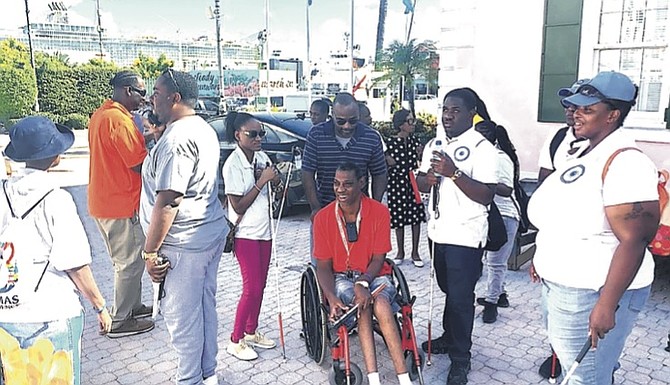
The Bahamas Alliance for the Blind and Visually impaired led a walk from Rawson Square to Government House to mark White Cane Day.
By JADE RUSSELL
Tribune Staff Reporter
jrussell@tribunemedia.net
ADVOCATES yesterday insisted The Bahamas continues to lag behind other countries in providing infrastructure that allows blind and visually impaired people to navigate public spaces independently.
Stefan Pitt of the Bahamas Alliance for the Blind and Visually Impaired spoke with The Tribune after his organization led a walk from Rawson Square to Government House to mark White Cane Day.
The demonstration aimed to show that blind and visually impaired people can live independently with proper mobility training rather than having to rely on others to get around.
The organisation has about 70 members, some of whom did not participate in yesterday’s walk because they were afraid of navigating public spaces.
“Some of our members are afraid of falling. They don't want to miss their step, fall down or buck into something and hurt themselves,” Mr Pitt said.
He said sidewalks in The Bahamas are not fully accessible to people with disabilities. He also pointed to traffic lights in other countries that have audible signals to help blind and visually impaired pedestrians determine when it is safe to cross the road. “In my opinion because I travel a lot,” he added, “We're far behind other countries.”
Mr Pitt said the organisation was working to promote education and independence among people with visual impairments.
He recalled that one member living in Long Island had never attended school or received adequate access to education. “She basically sits home all day and tries to learn the best way she can.
She comes over every now and then, but it's not effective,” he said.
Mr Pitt said he hoped to use knowledge gained from travelling abroad to help others facing similar challenges in The Bahamas.
Meanwhile, Social Services Minister Senator Barbara Cartwright reaffirmed the government's commitment this week to strengthening protections and expanding opportunities for people with disabilities, saying inclusion must extend to workplaces, schools, transportation, housing and full participation in community life.
Ms Cartwright made the remarks during the “Let’s Talk Disability Affairs” town hall meeting, organised by the National Commission for Persons with Disabilities at DW Davis High School.
The meeting brought together people with disabilities, advocates, government representatives and members of the public to discuss issues affecting the disability community.Topics included social assistance, disability awareness, registration with the commission, the AccessAbility Bahamas app, Urban Renewal services, National Insurance benefits, accessibility, advocacy and equal opportunities.
Ms Cartwright also highlighted provisions in the recently tabled Persons with Disabilities (Equal Opportunities) Amendment Bill, 2026, which proposes stronger measures addressing employment, workplace accommodations, abuse, accessibility and enforcement.
The proposed amendments include expanded employment requirements for companies with 50 or more workers, moving towards a two per cent staff quota for people with disabilities. They would also require employers, where possible, to reassign workers who develop disabilities on the job and can no longer perform their original duties.
Other proposed changes include stronger accessibility requirements for new public buildings and criminal penalties for physical, sexual, psychological and financial abuse of people with disabilities.
The amendments would also strengthen employment tracking and placement through collaboration between the Department of Labour and the commission.




Comments
Use the comment form below to begin a discussion about this content.
Sign in to comment
OpenID