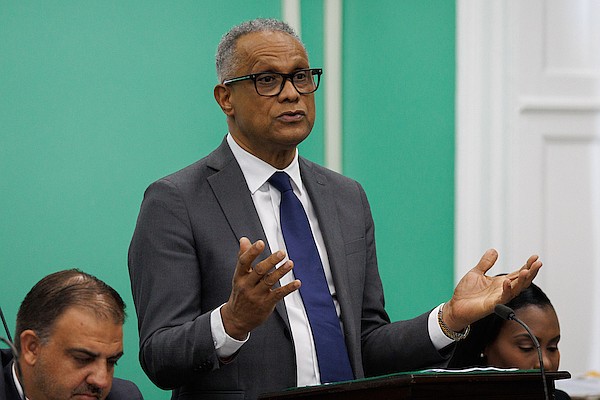
Minister of Health and Wellness Dr Michael Darville speaks in the House of Assembly on July 30, 2025. Photo: Dante Carrer/Tribune Staff
By EARYEL BOWLEG
Tribune Staff Reporter
ebowleg@tribunemedia.net
THE number of newly reported impetigo cases has declined significantly, with health officials recording just seven new infections this week in New Providence and Grand Bahama, according to Minister of Health and Wellness Dr Michael Darville.
Dr Darville said yesterday that, as of Wednesday, October 14, four new cases had been reported in New Providence and three in Grand Bahama. No new cases were reported in the Family Islands.
Although impetigo is not classified as a reportable disease under World Health Organization (WHO) and Pan American Health Organization (PAHO) guidelines, local health officials have been monitoring infections daily because of their impact on schoolchildren.
However, the ministry does not have a definitive overall case count, as some infections treated at private healthcare facilities may not be reported.
“While these figures are encouraging, a reduction in reported cases does not necessarily mean that transmission has completely stopped. Continued monitoring and vigilance is important for us in the Department of Public Health, as well as our clinics and schools across our archipelago,” Dr Darville said.
Impetigo is a common, highly contagious bacterial skin infection that spreads particularly among young and school-age children.
It typically begins as small sores or blisters that rupture and develop yellow, honey-coloured crusts, often around the mouth and nose. The infection spreads through direct contact with infected skin or contaminated personal items, including towels, clothing and bedding.
Acting Director of Public Health Dr Philip Swann said fewer than 70 cases had been recorded during the earlier surveillance period, compared with fewer than ten so far this week.
He said most infections appeared to be isolated cases, although health officials had identified instances of multiple students being infected at the same school, sometimes within the same grade.
Dr Swann said cases had also been identified among students in different grades with no known contact.
“There's also children other grades who normally interact with other students in those lower grades. For example, pre-K in some cases, and then grade six or grade nine in other schools with no known contact,” he said.
Asked which age group had been most affected, Dr Swann said cases appeared to be concentrated among students in grades four to ten.
Dr Darville said the Ministry of Health and Wellness had been working closely with the Ministry of Education, Science and Technology to address the infections in schools.
A virtual meeting was held on October 9 with the Director of Education, senior school administrators and other education officials, attracting more than 130 participants.
Dr Darville welcomed the Ministry of Education’s deep cleaning of schools to help curb the spread of impetigo and urged continued handwashing, proper care of infected areas and avoiding the sharing of personal items.
He stressed that children affected by impetigo should not be stigmatised.
The minister also encouraged teachers and school administrators to reinforce hygiene practices, maintain cleaning measures and communicate with parents when children show symptoms. The minister said teachers were not expected to diagnose the infection but played an important role in identifying possible cases.




Comments
Use the comment form below to begin a discussion about this content.
Sign in to comment
OpenID