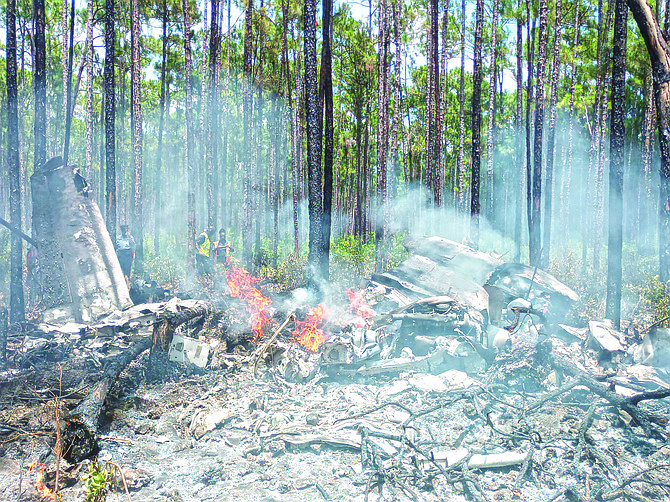
THE SMOULDERING remains of a Cessna 402 belonging to Flamingo Air after the plane went down in a pine forest in North Andros killing all ten people onboard, including the pilot.
By NEIL HARTNELL
TRIBUNE Business Editor
nhartnell@tribunemedia.net
THE BAHAMAS must “break the silos” and stop only responding when “crisis” strikes, aviation executives argued yesterday, after investigators urged greater surveillance and “preventative intervention” in response to the fatal Independence Day plane crash.
Dr Anthony Hamilton, president of the Bahamas Association of Air Transport Operators, and administrative chief at Southern Air Charter, told Tribune Business that “no one has a bye” and it will require “commitment and sacrifice” from all industry stakeholders to correct safety woes and other deficiencies impacting the industry.
He spoke out after the Aircraft Accident Investigation Authority (AAIA), in the latest update on its probe into the tragic crash that claimed the lives of the pilot and nine passengers during the 53rd Independence celebrations, revealed it has issued two safety recommendations for the Civil Aviation Authority of The Bahamas (CAAB) to implement.
One calls for greater “preventative regulatory intervention” by the CAAB, which has primary responsibility for regulating commercial and civil aviation, including the creation of risk-based safety “triggers” and escalated supervision for operators and pilots who display a “pattern” of involvement in safety-related events.
The other recommends heightened safety oversight and surveillance during peak domestic air travel periods such as public festivals, regattas, homecomings and other festivals as a means to boost regulation amid more frequent and packed flights.
“The AAIA recommends that Civil Aviation Authority Bahamas establish and implement a documented, risk-based internal safety event triggering and escalation mechanism for regulated entities based on the number, frequency, severity and pattern of safety-related events within a defined period,” the AAIA said.
In reply, it added that the Civil Aviation Authority Bahamas has already supplied it with its “existing risk-base surveillance methodology”, which analyses “occurrence trends, compliance histories, audit findings and corrective action performance to prioritise oversight”.
The Civil Aviation Authority Bahamas had also advised it is “formalising” a documented safety event triggering and escalation mechanism that features “defined trigger criteria, escalation levels, responsibilities” and other provisions plus provided three examples of its actual application.
The AAIA said this addresses “the intent” of its safety recommendation and “presents a credible framework of preventative regulatory intervention”. However, signalling that it is now looking for execution and implementation by Civil Aviation Authority Bahamas, it added that it will continue to review the procedure, records and “consistent operational application” before deeming the issue closed.
As for the second safety-related recommendation, the AAIA said: “AAIA recommends that the Civil Aviation Authority Bahamas develop and implement a formal, risk-based mechanism to identify periods of significantly increased domestic aviation activity - including public holidays, regattas, festivals and homecomings and apply enhanced safety oversight during such periods.
“CAA-B advised that, effective September 2026, satellite office surveillance coverage was expanded from a general 9am to 5pm schedule to 7am to 6pm, incorporating weekends and public holidays while retaining risk-based prioritisation. CAA-B also indicated that inspector surveillance records would be examined to verify completion and documentation of assigned activities.
“Expanded coverage is a positive and relevant measure, particularly for weekends and public holidays,” the AAIA added. “Continued review of evidence is required to establish that CAA-B has implemented a formal method for anticipating event-driven peaks in domestic aviation activity, and systematically directing enhanced oversight to the associated risks, as distinct from merely extending routine coverage hours.”
The AAIA said it considered Civil Aviation Authority Bahamas’ reply as “responsive”, but that not “all corrective actions have been completed”. Dr Hamilton, responding to the two recommendations, told Tribune Business that “all of us have a role to play” in the industry in addressing weaknesses, adding that “it’s only when a crisis comes that we pay attention to it”.
“Honestly, Neil, there’s nothing new about this,” the Southern Air and Association chief said. “We’ve known this for a long time about this industry. The industry needs a mindset of looking to ensure we are moving forward together. There are a number of silos in the industry, and they need to be broken.
“It’s only in a crisis situation where we’re seeing a coming together in that instance, and it’s blown away. We need to determine deliberately and intentionally as fas as the aviation industry in The Bahamas is concerned. It’s a bunch of lip service until we sit down and do it properly, and hold everyone accountable.
“No one has a bye,” Dr Hamilton added. “All of us are in this together, and it will not be corrected if we continue to operate in silos. None of us are exempted. In the Bahamian aviation industry, we must come together and fix it. If we come as a group, we will be able to fix this.
“It will take commitment and sacrifice, and many are not prepared to make the commitment and sacrifice to get this corrected. We can talk as much as we like, but until we get together and be focused about it… Everyone from top to bottom has to come to the table to be focused to correct it otherwise it’s a waste of time, a bunch of lip service and we’ll continue to make the mistakes.”
Dr Hamilton added that the Bahamian aviation industry needs an “atmosphere and environment” where all elements and voices are able to participate, otherwise there will be push back and resistance to reforms and change.
“A lot of things have been lagging,” he said. “There’s a lot of lag in the system. By design the system is supposed to be highly effective. That’s the only way in which the industry is going to make it. We just have to roll up our sleeves and get this thing done. Talking is over with the loss of those lives.
“Without exception, all of us have a responsibility. The entire ecosystem of Bahamian aviation has to be brought to account, stand up, take the necessary responsibility and do what we need to do… Follow through must take place so that the kind of investment being made, and that ought to be made in the industry, we can get true investment value for the benefit of all of us. That’s the way forward.”
Captain Randy Butler, the former Sky Bahamas chief executive and an ex-Civil Aviation staffer, who is now focused on industry safety, confirmed to Tribune Business that the Air Accident Investigation Authority’s release confirms it is looking for the Civil Aviation Authority Bahamas to demonstrate it is implementing and executing the two safety recommendations.
He suggested the issues raised by the Air Accident Investigation Authority are “not entirely new” as a similar call for greater oversight during Bahamian holidays and peak travel periods had been made in the wake of the 2022 Long Island regatta crash, which claimed one life.
“I think it points to the fact that surveillance and safety oversight must be continuous,” Captain Butler said. “They left it open so they did not close the question. The whole goal is prevention. It’s active prevention and continued Civil Aviation oversight.
“We have this identical recommendation again, so we did not follow through the first time this came about. We will probably be here again if Civil Aviation does not implement. The promise to do is just not enough.”
Captain Butler added that, during his time with Civil Aviation, any operator with a history of accidents or safety incidents “would have been elevated to heightened surveillance” and due diligence through inspections of their planes, operations and flying on their flights.
“The latest recommendations issued by the Aircraft Accident Investigation Authority (AAIA) following the tragic San Andros aircraft accident highlight the importance of continuous, effective aviation safety oversight throughout The Bahamas,” he added.
“The recommendations address two essential responsibilities: Identifying repeated or serious safety concerns before they develop into greater dangers, and strengthening surveillance during periods of increased domestic aviation activity, including regattas, homecomings and public holidays.”
Captain Butler, though, said: “These concerns are not entirely new. Following the June 2022 accident involving a US-registered Piper Navajo at Deadman’s Cay, Long Island, which claimed one life, the AAIA raised a safety concern with the United States Federal Aviation Administration (FAA) in February 2023.
“That concern called attention to the need for enhanced surveillance of US-registered aircraft operating in The Bahamas. The FAA responded that enhanced efforts would be undertaken in collaboration with CAA-B.
“It is therefore reasonable to ask what surveillance arrangements were subsequently implemented, what results were achieved and how those earlier lessons are informing the Authority’s present actions.”
“I also welcome the reported extension of surveillance office hours during weekends and public holidays,” Captain Butler continued. “However, extending office hours is not necessarily the same as conducting effective inspections where aviation activity and risks are greatest.
“In an archipelago such as The Bahamas, inspectors must have the personnel, transportation and resources necessary to reach the Family Islands regularly. I welcome the Prime Minister’s expressed confidence in our aviation safety system. My objective is to support that confidence through transparency, continuous improvement and demonstrated results.
“I am not suggesting that these recommendations establish the cause of the San Andros accident or prove regulatory failure. That investigation remains ongoing.
“We cannot simply promise to address safety concerns. We must implement corrective actions, verify that they work and ensure that the same concerns do not continue to arise after another tragedy. Aviation safety must be about prevention, not merely responding to accidents.”




Comments
Use the comment form below to begin a discussion about this content.
Sign in to comment
OpenID