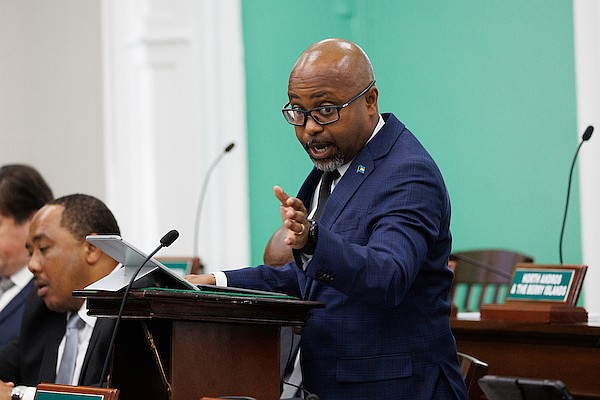
East Grand Bahama MP Kwasi Thompson in the House of Assembly. Photo: Dante Carrer/Tribune Staff
By DENISE MAYCOCK
Tribune Freeport Reporter
dmaycock@tribunemedia.net
ENVIRONMENT Minister Zane Lightbourne described as ‘inconclusive’ University of The Bahamas research that found cancer-linked cadmium in East Grand Bahama mangroves at more than 700 times the reference level, as the area’s MP demanded government money to trace the contamination and clean it up.
East Grand Bahama MP Kwasi Thompson, who attended a presentation of the findings on Tuesday, disputed that description in the House of Assembly on Wednesday. Although he agreed that the results should be independently verified, he said: “The authors were adamant in terms of standing by their results”.
Minister of Health and Wellness Dr Michael Darville said the government “takes this very seriously”. He said his ministry and the Ministry of the Environment wanted an independent study to test whether UB’s findings could be replicated and, if contamination was confirmed, to find its source.
The research, by Antonio Cadet, Veronica Toppin, Tamia Hamilton, Carlton Watson and Williamson Gustave, found average cadmium concentrations of 442.58 milligrams per kilogram of sediment in East Grand Bahama, compared with a reference value of 0.6mg/kg. The team collected 48 sediment samples from 12 locations in Dover Sound and East Grand Bahama.
Every cancer-risk estimate linked to cadmium exceeded the US Environmental Protection Agency’s level of potential concern for both adults and children. Estimates of other health effects raised particular concern for children. At the three most contaminated locations, the researchers recommended precautionary measures, including considering public advisories and further assessing how people might be exposed.
Mr Thompson, a Free National Movement MP, commended the researchers. He said they told him they needed more money to find out where the cadmium came from, establish whether contamination extended beyond the areas already tested, and work out what would be required to clean it up. He urged the government to pay for that work in East Grand Bahama and in other parts of the island where similar contamination could exist.
He said residents of East Grand Bahama were deeply concerned about the findings and what should happen next.
“People are going to be talking,” he said, “and they may not necessarily be talking from a point of knowledge, but they’re going to be talking nonetheless.”
He called for representatives from UB, the Ministry of Health and the Ministry of the Environment to visit Grand Bahama together. He said they should explain the findings, what precautions residents should take, if any, and “how concerned they should be”.
Responding, Mr Lightbourne said the government was aware of the report. He said it was “inconclusive at this time as far as I am advised”, and that independent verification was being sought.
He said the government did not want to cause unnecessary anxiety about public health. He said the matter had to be handled responsibly because of what it could mean for residents, visitors, businesses and people considering moving to Grand Bahama.
Mr Thompson said he was not trying to prejudge the science. He said residents needed the results verified and needed reliable information from the health and environment ministries.
Dr Darville said toxic metals could come from many sources, including battery storage. He said the government wanted to be sure “nothing is brewing, particularly in the waters in close proximity to the mangroves in East Grand Bahama”.
The study, published in the International Journal of Bahamian Studies and funded by the Wilson Grant and The Nature Conservancy, is believed to be the first published investigation of heavy metal contamination in Bahamian mangrove sediment.
In Dover Sound, the average cadmium concentration was 25.64mg/kg, although the metal was undetectable at three of the five sampling locations there. The highest concentrations were recorded in East Grand Bahama, even though that area is less industrialised than Dover Sound, which is near industrial and waste-handling facilities.
The source of the contamination remains unknown. The researchers listed several possible contributors: industrial discharge, improper waste disposal, stormwater carrying contaminated material to the coast, illegal dumping around Freeport and electronic waste. They also said Hurricane Dorian’s flooding and storm surge may have redistributed contaminated material along the coast in 2019. However, without sediment readings from before the storm, they could not say whether Dorian played a part.
The study itself acknowledged that one combined index, which averages the concentrations of all the metals tested, did not classify either area as polluted overall. The researchers warned that such averages could hide exceptionally high levels of a single metal.
They also said the true degree of contamination might be greater than their figures suggest. Because The Bahamas has no local reference values for metals in mangrove sediment, they used values derived from Cuban soils. Those soils hold metals more readily than Bahamian carbonate sediments.
The researchers stressed that their risk estimates relied on standard exposure assumptions. They did not establish that anyone had become ill as a result of the contamination. The study also did not test fish or other seafood, so it remains unknown whether the metal has entered the food chain.




Comments
Use the comment form below to begin a discussion about this content.
Sign in to comment
OpenID