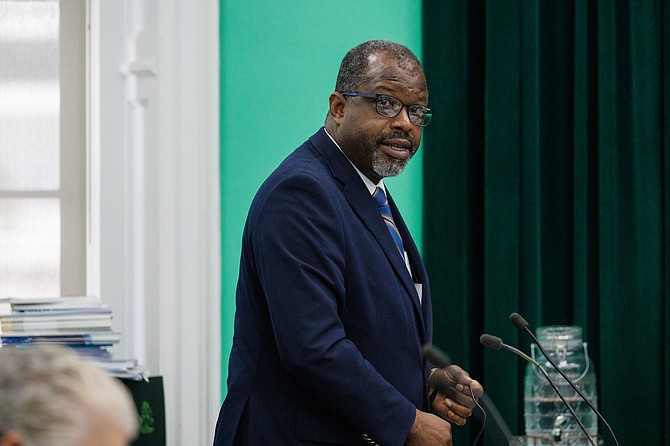
Wayne Munroe Photo: Dante Carrer/Tribune Staff
By FAY SIMMONS
TRIBUNE Business Reporter
jsimmons@tribunemedia.net
THE ATTORNEY General yesterday dismissed questions about the Government’s handling of the National Investment Fund (NIF), declaring that “nobody backed a dump truck up to the Central Bank” to remove hundreds of millions of dollars in cash.
Wayne Munroe KC defended the Davis administration against Opposition criticism of its public finances management and the near-$311m said to have been spent from an account in the National Investment Fund’s name.
He spoke out during a Senate debate on financial services legislation, responding to Opposition Senator, Dr Trevor Johnson’s, demand for an accounting of roughly $700m in excess borrowing that the Government previously said had been transferred to the NIF.
“What I can say is nobody backed a dump truck up to the Central Bank, put $400m in cash in a dump truck, and drove away from the Central Bank,” said Mr Munroe.
He argued that the Opposition was raising questions before the relevant figures had been fully compiled and reported, and said the resolution authorising the borrowing had made clear that the proceeds were intended for infrastructure.
“The NIF resolution, if you want to call it that, made it quite clear; those funds were to go into infrastructure, and nobody is questioning that they went into the infrastructure,” said Mr Munroe.
He added that the Auditor General would examine publicly funded spending through the usual reporting and accountability processes.
“The next point is something that's powerfully simple. You know, this question asking — I thought we had exposed that before the last election — as part of the politics playbook,” he said. “Everyone knows that at the end of the year, and at other intervals, you report.”
Mr Munroe urged the public to judge the Opposition’s criticism in light of the timing of its questions, stressing the figures needed to be compiled and accurately reported before conclusions were drawn.
Dr Johnson, however, argued that the Government’s own disclosures had left fundamental questions unanswered about how the money was transferred, spent and accounted for.
During his contribution, he cited the 2026-2027 Budget communication, which stated that gross borrowings during the first nine months of the previous fiscal year totalled $2.5bn, while debt repayments amounted to $1.8bn. The excess borrowing receipts, the communication said, were transferred to the NIF rather than used to finance the deficit.
Dr Johnson also cited a May 28 briefing at the Office of the Prime Minister at which Michael Halkitis, minister of finance, reportedly described about $700m in outstanding borrowings and additional unspent sums as having been placed in the fund for infrastructure.
However, he said Mr Halkitis subsequently told Parliament that approximately $310.9m had been used, including about $210m for roads and buildings and another $103m for airport redevelopment.
Dr Johnson argued that the explanation left more than $389m of the roughly $700m transfer unaccounted for in the figures presented. He also cited the Ministry of Finance’s nine-month budget-performance report, published in July, which he said showed an NIF balance of $200,000 at the end of March 2026.
“So I ask a simple question: Where is the rest of the money?” he said. “The Bahamian people should not have to piece together the story of their own money, and the Bahamian people should not have to guess. They should not have to speculate.”
Dr Johnson said the issue was directly relevant to the financial integrity legislation under debate, arguing that the Government must demonstrate the same transparency in its financial dealings that it expects from institutions and businesses.
“We cannot come to this honourable Chamber to strengthen our laws against illicit financial transactions while leaving fundamental questions about how we manage our own public money unanswered,” he said.
“Accountability cannot be selective, and financial integrity cannot be something we demand of others while struggling to demonstrate it ourselves.”
The dispute over the NIF has been developing for months. Opposition Leader Michael Pintard has questioned the legal authority for transferring borrowed funds into the vehicle, the fund’s governance arrangements and the extent to which the Government has accounted for the money.
The Government has maintained that the borrowing was authorised and that the NIF was used to finance infrastructure and national development projects. Mr Halkitis has previously said the Ministry of Finance and Treasury administered the funds under the Public Finance Management Act while its governance arrangements were being completed.
The controversy has also centred on the Fund’s oversight structure. The Opposition has questioned how the account could be operated and transactions undertaken while the NIF’s Board of Governors had not formally convened. The Government has argued that it acted on legal advice and within its authority.
Mr Munroe said the borrowing resolution’s stated purpose was infrastructure investment, and challenged the Opposition to set out its own approach to borrowing and national development.




Comments
licks2 1 hour, 31 minutes ago
That's why accounts auditing professionals is expected to ask questions of such complex funds management techniques and ability to read such funds management techniques!
Medical Doctors are not!! Nor are layman like I am. . .but we know that birds-eye and anecdotal questioning is NEVER the means of answering these types of complex financial interactions!!
Sign in to comment
OpenID