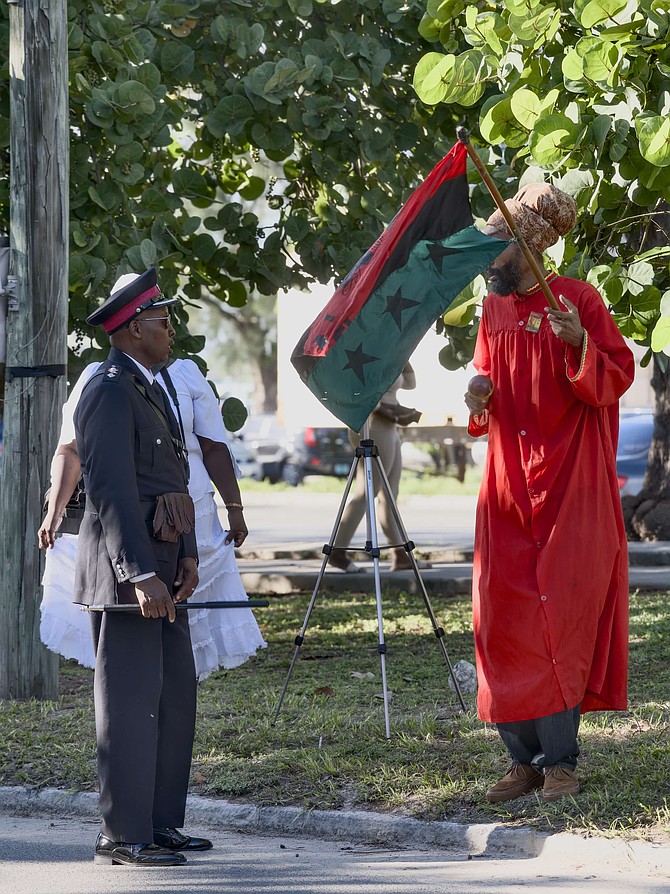
A POLICE officer speaks with a member of the Rastafarian group protesting during King Charles III’s visit yesterday. Photos: Chappell Whyms Jr
By KEILE CAMPBELL
Tribune Staff Reporter
kcampbell@tribunemedia.net
RASTAFARIANS protesting King Charles III’s visit accused police of trying to keep them out of sight yesterday after officers repeatedly ordered them to move while the monarch attended a youth rally at Clifford Park.
Rastafarian priests and supporters beat drums, waved flags and held placards as they chanted for reparations, a formal apology for transatlantic slavery and repatriation to Africa. One placard read: “REGRET IS NOT ENOUGH WE NEED A FULL APOLOGY.”
Priest Phillip Gibson, 61, a member of the elders’ council who has followed Rastafari since he was 13, said police were directing demonstrators to an area where their banners would be less visible.
The group first gathered near the old cannons across Marcus Bethel Way, then moved farther down Western Esplanade after High Priest Richmond McKinney, leader of the Ethiopia Africa Black International Congress (EABIC) Bahamas branch, discussed with officers where they were allowed to demonstrate. Uniformed officers stood among the protesters throughout and approached organisers several times with further instructions to move as the chanting and drumming continued.
EABIC Bahamas vice-chairman Priest Ethelbert Diamond Harrison, 57, questioned why the Rastafarians were being moved while members of the public gathered for the rally.
“Are we not allowed to partake in the ceremony? The public was invited. We are the public,” he said. He said officers were acting on orders. “We know it’s a command coming from the higher heads coming down,” he said.
Priest McKinney said organisers had secured a protest permit after meeting Commissioner of Police Shanta Knowles, who he said handled their discussions respectfully. He blamed the first relocation on a misunderstanding over where the group was permitted to demonstrate, but said further police instructions eventually led them to end the protest about an hour after the King’s motorcade drove past them on the way to Clifford Park.
He said the repeated interventions reflected wider concerns about the treatment of Rastafarians, who he said had “faced oppression for a very long time”.
“We know they have to do their job, but at the same time they have to be mindful that we all are one,” he said. “So we hope that we have a better dialogue going forward, and we hope that even they learn more from this.”
Priest Gibson said the red, black and green of the Rastafarian banners represented the blood of the people, Black people and vegetation, and contrasted them with the red, white and blue of Britain.
“That is not our king,” he said. “We want freedom, redemption, international repatriation. That’s our only objective. We don’t want nothing to do with the British monarchy.”
In a six-page petition addressed to the King, the EABIC called for a formal apology for slavery, reparatory compensation and help for people of African descent who wish to return to Africa voluntarily. It also called for formal talks involving the Rastafarian community, Caribbean and African governments and British institutions and requested a written response outlining how further engagement could take place.
The call for reparations also drew support from outside the Rastafarian community.
Sharon Purser-Cooper, 68, a Christian who said she has taught in The Bahamas for 41 years, joined the protest but said she does not want to go to Africa.
“I respect my Rastafarian brethren, but I do not wish to repatriate to Africa. I want to visit my homeland, I plan to stay right here, and I want to fix right here,” she said.
Mrs Purser-Cooper said reparations should help meet the country’s needs, including healthcare, education, agriculture and infrastructure, rather than being limited to a set sum of money.
“We are not begging for anything. We are making a demand from them,” she said.
University of The Bahamas journalism student Jashai Burrows said frustration over preparations for the visit, including roadworks and the involvement of schoolchildren in the celebrations, led her to join the demonstration.
She was particularly critical of public and private schoolchildren being encouraged to attend the youth rally “to celebrate someone who represents a system that has oppressed us for centuries”.
“I think there’s something deeply disturbing about that,” Ms Burrows said.
She said the heavy police presence around the demonstrators was unsettling. “It kind of has me feeling as though they’re in fear of what we might do, in fear of our voices,” she said.
Asked whether the protest was getting its message across, she said: “I’d hope that we at least get acknowledged, and that our anger is heard.”
Priest McKinney said the demonstration was aimed not only at the King but also at raising awareness among Bahamians of the Rastafarian community’s long campaign for justice.
The group plans to keep protesting. According to a flyer, the EABIC has called another demonstration for 3.30pm at the Registrar General’s Office on Shirley Street.
“When he leaves, he’s going to continue to be protested until we get our demands,” Priest Harrison said.
Before the tour, Buckingham Palace said the King would not shy away from what he has called the darkest days of Britain’s past, but would not apologise for slavery, and the British government has ruled out paying reparations.
As Prince of Wales, King Charles spoke of his “personal sorrow” over slavery’s enduring impact at the Commonwealth summit in Rwanda in June 2022. At the 2024 Commonwealth summit in Samoa, he said “the most painful aspects of our past continue to resonate”, but stopped short of an apology or any commitment to reparations.




Comments
Use the comment form below to begin a discussion about this content.
Sign in to comment
OpenID