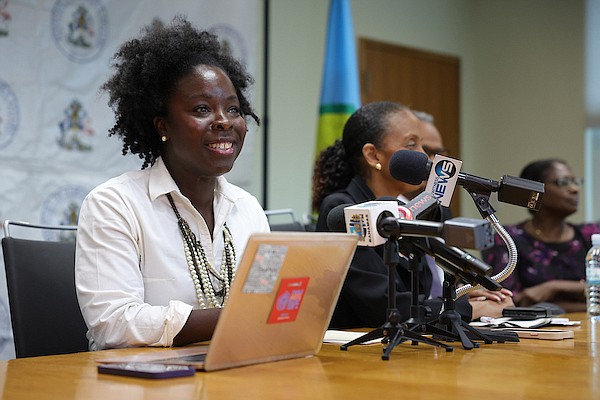
Dr Niambi Hall Campbell Dean
By KEILE CAMPBELL
Tribune Staff Reporter
kcampbell@tribunemedia.net
THE chair of the Bahamas National Reparations Committee said police told her she could only watch King Charles III’s Junkanoo celebration in Parliament Square yesterday if she put away her poster calling for reparations.
“I wasn’t allowed to display it, and that if I wanted to enjoy the Junkanoo, I would have to do so without the poster,” Dr Niambi Hall Campbell-Dean told The Tribune.
She said she attended the celebration in her personal capacity as a Bahamian, intending to enjoy the culture while showing her opposition to the King’s failure to formally apologise for Britain’s role in slavery. She and others put their posters down at the direct request of officers, she said.
British reporters travelling with the King also reported that police quickly moved on activists in the Parliament Square crowd who were holding placards reading “Pay us what you owe us”.
The King watched the Junkanoo rush-out for several minutes before taking a pair of maracas and stepping into the parade himself.
Dr Hall Campbell-Dean’s account is the second complaint in two days that police tried to keep reparations protesters out of the monarch’s sight. On Tuesday, Rastafarian demonstrators demanding an apology, reparations and repatriation to Africa accused officers of repeatedly ordering them to move during the King’s youth rally at Clifford Park.
Dr Hall Campbell-Dean said the committee’s campaign did not depend on the King apologising during his visit.
“Our work and our movement is bigger than just this king apologising,” she said. “If he doesn’t, then we’re just going to continue to do the work.”
She said the movement was also about teaching Bahamians the history of the country’s relationship with the British monarchy, through writing, seminars, workshops and talks in schools.
“It’s also about bringing awareness to the Bahamian people as to why it’s problematic for him to be here and not apologise,” she said.
Speaking at Clifford Park on Tuesday, the King acknowledged the suffering and injustices of the past and said some of the best of Bahamian culture had been born out of darkness. He stopped short of a formal apology, instead pointing to discussions among Commonwealth leaders at the Commonwealth Heads of Government Meeting in Antigua and Barbuda, which runs from November 1 to 4.
Dr Hall Campbell-Dean said protests and the summit served different purposes. Demonstrations helped educate Bahamians, she said, while the summit was a chance for governments to move the issue forward. She hoped leaders would go beyond calling slavery a dark chapter in British history and address responsibility for what was done.
“It was a crime then, and it is a crime now,” she said.
She said she was disappointed, though not necessarily surprised, that some Bahamians opposed reparations, blaming gaps in public understanding of slavery and its atrocities.
“You know, we still have a long way in learning the truth about what happens in this system,” she said. “We don’t know a lot of the details that would allow us to fully understand all of the atrocities that were committed.”
She said chattel slavery depended on denying the humanity of enslaved Africans so that treating them as property could be presented as lawful.
“But if you’re no longer a person, then what I’m doing is not a crime, right? So they remove the humanity to try and add some sense of legality to a completely immoral act, you know,” she said. “And when we understand and learn these details, then I think the movement becomes very simple, you know. A crime was committed. You have to pay.”




Comments
Use the comment form below to begin a discussion about this content.
Sign in to comment
OpenID