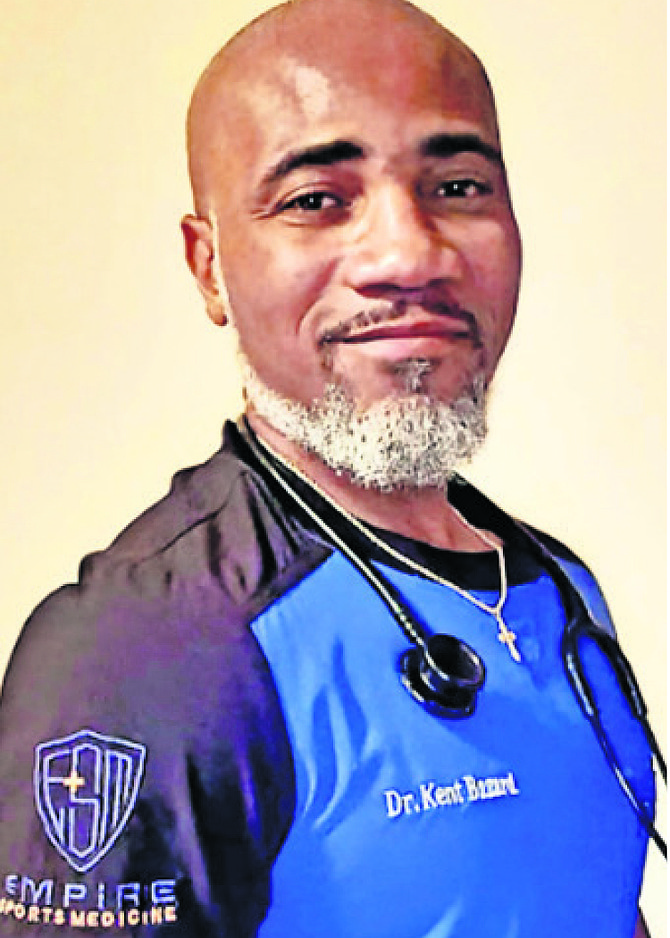
Dr kent bazard
By DR KENT L BAZARD
Sports Medicine Physician
EVERY year, The Bahamas produces young athletes with remarkable potential. We see them at school sports days, interscholastic championships, club competitions and national trials. Some demonstrate exceptional speed, others possess natural coordination, strength, endurance or technical ability. Their performances attract attention, and conversations quickly turn toward scholarships, national team selection and the possibility of representing The Bahamas internationally. Yet identifying talent is only the beginning of a much longer process.
The more important question is whether we have established the systems necessary to develop that talent consistently, safely and over an extended period.
In the first article of this series, I introduced the concept of the sports ecosystem, an idea that became central to my experience during the United States Department of State's International Visitor Leadership Program (IVLP), *American Excellence in Combat Sports*.
Throughout the programme, we examined different aspects of sporting development, administration and professional competition. Although combat sports provided the foundation for our visits and discussions, many of the lessons were applicable to sport in general. One of the most significant was the importance of having a recognisable pathway through which athletes can progress from their earliest experiences in sport to increasingly advanced levels of participation and performance.
A particularly useful perspective emerged from examining the role of sporting organisations and national development structures. The United States has an extensive network of schools, community programmes, clubs, collegiate institutions, national governing bodies and professional organisations. These institutions do not always operate under a single system, and their relationships are not without challenges.
Nevertheless, they illustrate how different levels of participation can contribute to a broader sporting environment. An athlete may begin in a community programme, receive more specialised coaching through a club, compete at school or collegiate level and eventually enter a national or professionalpathway. Each stage presents new opportunities, but also requires different forms of support.
For The Bahamas, this raises an important distinction between identifying talented athletes and developing them. Talent identification is relatively straightforward when a young athlete is already outperforming their peers.
Talent development is considerably more complicated. It requires an understanding of physical maturation, technical progression, training demands, injury risk, psychological development and the opportunities available at each stage of an athlete's career. An exceptionally fast 12-year-old, for example, may not necessarily become an exceptional 22-year-old sprinter.
Early physical maturity, previous training exposure and differences in biological development can all influence performance during childhood and adolescence. Without a structured approach, we risk placing too much emphasis on immediate results while overlooking athletes whose potential may emerge later. This is particularly important in a small country where our available talent pool is limited.
We cannot afford to overlook promising athletes simply because they mature later than their peers or lack access to the same coaching and facilities. A more deliberate development system would consider not only current performance, but also movement ability, physical development, technical skills, training history and long-term potential. It would create opportunities for athletes to enter, leave and re-enter development programmes as their abilities and circumstances change, rather than treating early selection as the final determination of sporting potential.
The role of coaching is fundamental to this process. During the IVLP, our exposure to different sporting organisations reinforced the importance of coaching education, technical standards and the administrative structures supporting those who work directly with athletes. Coaches are often the first to recognise talent and usually have the greatest influence over an athlete's daily development. Yet coaching requires considerably more than knowledge of drills and exercises.
Effective coaches must understand age-appropriate training, progression, recovery, communication and the distinction between developing an athlete and simply preparing them to win the next competition.
In The Bahamas, many coaches have developed considerable expertise through years of practical experience, often while working with limited resources. Their contributions should be recognised and supported through more accessible continuing education, mentorship and professional development.
National sporting federations could play an important role in establishing coaching pathways that combine practical experience with contemporary knowledge of sports science, injury prevention and athlete welfare. This would not require every coach to become a sports medicine specialist or exercise scientist. Rather, coaches should have access to relevant expertise and understand when to involve other professionals in an athlete's development.
Another important consideration is the relationship between schools, clubs and national sporting programmes. Each serves a different purpose, but their activities frequently overlap.
Schools introduce large numbers of children to organised sport and provide opportunities for participation. Clubs often deliver more specialised technical instruction and regular competition. National federations establish competitive structures, selection criteria and pathways toward international representation. Ideally, these organisations should complement one another.
In practice, however, athletes may find themselves navigating competing training schedules, inconsistent coaching approaches and overlapping competition demands.
A junior athlete might participate in school practices, attend club training and receive additional private coaching during the same week. Each coach may be acting in the athlete's best interest, yet no single individual may have a complete picture of the athlete's total workload.
This becomes particularly concerning when athletes are preparing for major championships or moving through periods of rapid growth. Without communication between the adults responsible for their development, training demands can accumulate without adequate attention to recovery, nutrition or injury risk.
A coordinated athlete development pathway would encourage greater communication among these groups while respecting their individual roles.
Schools should not have to become elite training centers, nor should national federations attempt to replace community clubs. The objective should be to establish clearer expectations for progression, competition exposure and athlete support.
Shared development principles, appropriate information-sharing arrangements and more consistent monitoring could improve continuity as athletes move between different sporting environments.
Sports science and medicine become increasingly important as athletes advance. At the introductory level, the emphasis should remain on participation, movement competence, enjoyment and the development of fundamental skills. As training becomes more specialised, objective assessments can help coaches identify physical strengths, limitations and areas requiring attention.
Strength testing, movement assessments, sprint timing, jump performance and other measurements can provide useful information when interpreted appropriately. However, testing should guide development rather than become another mechanism for prematurely excluding young athletes.
From my perspective as a sports medicine physician and performance coach, this is one of the areas where The Bahamas has considerable room for improvement. We frequently invest significant effort in preparing athletes immediately before major competitions, but long-term physical development requires a more continuous approach.
Athletes need appropriate strength and conditioning, nutritional support, injury management and recovery strategies throughout the year, not only when national team selection approaches.
An athlete returning from injury should also have a clear pathway back into training and competition, with communication between the treating clinician and coaching staff.
These services do not necessarily have to be housed within one large national facility. A coordinated network involving existing medical practices, training centres, educational institutions and sporting organisations could provide much of the necessary support.
The important consideration is establishing standards, responsibilities and referral pathways so that athletes can access appropriate services when needed. More advanced centralised facilities may eventually become part of the solution, but effective coordination should begin long before every desired building or piece of equipment is available.
The collegiate pathway also deserves attention. For many Bahamian athletes, obtaining a scholarship to an American university represents a major opportunity for education and sporting development. The collegiate environment can provide access to coaching, competition, strength and conditioning, medical care and academic support that may otherwise be difficult to obtain.
However, scholarships should not be viewed as the only successful outcome of junior athletic development, nor should an athlete's progression depend entirely on leaving The Bahamas.
We should be equally interested in developing opportunities for athletes who remain at home, those who do not obtain scholarships and those whose sporting careers continue after university. A functioning development pathway must consider the transition from junior to senior competition, an area where athletes in many countries struggle to maintain participation.
Employment, education, family responsibilities and limited financial support can make sustained high-level training difficult. Without appropriate opportunities and institutional support, talented athletes may leave competitive sport before reaching their full potential.
This concern extends beyond track and field, swimming and the sports that traditionally receive the greatest public attention. Combat sports, basketball, volleyball, soccer, tennis and numerous other disciplines require development structures suited to their particular demands.
Although the technical requirements differ, the underlying principles are similar: accessible entry points, qualified coaching, progressive competition, appropriate medical support and realistic opportunities for advancement.
An effective national approach must also acknowledge that not every child who participates in sport will become an elite athlete. Nor should that be the expectation. Broad participation provides physical, psychological and social benefits that extend well beyond competitive success.
Community programmes can promote physical activity, discipline, confidence and positive social engagement. They also create the foundation from which future competitive athletes may emerge.
A sporting system focused exclusively on identifying the next international medallist risks neglecting the much larger population that benefits from participation.
The challenge for The Bahamas is therefore to strengthen both ends of the development process. We need opportunities for more children to become involved in sport, while ensuring that those who demonstrate the interest and ability to progress have access to increasingly appropriate support. These objectives should reinforce one another.
A broad participation base increases opportunities to discover talent, while visible pathways toward higher levels of achievement can encourage continued involvement. None of this requires us to copy the American sporting system in its entirety. The scale of its population, educational institutions, commercial opportunities and financial resources differs considerably from our own. The more useful lesson is organisational.
We should examine how responsibilities are distributed, how athletes move between developmental stages and how different institutions contribute to a common objective. Those principles can be adapted to a smaller country, particularly one where communication and coordination should be relatively manageable.
The Bahamas has demonstrated repeatedly that it can produce athletes capable of competing internationally. The next stage of our sporting development should focus on making that success less dependent on exceptional individual circumstances. A talented child should have a reasonable opportunity to progress through an organised system, with access to appropriate coaching, competition, education and healthcare as their needs evolve.
Developing such a pathway will require cooperation among schools, clubs, national federations, government agencies, private organisations and families. It will also require a willingness to examine existing practices and identify where greater consistency is needed.
The objective is not to eliminate the individual contributions that have sustained Bahamian sport for generations, but to provide those efforts with a stronger structure.
Our athletes already demonstrate what is possible when talent meets opportunity. A more coordinated development system would help ensure that opportunity is available to a greater number of them, and that the support they receive does not end with their first significant achievement.
In the next article, I will examine another important component of the sports ecosystem - the medical, scientific, educational and regulatory infrastructure that supports athlete performance while protecting their health and well-being.




Comments
Use the comment form below to begin a discussion about this content.
Sign in to comment
OpenID