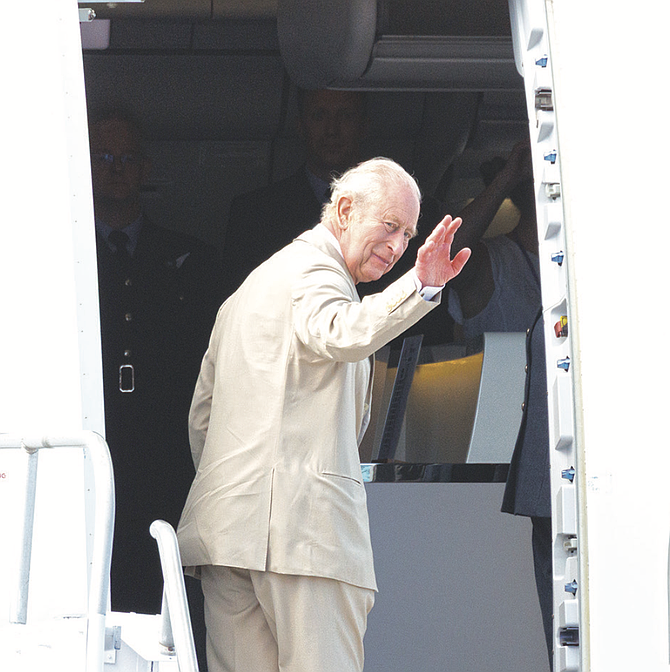
BRITAIN’S King Charles III waves before boarding the royal plane at Lynden Pindling International Airport in Nassau, Bahamas, yesterday. Photo: Tim Aylen/BIS
By EARYEL BOWLEG
Tribune Staff Reporter
ebowleg@tribunemedia.net
KING Charles III left The Bahamas yesterday with a final wave from the steps of his aircraft, as Buckingham Palace hailed his three-day visit a “strong diplomatic success”.
The monarch, dressed in a tan suit, arrived at the airport in a royal convoy, travelling in a Mercedes bearing the Royal Standard of the United Kingdom.
As the Bahamian national anthem rang out one final time, Commissioner of Police Shanta Knowles and Royal Bahamas Defence Force Commodore Floyd Moxey escorted the King along the red carpet.
Waiting at the foot of the aircraft were Prime Minister Philip “Brave” Davis, Governor General Cynthia “Mother” Pratt and Health and Wellness Minister Dr Michael Darville. Mr Davis was accompanied by one of his grandsons.
The King and the prime minister became engrossed in conversation for several minutes before the monarch made his way to the aircraft. Just before stepping inside, he turned and gave a final wave, marking the end of the Bahamian leg of his Caribbean tour.
The Royal Standard, which had flown from a flagpole in the middle of the tarmac, was then lowered.
A Buckingham Palace spokesperson said the King had been “delighted to return to the islands, which have such a special place in his heart”.
“The great wall of cheers he received when greeting crowds will echo long in his memory,” the spokesperson said, “and be a source of tremendous pride and encouragement as the tour continues to Guyana and Antigua and Barbuda.”
The Royal Family also thanked Bahamians on social media.
“Thanks to all those who welcomed The King so warmly during his visit to The Bahamas,” the post said.
At home, the reaction was mixed. The King was met with enthusiasm by many of those who greeted him, and at times people lined the streets to watch his motorcade pass.
However, many Bahamians questioned what tangible benefit the visit would bring the country. Others were frustrated by the school and road closures that came with it. Police closed dozens of roads across New Providence for the visit. Killarney MP Michela Barnett-Ellis asked why it took the King’s arrival to get roads repaired, a claim Works Minister Clay Sweeting denied, saying the repaving of Shirley Street had already been planned.
Some used the moment to accuse the Davis administration of hypocrisy. They argued that its professed support for The Bahamas becoming a republic did not match its words of welcome for the King, or the public money spent to host him. The government has yet to disclose what the visit cost.
The visit was also shadowed by renewed calls for Britain to pay compensation for the transatlantic slave trade. Members of the Rastafarian community and other protesters held placards at royal events demanding “pay us what you owe us”.
In his first speech after arriving on Tuesday, at a youth rally at Clifford Park, the King acknowledged “the great suffering and injustices of the past in these islands and beyond”, but stopped short of an apology. The Bahamas National Reparations Committee had demanded an apology for slavery and colonisation and objected to taxpayers funding the visit.
Responding to the demonstrations, a Buckingham Palace spokesperson defended the King’s approach.
“The visit proved an opportunity to celebrate and reaffirm the modern partnership between The Bahamas and the UK,” the spokesperson told ITV, “to address the shared challenges of the future and also to acknowledge the great injustices of the past in a respectful way.”
Palace staff also described the visit to ITV as “a sensitive balancing act”.
The King touched down at Cheddi Jagan International Airport in Guyana yesterday afternoon to begin a two-day state visit. He will then travel to Antigua and Barbuda, where he will be joined by Queen Camilla for the Commonwealth Heads of Government Meeting from November 1 to 4.
The visit, his first to The Bahamas as monarch, was packed with engagements across New Providence.
After landing on Tuesday, the King greeted Bahamians in their own dialect before addressing about 300 young people at Clifford Park, the same ground where he watched the Bahamian flag raised at Independence in 1973. He drew laughs by naming three of Junkanoo’s biggest rival groups, the Valley Boys, the Saxons Superstars and One Family, and joking that the prime minister would want him to declare his allegiance.
On Wednesday, he laid a wreath at the Royal Bahamas Defence Force’s Coral Harbour base for the four marines killed when HMBS Flamingo was sunk by Cuban jets in 1980. Retired Captain Whitfield Neely, a Flamingo survivor, said the King told him they were “family” after the two men discovered they had both trained at Britannia Royal Naval College in Dartmouth, England.
At Bonefish Pond National Park, the King asked so many questions about the mangroves that Bahamas National Trust executive director Lakeshia Anderson-Rolle said he “partially led the tour”. He later burst out laughing at the Bahamas Boxing Academy when he was handed a T-shirt showing him as a boxing champion, complete with crown, gloves and title belt.
That afternoon, the 77-year-old monarch swapped royal reserve for a cowbell in the national colours, stepping into a Junkanoo rush-out on Bay Street to the classic Naughty Johnny and disappearing among the feathered costumes as spectators waved Bahamian flags.
His official programme ended with a garden reception at Government House, where Dame Cynthia welcomed him “home to The Bahamas” and wished him a long reign. There, the King greeted guests including former prime ministers Hubert Ingraham, Perry Christie and Dr Hubert Minnis.




Comments
Use the comment form below to begin a discussion about this content.
Sign in to comment
OpenID