BY ANNELIA NIXON
TRIBUNE Business Reporter
anixon@tribunemedia.net
THE GOVERNMENT is facing mounting pressure over its handling of unresolved workplace grievances with trade union leaders pointing to stalled industrial agreement negotiations and outstanding payments.
The concerns come as industrial tensions have surfaced with the 2026-2027 school year start. The Bahamas Educators Managerial Union (BEMU) took industrial action yesterday, while the Bahamas Union of Teachers (BUT) warned its members could follow suit.
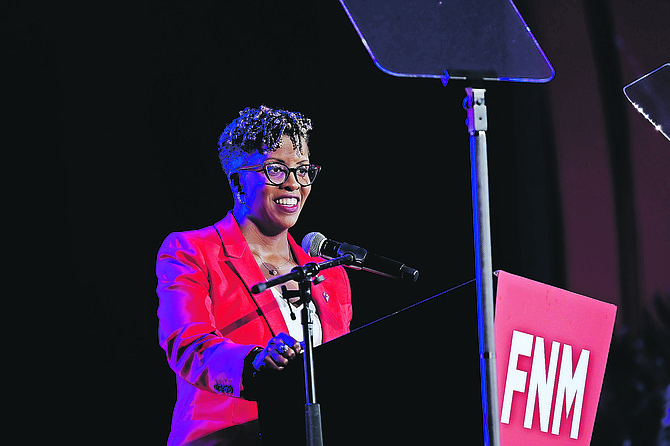
Michela Barnett-Ellis, Opposition MP for Killarney and shadow minister for labour, said these developments expose wider weaknesses in the Government’s approach to industrial relations, arguing that public relations cannot compensate for unresolved workplace disputes.
“Public relations cannot substitute for good industrial relations,” Mrs Barnett-Ellis said. She criticised what she described as the Government’s focus on demonstrating that schools are functioning rather than addressing the underlying labour issues affecting educators.
“The opening of a new school year should be about our children, their teachers and ensuring that our schools are properly staffed, properly managed and ready to provide the education our students deserve,” Mrs Barnett-Ellis said.
“Instead, on only the second day of the 2026-2027 school year, school administrators are taking industrial action, the Bahamas Union of Teachers is warning that its members may soon follow, and the Government is acknowledging shortages of principals and teachers.”
Mrs Barnett-Ellis said the BEMU’s concerns over schools without principals, outstanding payments and unresolved promotions are particularly troubling given that some of the issues labelled as “legacy issues” should have been resolved. She also questioned why higher-level government intervention only came after industrial action commenced, noting that the BEMU has said it raised its concerns with the Government over the past two months.
“If these matters have been actively raised for two months, why did it take the commencement of industrial action to generate this level of engagement?” Mrs Barnett-Ellis asked.
Her comments came as Belinda Wilson, the BUT president, confirmed that the union’s members reported for work on Tuesday, September 1, despite mounting tensions over salary negotiations.
She said 80.5 percent of BUT members who responded to the union’s survey voted to reject the Government’s salary counter-proposal, while 81.1 percent rejected the proposed maximum salary scale. She said the union had given the Government until midnight Wednesday, September 2, to respond to its counter-proposal.
“If we do not have an agreement with the Government, then we should take industrial action,” Mrs Wilson said. She added that an emergency general membership meeting is scheduled for Thursday, September 4, at which members will discuss the way forward.
At the same time, Mrs Wilson sought to clarify that BUT members were not involved in industrial action yesterday. “Bahamas Union of Teachers members from Grand Bahama to Inagua reported to 162 schools on 24 islands and cays today on time,” Mrs Wilson said. “Some even reported before time.”
Obie Ferguson, president of the Trade Union Congress (TUC), said the umbrella union body supports the BEMU and would assist if called upon as it is an affiliate member. He also pointed to unresolved issues beyond the education sector, including outstanding payments allegedly owed to former Grand Lucayan workers who were terminated.
“There are workers in Grand Bahama who were terminated on February 27; they have not yet been paid,” Mr Ferguson said. “That is creating hardship on those workers. We call on the Government to pay those workers.”
Mr Ferguson said the TUC could not describe its industrial relationship with the Government as satisfactory while significant issues affecting workers remain unresolved.
“We can’t say we are pleased if we have outstanding issues that affect the average Bahamian,” Mr Ferguson said. “If those issues are outstanding or not being addressed properly or on a timely basis, it is very difficult for you to say that things are well.”
However, the assessment of Government and trade union relations is not all negative. Dwayne Woods, president of the National Congress of Trade Unions of The Bahamas (NCTUB), said the relationship has improved and credited social dialogue and negotiations for helping to resolve disputes. The NCTUB has 13 affiliates, Mr Woods said, with around nine having already signed industrial agreements and four or five still pending.
“As far as we are now as the Congress, we’ve come a long way and the Government seems to be working with us,” Mr Woods said. “With that being said, I have to speak truth to power that it appears that they are on the right track.”
Mr Woods said disagreements with the Government remain, but his organisation has deliberately sought to resolve them away from the public spotlight.
“It’s not that we don’t experience differences or issues with the Government,” Mr Woods said. “But we find ways to resolve our issues by way of social dialogue and we negotiate our issues in the boardroom, not on social media or in the press.” He added that confrontation should be viewed as a last resort and encouraged other unions to pursue dialogue.
Mrs Wilson, however, offered a far more critical assessment in her capacity as president of the Bahamas National Alliance Trade Union Congress (BNATUC), accusing the Government of employing a “divide and conquer strategy” in its dealings with organised labour. She argued that government consultations with unions are often superficial and fail to produce meaningful changes to policies, regulations or legislation.
“Effective consultation means jointly examining and discussing problems of concern to both the employer and the union,” Mrs Wilson said. Among the outstanding issues she identified are the need for a livable wage, an increase in the minimum wage, implementation of a universal agency shop fee, alleged breaches of industrial agreements, workplace discrimination and victimisation, and revisions to the Employment Act and Industrial Relations Act.
She also called for a more effective National Tripartite Council and stronger social dialogue, legislation governing occupational safety and health, and improved maternity benefits.
Mrs Wilson said the Government must also address concerns over Bahamianisation, particularly amid what she described as the continued appointment of foreign managers in sectors where qualified Bahamians are available.
“The Government must answer the question sooner than later: Do we still have a Bahamianisation policy?” Mrs Wilson said. She further criticised the Government’s Labour Relations Unit and questioned whether taxpayers are receiving value for money from consultants involved in negotiations.
For Mrs Barnett-Ellis, the developments in the education sector should serve as a warning that unresolved industrial issues can quickly escalate into disruptions affecting public services.
“Government is one of the largest employers in The Bahamas,” Mrs Barnett-Ellis said. “It should therefore be setting the standard for good industrial relations; early engagement, good-faith negotiations, timely payment of monies owed, fair treatment of employees and resolution of grievances before they reach crisis point.”
Mrs Barnett-Ellis said the Government should focus less on managing the public perception of its labour relations and more on resolving the disputes themselves.
“Our children do not need a public relations exercise,” Mrs Barnett-Ellis said. “They need principals in their schools. They need teachers in their classrooms. And the professionals responsible for educating them deserve a government that engages with them before matters deteriorate into industrial action.
“The cameras will eventually leave the schools. The unresolved problems will remain. It is time to move beyond managing the optics and start resolving the issues.”




Comments
Use the comment form below to begin a discussion about this content.
Sign in to comment
OpenID